Power

I hated the powerlessness of childhood. My parents tried to determine what I ate and what I wore and when I slept, peed, or felt angry. At least one of them answered most of my why questions with that button-pushing unsatisfactory declaration: “Because I told you so.”

When I complained, the other one assured me that childhood was going to be the good time in my life, the carefree years before I had to work hard and pay bills.

They couldn’t have been more wrong. “Because I told you so,” is despotic. Passive/aggressive even. Hard work is often its own reward; it generates a solid feeling of ability and accomplishment. Paying the bills isn’t nearly as obnoxious as being sent to bed before you’re tired.

I have loved the power of maturity. I’ve spent most of my adulthood in charge of what’s around me: myself, kids, pets, home, business. I have thrived. And yet …

I’ve learned how taxing decisions are. I try to limit mine. I don’t drive, seldom shop, opt out of coupons.

I’ve learned that making a choice is a creative opportunity. No matter how mundane, it’s an occasion to bring integrity to the subject, to select with sense, clarity, balance and an avoidance of chaos. I try to face my decisions head on and walk through the process with interest.

I’ve learned that the best vacation for me is one where I don’t have to make decisions. I like cruises and small tours and some all-inclusive arrangements. I’m on a break, and I don’t want to pick a restaurant. Heck, when I’m on a decision break kind of vacation, I don’t even care if inconvenience occurs. I can roll with it all. It’s not my problem. I’m not in charge.

Posted in Lessons | Leave a comment

Pomes Away

9.8.08
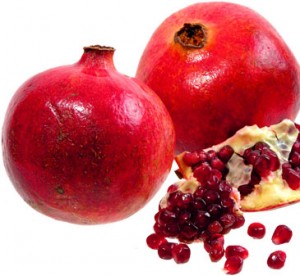
Someone told me recently that a pomegranate is really an apple bomb. I think that’s correct.

In fact, the dictionary says the pomegranate (punica granatum) comes from the Latin words pomum (apple) and granatus (seeded).

We’ve all seen pome before. Pome is apple. Pome de terre (earth apple) is how the French refer to a potato. Pomodoro (pomo d’oro), or golden apple, is Italian for tomato.

Punica is another word for Phoenician, and if that’s not where the fruit was grown, it was probably a popular place from which to ship it.

Now let’s look at granatus. It means grained or seeded. So at first, pomegranate means seeded apple, which is appropriate. But granum or granatus also gave rise to:

– granite, which is a grained or seeded stone;

– granitas, which is a frozen dessert that looks like seeds;

– grenade, which is a small bomb known for its seed-like explosive contents.

In other words, yes. The seeded apple is also an apple bomb. A pome-grenade.

I think we know the seeds are delicious, but the red is tenacious. We’ve all been advised to handle pomegranates under water or suffer the stain of red fingers.

(In the olden days, there was another delicious way to dye your fingertips. When I was a kid we didn’t grow pistachios in California. The nuts came to us all the way from Persia. They arrived in two preserved varieties: tasty but dyed red; or with shells deep white from excess salt. You could get the best red pistachios at Knott’s Berry Farm. But that was back when you couldn’t get much more there: boysenberry everything, pistachios, gold-panning, a donkey ride, and a tilted house …)

Posted in Food, Language | 2 Comments

Bureaucracy


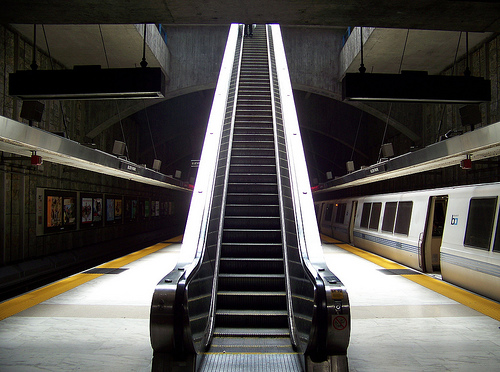
The escalator ribbons up, the while
a young man keeps his place by walking down.
He practices his rap and makes us smile
who weren’t yet awake enough to frown.
But here’s a BART announcement in the air:
The disembodied voice of civil patter
that tells him not to play that way – not there –
asserting that it’s just a safety matter.

Hello! I think, why say aloud that lie?
He threatens not himself nor anyone.
There’s half a dozen cops about, so why
attempt to stop this man from having fun?
He’s marching nowhere, making pretty sounds,
and it’s authority that’s out of bounds.

Posted in Poetry | Leave a comment

TV Interruptus

“Dinner time!”

“Just a minute Ma.”

“No. Now. Your food’s going to get cold.”

“But Mom, the show’s about to …”

“Get in here now! You can watch the show when they rerun it.”

I came, I ate, and I never saw the rest of that show.

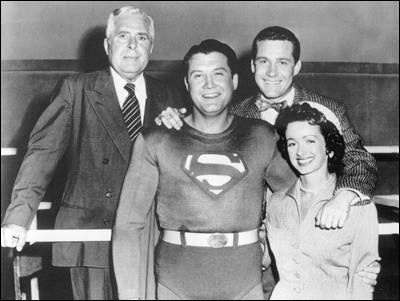
It was Superman. I think we were still in New York; if in California it was shortly after our move, so I’d set this vignette around 1958. I was 8 and my mother was 33.

My parents insisted that we eat dinner as a family, every night. I didn’t like the practice then, and I’m still not sure I agree with it. I mean, it makes obvious sense: time together, hearing about each other’s day, settling disputes, making plans, eating well. But the truth of my experience was that I and my brothers got plenty of those ingredients, on weekends and vacations but also as we intersected with our parents every day. The custom of waiting, hungry, till Dad got home from work so we could sit down together tired and irritated … that didn’t actually produce any of the memories and lessons I’m now recording.

Anyway, that evening in probably 1958, I was summoned away from a Superman episode, to dinner. I recall the show scene – Kryptonite fingerprints on a classic black telephone, black-and-white of course, because even if the show had color our television didn’t.

My mother was wrong. Perhaps not about the value of family dinners, but about me ever seeing that episode of Superman again. Because I’ve occasionally tuned into 24-hour marathons of the old show, and I’ve never caught the end of that one.

I started to tell Otto this memory about a month ago. He was ignoring his parents’ invitations to the dinner table and I began to describe my missed Superman. Katie and Sean stopped me. They pointed out that Otto didn’t need to learn that by listening to his parents he’d in fact miss out on exactly what he wanted to experience. Which seemed kind of no duh to me at first, which is why it so effectively shut me up.

I wish I’d had the wit to describe why I was trying to tell the story then, but it took me awhile to figure that out myself. See, the thing I learned from missing Superman is that missing it wasn’t a tragedy. I flourished even without it. And in some ways, that unfinished Superman episode is my favorite.

Posted in Lessons | Leave a comment

After Rain, Quakes and Slides


It appears that I started this sonnet in January 1993, after two close quakes and too much rain. I remember that the second earthquake was so abrupt it shook the water out of my nightstand drinking glass but left the glass standing.

I woke too warm at three the other night,
removed my shirt and stretched back into rest,
and then the earthquake jolted left and right
and left, and left me too alert and stressed.

I read last night, in bed before I slept,
for I was too fatigued from overwork,
when suddenly the edifice was swept
in upward violence and downward jerk.

So first the Hayward lets a little go
and then the Calaveras is at fault.
The rain we wanted now we want to slow
as we are hit with nature’s hard assault.
A cold reminder solids don’t exist,
and life’s a lease on portions of the mist.

Posted in Poetry | Leave a comment

Unwisdom


Three days ago I put up a post about a show I watched. The program refuted the idea that there’s a balance in nature, and I was puzzled. I don’t see enduring balance in nature. I don’t think there is an argument to refute.

But there’s something. I call it arrogance. We people sometimes fall into the myth that we know what we’re doing.

The reason to refrain from clear-cutting forests or burning now the carbon that was buried eons ago is not about upsetting some comprehensive balance. Instead, it’s about acknowledging that we know not what we’re about to do.

I understand that we’re an impulsive species and culture, but the best way to make a choice when you don’t have enough data is to refrain from choosing as long as you can.

The reason to not degrade an environment is we don’t understand enough about the consequences of that strategy.

It’s similar to why you should avoid the doctor. He knows a lot but not enough. He’s more likely to interfere with your body’s own wisdom and slow things down or complicate them, than he is to cure you.

The reason to avoid dietary supplements is we don’t know enough about how the ingredients work and about what other elements should be present to make them work best.

The reason to resist the death penalty is we don’t know enough, really, about the witnesses, about the convicted, about the future.

The reason to be a nonviolent anarchist is because we need to view laws like they’re necessary evils, or lucky charms that have perverse effects, and limit them as often and as seriously as possible.

This is not about balance. It’s about the appropriate, literal humility that comes with having our feet on this earth.

Posted in Lessons | Leave a comment

Onion Opinion

9.8.08
I looked up “opinion” recently, and I was disappointed to see that it means itself. My resources assert that it has been used since the mid 13th century, that it is a belief that rests on grounds insufficient to produce certainty, and that it comes from opinio and opinari, Latin for opine.

Ho hum.

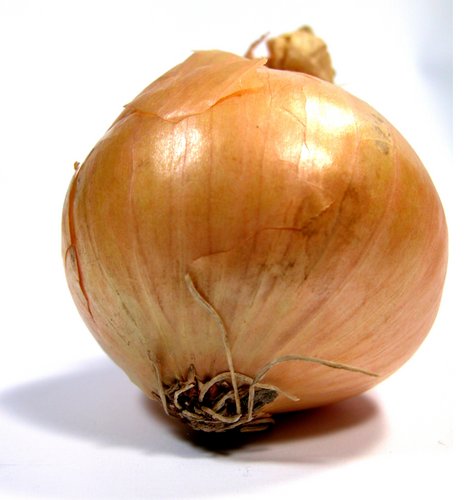
But that put me in the neighborhood of the word onion. On the same page, or just a “pi” deletion away, electronically. “Onion” entered our language about a hundred years after opinion. Around 1350. Onion is the same as the ME onyon and the Old Fr. oignon and the Latin ūniōn. Those words mean unity, oneness, a large pearl. Akin to union.

The onion (Allium cepa) is a plant of the lily family, with an edible bulb that has a strong smell and taste and perfectly concentric layers. Although the word is less than 700 years old it appears the food has been cultivated for millenia, starting in the Nile region.

In my soup-inventing years, when the object was to produce a meal out of whatever happened to be in the kitchen, I could manage without just about any ingredient except onion.

And I understand Julia Child said at least once: “It is hard to imagine a civilization without onions.”

They’re good food. Raw they add tang, dehydrated they are crunchy and easy, and cooked, especially when sauteed slowly, they caramelize and release intense flavor. The smell of fresh-cooked onions is universally attractive.

In the old days before email, before fax machines even, recordkeepers made copies on an impact typewriter, by interlacing carbon sheets with paper so thin it was called “onionskin.” Onionskin paper even had fingerprint whorls like the vegetable. Its pattern distinguished it from airmail paper, which was also exquisitely thin, and which was necessary because back then, in 1970 or so, it was financially correct to make your transoceanic letters light.

Posted in Food, Language | Leave a comment

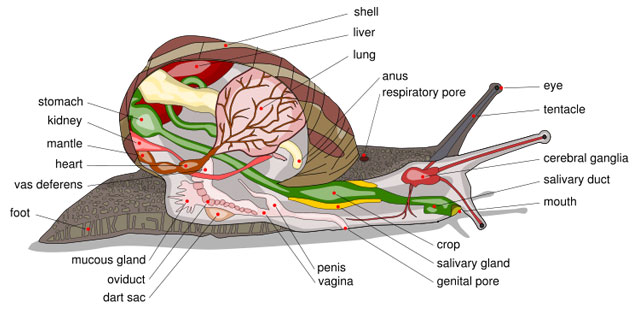
Snails


I posted Snail Trails on January 12, 2011. It carried a report about the morning I was the scourge of Berkeley snails.

I just reviewed a sonnet I wrote about that experience. To tell the truth, I think the number of dead was more like 30. But other than that, I am telling the truth. Here it is.

I slaughtered 8 and 40 healthy snails
along the way to work. The drizzle stopped
but walks were wet for rain-enabled trails
of slime. Beneath my feet their cases popped
a satisfying crunch: emphatic end
to garden-lacing Berkeley escargot.
Perhaps a foxglove will not have to bend
for that, and maybe multiples will grow.

I flattened curving beauty then, around
each formless alien, and left a pool
of ichor on the walk. Upon that ground
the next day showed the signs I had been cruel
to snails. But in a week my walk supplied
no evidence of pseudopodicide.

Posted in Critters, Poetry | Leave a comment

Unbalanced


I watched an hour-long show last month, which seemed to make an organized rebuttal to an argument I never considered. I had to derive the argument from the rebuttal.

The program attempted to demonstrate that there is no such thing as balance in nature, and that utopian schemes which are based on the balance fallacy are not inspired by nature but by the science that gives us machinery.

It was weird. I watched as the creators of the program proved that natural conditions like the ratio of predators to prey don’t acquire equilibrium, really, ever. The proportions are always in flux; the environment is always dynamic; the responses and adaptations are ever changing.

No duh, was my consistent response. Who thought otherwise?

The show became more unreal as the narrator began speaking about leaders in the field of ecology, folks I’d never taken very seriously. I mean, I read The Sea Around Us when I was 13. I’ve been engaged in the subject all my life. I don’t think the Odum brothers were all that influential… And Buckminster Fuller? Really? I was right here in Berkeley for the late 60s, and I can assure you that we were no more into geodesic domes than the folks across the bay were into peacock feathers. That was propaganda, people. It never much happened.

They even interviewed members of failed communes, and discovered what any co-housing participant has long known about the variety of personalities in a community, and about how bullying begins.

I’m not saying it was a bad program. It was watchable. But it made a point no more radical or fresh than the idea that we should eat unrefined clean-grown foods or get regular rest and exercise. And while it shot down the myth of self-regulating cultures, it didn’t offer any suggestions, despotic or democratic, for how to go forward.

But maybe I’m the one off-balance. I described the message of the show to a buddy last night, and when I complained that there’s no point in refuting a natural balance argument that doesn’t exist, she objected. “Sure there’s balance in nature,” she asserted. “You hear about it all the time.”

Posted in Question | Leave a comment

Nonsense


Acceleration, in the rodent race,
is treasured by electrons, fossil fuels
in oxidation, more defined by pace
than bullets, and as coveted as jewels.
The run is competition for an end
that no one known to any has acquired.
I watch somnambulating people spend
their decades in a race to be retired.

And we adapt more readily than mice.
Minute adjustments made remake the mix
so we can phone or scan while driving. Twice
the work is done without attempt to fix
the base invasion: ivy-veined commute –
a labyrinth with cul-de-sacs at root.

Posted in Poetry | Leave a comment