Unfinished Symphonies

This may be a bit like jumping to the end of the novel. Probably it will read better if we work up to it instead of blurting it here.

And maybe I’ll wisely wind up and down to it, in another place. But here, today, allow me impatience. Permit me impulse. Let me be curt.

The truth is, language isn’t finished. Neither is math. Both are ways to proceed, shortcuts often and tricks at times, for conveying ideas and for speeding calculations.

We can make other sounds than modern languages use. We can form other symbols for numbers and operations.

The infinite power is in you, to invent new sounds, new ways to organize, and new pathways, neural or stellar.

Don’t talk to me about God’s word. God doesn’t need words. Words are for us, among us. Go ahead: make new words and make new sounds. Then get your friends to use them.

As for numbers, it’s pretty easy to see that addition is fast-counting and multiplication is fast-adding. And adding exponents is a quicker way of multiplying. You can invent your own maths, for solving or at least organizing the challenges you meet. Some philosophers opine that math is the only pure invention of the human mind. I don’t understand what that means. And it’s probably incorrect anyway. We are receiving intimations that some numbers may be powerful, perfect, and tenacious enough to exist even if we don’t.

Like 496.

Oh, and Doug Adams’s answer? 42? That really does beg the question. Don’t ask what’s 6 times 7. Instead, consider this:

What’s 6
times 6
plus 6?

Posted in Lessons | Leave a comment

Lief Collection

9.8.08
I wondered awhile ago from where we got the word belief, and before I looked it up I added some rhymes to it: lief and relief.

I started with “lief.” My sources indicate it’s been used since before the 12th century. As an adjective it means dear, beloved, willing, inclined. As an adverb, it means gladly or willingly (I would as lief go to the library as to the movies). As a noun (now obsolete) it meant a darling, a loved one. The word came to us from the Middle English leef, which hailed from the Anglo-Saxon leóf or Old English lēof, meaning “dear, beloved.”

“Belief” arrived a bit later. It comes from the Middle English beleve, beleafe. Those words descended from the Anglo-Saxon geleafa from gelēfan, which meant … belief. But when I looked closer at gelēfan, I saw it contained lēfan, which meant “allow.” That word was akin to the Old English lēof, which as mentioned above meant dear, and which gave us the words lief and love.

Love? Sure enough, my dictionary says it’s from Middle English lufu, akin to Old High German luba, and in fact the same old lēof. It’s all related to the Latin lubere (to please). So I learned: when we “believe” in something, we really are referring to an opinion we love.

When I turned to relief, I expected a relationship. I didn’t find one. The word has been used since the 14th century and comes through the French from the Latin (relevare = to raise, from levis = light (unheavy)).

By the way, I also looked into grief, brief, chief, and thief. As far as I can tell, they’re no more related to lief/belief than relief.

Posted in Language | Leave a comment

The Collector


Amazed at images of light, he must
progress to oil after four pastels,
advance from clay to filigree of rust
in eighteen metal pours. He never sells
his acquisitions; yearly he’ll adjust
his wiring, add a shelf, pull walls apart.
There’s nothing else compels him like his lust
for ever more expensive works of art.

A reverential boy, agnostic teen,
and atheistic childless adult,
his universe is ordered nice and mean.
The best have lived already. A result
can be predicted. Creativity
for sale evokes his infant ecstasy.

Posted in Poetry | Leave a comment

Spider


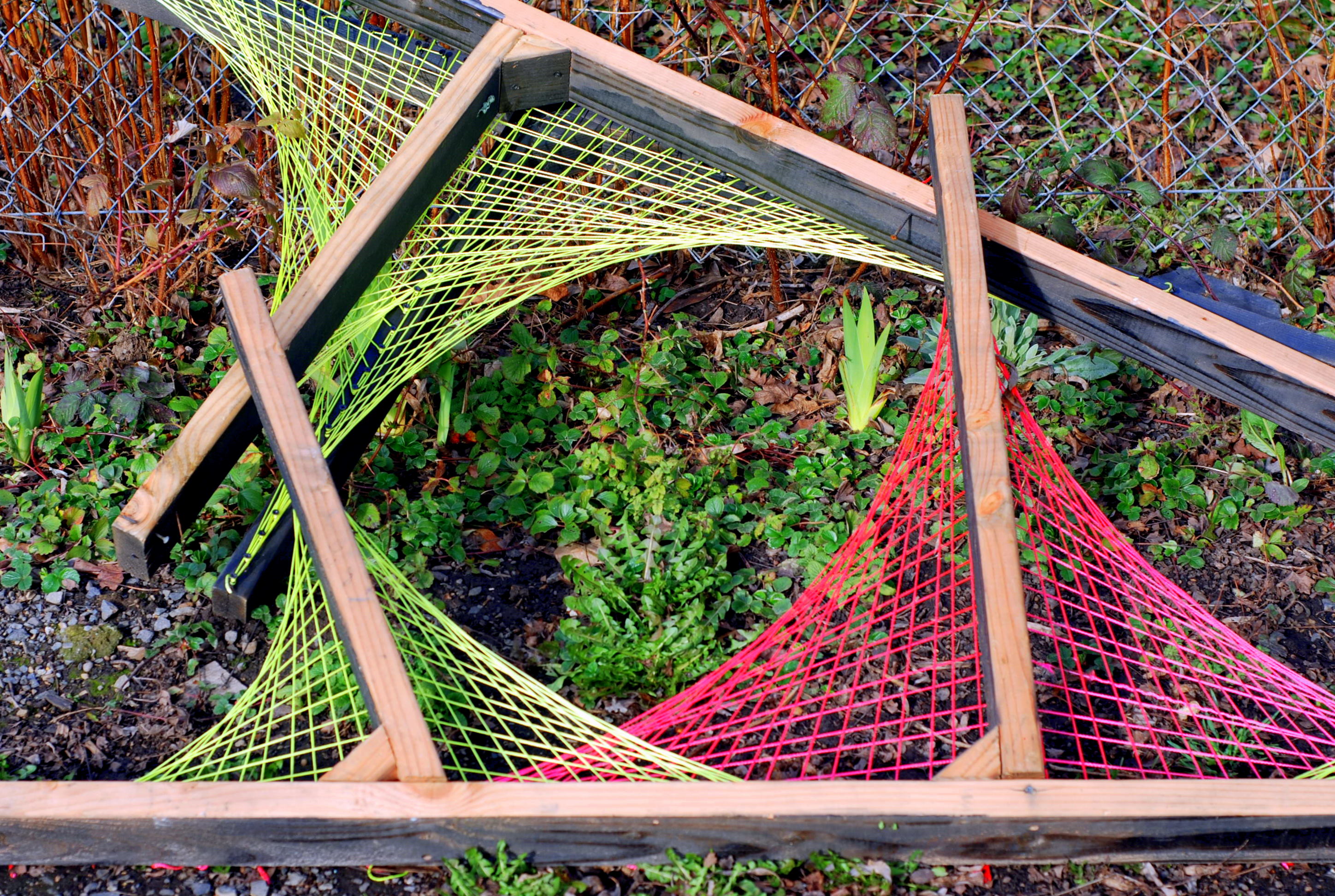
A thousand spider webs depend on eaves,
enjoin the plants, embroider autumn air.
September drinks the chlorophyll from leaves
while I walk into webbing everywhere.
A strand of stickiness across my face,
resisting my impatient fidget twitch,
annoying as a bug – it takes the place
of dread mosquito – tease for toxic itch –
impels me to the realization, true
as autumn’s fall, that webs are good as gold
to me, and spider wishes coincide
with mine. Attempting to adopt her view,
I spider-dream and spin a plan. I hold
my frame insistent to be satisfied.

Posted in Critters, Poetry, Weather | 3 Comments

Concrete Thoughts


I fell on the sidewalk on May 6 of this year. And I tripped and had a bad financial district stumble a year ago in February. I’ve learned about my mind and body as a result of those mishaps, but I wonder if I can learn about pavement too.

I’m sure I wasn’t paying attention when I fell; that’s part of how the accidents happened. Well suddenly I had to care for (parts of) my body in ways not customary; that slowed me down. That gave me the time and motivation to consider how crazily I’d been dashing around.

And an immediate result of the last fall was a reconsideration of footwear, followed by a fresh approach to ambulation and respiration in general. I now try to walk with better balance and focus, with more measured breathing.

Those are all to the good. But maybe something can be done about the pavement too.

As long as there are sidewalk trees (may they flourish forever), there will be tree roots capable of prying up slabs of concrete. Like a glacier, like a concrete tsunami, the sidewalk will rise again, to trip the unwary pedestrian. So maybe we should use another material.

Asphalt alone won’t work. It has the flexibility we may desire, but it’s just too soft, too gooey in summer heat. It’s too flexible.

Concrete is too strong and hard, and asphalt is too soft. What about playground material? What if we treat the sidewalks as playgrounds, of a type, for all citizens?

It’s been about 20 years since I spent time in playgrounds. They’ve changed. Gone are many of the metal pieces. No longer are tetherball poles or concrete slides to be found. But the under-equipment surfacing has changed for the better. Where there isn’t sand, there’s this new composite made of old truck tires and other rubber/plastic parts. It’s spongy but strong. It can take the wheels of a stroller or chair but it is gentle on the feet, ankles, knees and hips. And it appears durable.

Imagine a sidewalk made of such a person-friendly material. Or something like that.

Posted in Universal Design | Leave a comment

Oxymoron

9.8.08
… is one.

Really. Oxys is from the Greek for “sharp,” and moros is the same Greek “foolish, dull” that brought us moron.

Oxymoron means sharp-dull. The dictionary says the word is a figure of speech in which opposite or contradictory ideas are combined.

Other examples are:

Make haste slowly (dictionary)

A cruel kindness (dictionary)

Jumbo shrimp (Dad)

Military Intelligence (also Dad)

Dodge Ram (Richard)

Sophomore (wise fool)

Contemplating oxymoron brought up oxygen for me. The origin is the same oxys (meaning acid, says my dictionary, but also clearly sharp, as in quick and alive), followed by the gennān of generation). The word oxygen means the tang of life.

Posted in Language | Leave a comment

The View from Our Table


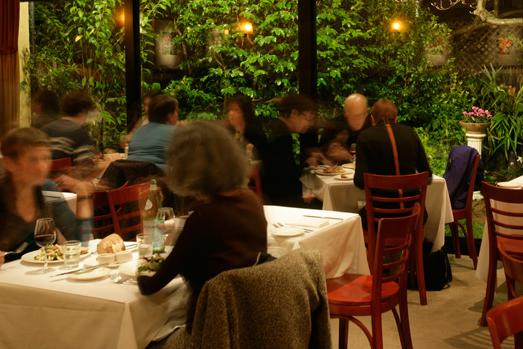
I watched a couple dine last night, instead
of paying strict attention to my host.
I didn’t see the garden as I fed
my eyes with her and him. They shared pot roast
and dense souffle. Each drank a different wine.
Their hands at first were joined in love or prayer.
Their eyes were locked and neither gave a sign
of noting any other diners there.

And yet the woman seemed a dyke or nun:
unstyled, unadorned, that shorn and dim.
She looked mid-50s. He could be her son,
with unlined face and woolly hair. At him
she spoke; he caught each cadence of her lip.
I couldn’t guess at their relationship.

Posted in Poetry | 2 Comments

Tesseract


I understand that the term was coined in 1888 by Charles Howard Hinton. He took it from the Greek words tesserais actines, which mean four rays.

A tesseract is also called a hypercube or a 4-cube. Simply put, a tesseract is to a cube what a cube is to a square.

But that’s not enough. Here’s how I received the idea.

When I was in junior high, I was exposed to a book called Flatland, by a man named Edwin Abbott Abbott. The publication date was 1884 (that must have been quite a decade) and I understand now that he intended it as a cultural satire. I didn’t read the whole book; what grabbed me was the set up and the beginning.

Flatland is just that: flat. Its inhabitants are two-dimensional shapes, and its hierarchy is based on angles; the more you have, the more you get. So a triangle is at the bottom of the social scale, and circles rule.

The flat culture experienced a mysterious event: through the plane of its existence a sphere passed. But the two-dimensional inhabitants couldn’t see a sphere – they had no depth perception – so the ET appeared first as a dot, and then as a circle which grew and grew and shrank and shrank back to a dot and nothingness. And that’s what the event was, for most of the flatlanders. But a few of them experienced a tingle of hyperperception. They couldn’t fully see or draw the sphere, but they got intimations of it.

A tesseract occupies space that has one more dimension than our own. We cannot see it or draw one. But if we relax our eyes and mind and allow the serenity of thought to proceed, we can get intimations.

Imagine that we’re sitting across from one another at a table. Between us, hovering in the air like a hologram, floats a perfect cube. Now let it blossom. Allow each of its six square faces to be one side of a new cube that extends outward from the root shape. But don’t build a cubist flower. No: the thing about a tesseract is that each of the added cubes shares its edges with its neighbors.

That’s the only way I’ve found, to peek into the universe that has one spatial dimension more than ours. And there’s no reason to assume that’s the limit. But there’s every reason to conclude that our brains, adapted as they are to three spatial dimensions, can’t reach much farther.

Posted in Lessons | Leave a comment

Metaphoraging

Adrift I am, and starting to float free
of old relationships I wouldn’t rock.
I wallow from the harbor clumsily
but as the distance grows between the dock
and me, I find a purchase for my keel.
I stretch within and animate my mast.
I start to plow the water, though I feel
I know not what, nor how long it will last.

Cut loose, deplored, abandoned and at sea,
this battered spirit isn’t vanquished yet;
the tatters in the sail can be repaired.
Before I was becalmed, but energy
is loosed by this – a tantrum got me wet –
and I’ll sail farther with my psyche bared.

Posted in Poetry | Leave a comment

Bad Teachers


I don’t want to sound disrespectful. I know the good ones won’t take it personally because this doesn’t apply to them. But I’m tired of pretending that all teachers (or soldiers) are heroes.

Sure their jobs are important. But not as important as our false reverence suggests. The truth is: classmates are more powerful than most instructors, in terms of challenging us and making us who we become. The fact is: no teacher is better than a bad teacher, just like no dad is better than a bad one.

I had a few wonderful teachers. I’ve mentioned a couple of them by name in earlier posts (Seaman, Borup). They ran my 1st and 5th grades. I remember a good one from junior high, although the name escapes me, and I was impressed with Tino Lavezzo and Mr. Bachelor at Redwood. Probably I’m misspelling their names; they taught social sciences and senior math, respectively. At Cal I was lucky to study Greek under horny old Joe Fontenrose, I took some important advice from my Comp Lit professor, and John McWilliams (who never got tenure) was the English professor from whom I learned the most.

Have you counted? That’s eight saints. Out of guess how many instructors? My quick tally yields about 120, from kindergarten through attainment of my BA degree. I conclude that I enjoyed about 7% great teaching and over 93% mediocre or worse. I don’t think my experience was much different from that of most students. Is this acceptable? Maybe …

It wasn’t any better when I became a parent, and saw the teachers my children had. In general they were a bunch of whiners, moaning about how hard their jobs were and begging for pencils.

The most appalling condition I encountered was teacher ignorance. My kids were bright but challenging, so notes were sent home. Just about every one had misspellings or grammar gaffes. Most of the teachers threw hissy fits about minor acts of rebellion – they just couldn’t take it any more – well okay, I thought, but get yourself out of the classroom until you’re better; it’s time for the teacher to take a time-out or sign a behavior “contract.”

The best/worst came from a junior high math teacher. She was very frustrated about a proposed save-the-district 5% pay cut. “It’s really not fair in my case,” she complained. “My husband teaches in the district, too. So for our family it’s 10%.”

Posted in School | Leave a comment