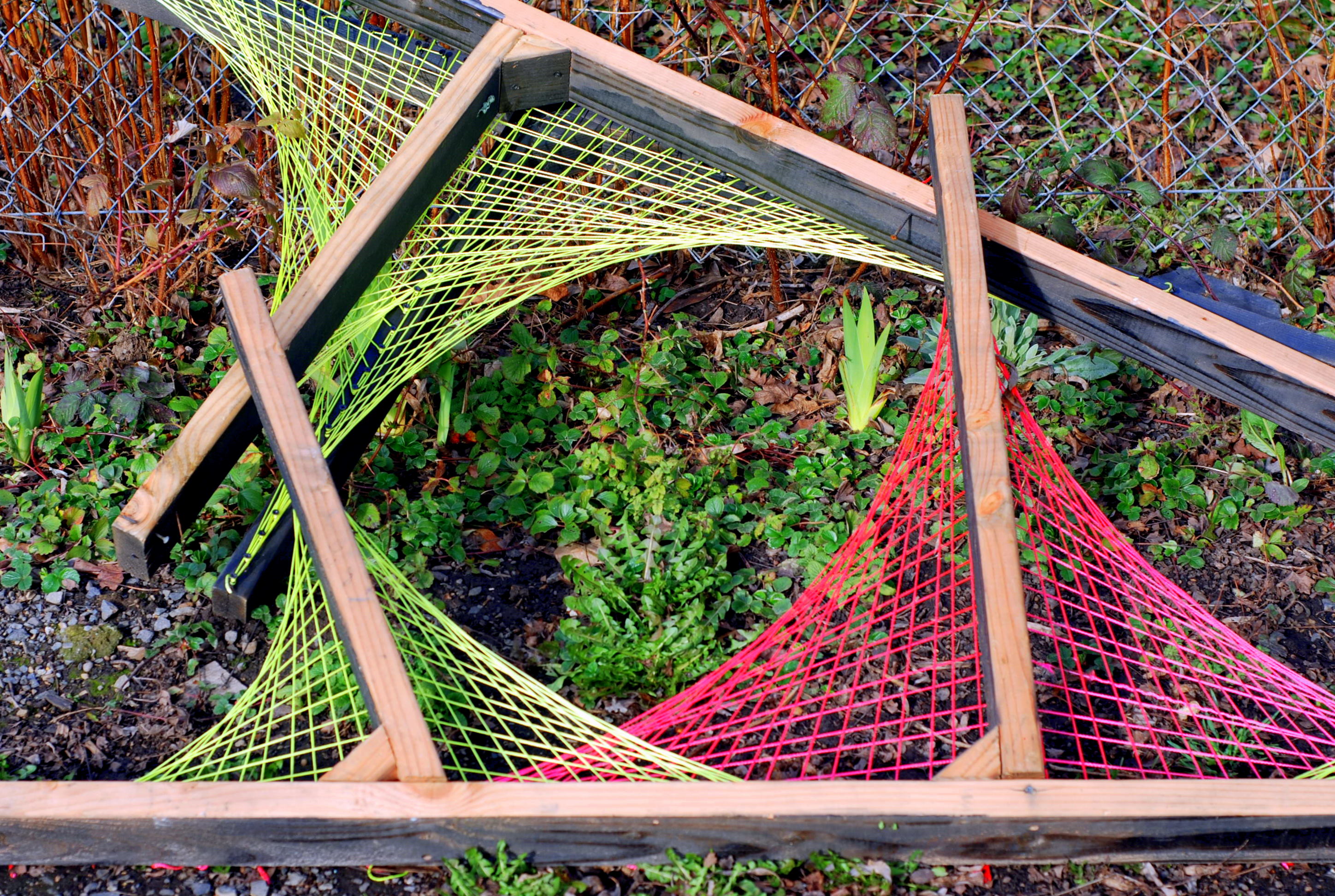
ArcAngle 3

When I was in my early 50s, I thought often about how to house people, attractively, cozily, affordably, naturally. As described in the other posts in the “universal design” category, I found it gratifying to contemplate how to build with intelligence and forethought. It’s been my experience that if necessity is the mother of invention then laziness must be the father, because my fresh ideas are almost always inspired by a fear of future retrofits. I disdain redoing.

I imagined a few broad building ideas, and I enjoyed envisioning them. But I’m 61 now, and I’m lazy, and I don’t think I’ll be building them or even refining their design. I’m writing them to get them out of my head. Feel free to do with them as you please.

I described my first concept, the spiral-ramp building, in ArcAngle 1 (March 2), and the second, the ramp-around rectangle, a week later. Those ideas led to the realization that walls and floors were getting in my way, and any wood frame was limiting permitted height. I began to toy with metal frames, imagining fabrication from recycled cars.

What fun! The first form was a multi-storied building with permanent metal scaffolding on the outside. The scaffolding acts as ramp and also as benches and maybe play areas around the building. The walls are no longer load-bearing, and can be moved at little expense.

The next idea moved the framing inside. I imagined that the infrastructure would be designed by the future residents, with engineering approval of course. If some people wanted a spoke of frame to intrude into one of their rooms, perhaps with hooks or another detail, that might be possible. The idea is the future residents would design a tree of recycled metal, and then apartments would hang from the branches. Walls, ceilings and floors become acoustical and visual and thermal barriers but not load-bearing treasures.

This building seemed to me to be the ultimate habitat for humans. I haven’t gone beyond it yet.
Posted in Universal Design | Leave a comment

What Goes Around

  When I was 16 I was into poetry and wax-resistant dying and my best friend Ellen, with whom I examined cosmology, world philosophy, and gossip.

One of our conclusions then – a private catch-phrase between us – was a modification of the saying “variety is the spice of life.” We subbed “vice” for “variety.” It was VITSOL to us.

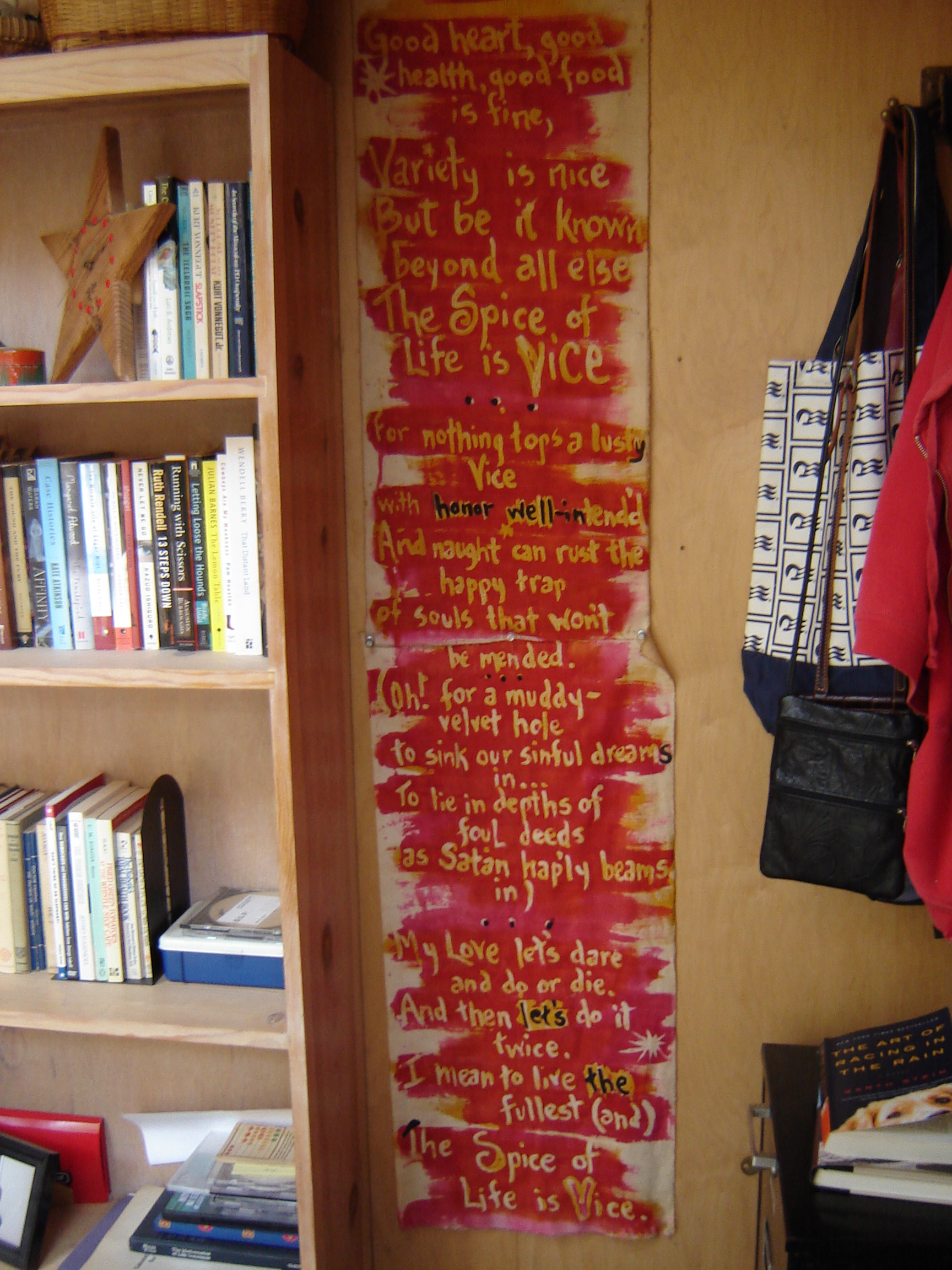
The autumn of 1966, I wrote a ditty to that theme. Then I sloppily scrawled it in paraffin/beeswax on two pieces of cotton, slapped on cold water dye, ironed out most of the wax, and presented the tapestry “To Ellen,” for her November birthday.

She treasured it. In fact, she kept it so well that in 1992, when Katie finished her 16th year, Ellen sent the hanging as a birthday present to her.

And when Katie left home a year later, she abandoned the poem. It remained on the wall of her sunporch bedroom.

Soon after, I moved my study into the sunporch. And there it was, back with me: my old verse.

So when I left that house and moved here, of course it came along. It’s tacked on the wall in this small office/shed, between the bookshelves and the two-drawer file cabinet, above the vacuum cleaner.

Here it is, come full circle and readable but not correct. Long ago we concluded that neither variety nor vice make the spice of life. Stress does.

Good heart, good health, good food is fine,
Variety is nice
But be it known beyond all else
The Spice of Life is Vice

For nothing tops a lusty vice
With honor well-intend’d
And naught can rust the happy trap
Of souls that won’t be mended.

(Oh! for a muddy velvet-hole
to sink our sinful dreams in …
To lie in depths of foul deeds
as Satan hap’ly beams in)

My love let’s dare and do or die.
And then let’s do it twice.
I mean to live the fullest (and)
The Spice of Life is Vice.

Posted in Poetry | 1 Comment

The Pump

  When I was 40 I bought my first house and found the pump. It was my third piece of residential real estate in fact, but the others were acquired with spouses; that creekside cottage was mine-all-mine.

The house was built in 1912. It nestles in a ninety degree turn of Codornices Creek, exactly where The Alameda becomes MLK in Berkeley. The house and creek bend are below the sidewalk, so the water runs year-round along the south side of the cottage and then parallel to the rear wall and through the back yard.

The seller disclosed that the basement flooded in heavy rain. When I spotted the pump in it of course I assumed it was for getting water out of the place.

Not so! It turned out the pump was around for (illegal) acquisition of irrigation water in drought years. Apparently someone had used it to deliver creek water to the yard. It wasn’t necessary after a flood.

When the rain falls for a quarter hour or more so hard that you can’t see across the street, Codornices Creek will crest its banks. It courses under so much asphalt that it just can’t take all the run-off. It races cappuccino-colored, debris-pocked, and strong; it tears out chain link and floats yard bridges without a pause.

The water didn’t pour into the basement when that happened. Rather, the creek widened to include half the house foundation. I wasn’t down there to see it but I’m sure the flood came from below. Because that’s how it left, through below.

Right after an event there’d be a foot or so of water in the west side of the basement. But the muddy stuff subsided inside at the same rate that it sank back into the ground outside.

The water came in and the water retreated. The frame was hundred year old redwood, so hard it was almost petrified, able to easily withstand the incursion.

I sold the house four years ago and began my experience in one-room dwellings. I offered to explain the basement to the buyers but they never took me up on that. They spent extraordinary sums replacing the foundation and even raising the house to make the basement usable. I lived there 17 years. I’m sure that didn’t work.

Posted in Lessons | Leave a comment

Kaleidoscope

  When I was almost 54, I glanced out the BART window and was dazzled by sun diamonds.

It was a bright winter morning and I was on a train headed to San Francisco. My seat was on the port side, and as we barreled above some vacant lots that angled near the tracks, the rising sun picked out thousands of shards of broken glass and turned them into jewels.

I was struck by the loveliness trash can make. I tried to capture that idea in a sonnet about the accidental invention of the kaleidoscope. I took gross liberties with history (sorry, Sir David Brewster), and I got to use the word “sublime.”

I learned what sublime means in high school chemistry class. It’s our verb for the rare transformation of a solid to its gaseous state without passing through a liquid phase. The common example of sublimation is how dry ice melts to gas without ever showing us liquid CO2.

I like the kaleidoscope sonnet I started that day and it’s been one of the most favored poems I’ve shown to friends. So I have submitted it to a number of small poetry publications. It has never been selected. Other sonnets, less good in my opinion, have been printed instead. I suspect there’s a lesson in that.

Today I’m publishing Kaleidoscope myself:

Imagining the first kaleidoscope,
an instrument by accident destroyed
when some unbidden son’s forbidden grope
resulted in a crash … That kid enjoyed
the broken glass – so trash to beauty twirled,
the same way freeway cloverleafs are grand,
an oil slick’s a gleam, and car tapes hurled
on pavement curl like ribbon off God’s hand.

A storm makes sculpture out of tenements.
A beam of light bejewels a vacant lot.
A gated enclave’s nothing but a fence
outside, yet every fallen leaf’s a yacht.
I note the dirt. I recognize the grime.
But when I squint at squalor it’s sublime.

Posted in Poetry, Writing | Leave a comment

Calculus

     When I was 17 I came to Cal. One of the classes I enrolled in first quarter was calculus. I think it fulfilled a Breadth requirement. I signed up with Nick and his friend Steve, who we called Cap’n Crunch. We took it Pass/Fail.

This was 1967. Actually it was Pass/Not Pass – failure was not an option. Nick and the Cap’n and I agreed to split up the work. That meant we all did okay on homework grades but tended to know only about a third of the material for tests. And also didn’t enjoy the course. But did well enough to not Not Pass.

Fast forward five years. I’m 22 and engaged to be married. I’m in the living room in Marin, with Dad and Andy.

Andy asks me a question. He’s looking at an odd shape on the paper in front of him (he’s on the carpeted floor by the fireplace and I’m curled up in a chair with a book, approximately above him).

He asks how to compute the area of the irregular shape. I gaze for a minute and then I say: “Well it isn’t like a square or rectangle, but how about if you cut it up into as many little squares as possible and then add together their areas? If you made the squares really small you’d get a close approximation.”

And while Andy is looking up at me with comprehension and agreement in his eyes Dad says, “Very good, Mar. You just explained calculus.”

Well I was astonished. And sorry. If only I’d known that’s one of the things we were doing, I think I would have paid some attention in class.

Posted in Lessons, School | Leave a comment

ArcAngle 2

  When I was 47, I helped established a nonprofit (Hearth, Feb 16) and dove into universal design. And once we got into University Neighborhood Apartments (UNA, Feb 17), I spent much time contemplating that structure.

UNA was always a tight-space puzzle. We were replacing an old paint store on University Avenue with 27 affordable apartments. We backed up to a concerned lovely neighborhood so the roof lines had to be low at that boundary and staggered, and we butted up against retail establishments (and one tucked-back little house) on the sides. We went as close to the property lines as permitted, but of course set-backs were required. There was simply no room to ramp the building; we had to make due with stairs and an elevator.

Which got me to thinking: what if we ramped that rectangular building on the outside? What if we used the set-back area that is above the street level to hold a sweetly sloping pathway around the residential floors of the building?

I think the idea is compelling. The biggest challenge would be window placement.

It then occurred to me that there could be contention on the ramp. Possible disagreements about speed and right of way between, say, kids with skateboards and retirees with walkers. That’s okay, I responded to myself; that’s what community is about, settling the matters that arise between participants.

In fact, I then recalled the days in the early 90s when Danny was so into video games. One of the several I enjoyed seeing was SimCity, a quasi-educational program of urban planning that was eyecatching because of the insect-like busyness of its streets. I now want to build a protective but transparent wall around the ramp. It will keep residents from falling, if any tussle should get out of hand. More: it will give outsiders a show, a kinetic sculpture of the life in the place.

Posted in Universal Design | Leave a comment

Approaching Spring

     When I was around 50 and walking one spring morning, I was amused to encounter a clump of purple wisteria flowers poking like a face through a front yard fence.

wisteria blooms
pilloried between fence slats
face the morning sun

Soon after, walking in the same season and the same neighborhood but looking up and down, I was impressed by the calligraphy of leafless branches against the bright sky. I didn’t have a camera so I tried to fill my eyes. And later on I recorded this:

The canopy is azure shot with cracks
that spider like a jigsaw puzzle cut
a thousand pieces small. A tree makes tracks
across the sky and I look up, unshut
my eyes and grasp a graphic miracle
amazing more than all the ads and art
we fabricate, and fleet. That tree will fill
with leaves and grow my simile apart.

Above, a sycamore dissects the sky
with capillary branches, while a jay
repels with confidence a thieving crow.
A broken sparrow’s egg begins to dry
on warming concrete as I walk today
beneath a metaphor, within a show.

Posted in Poetry | Leave a comment

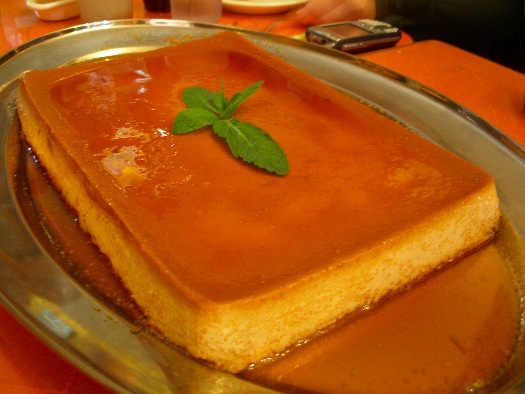
Remember the Flan

   When I was 24 I learned the truth about Pyrex. Nick and I were making flan in our Bonita Street apartment when the pan and the misconception came apart.

I’d always enjoyed pudding and I’d recently tasted flan. Or creme caramel I should perhaps specify, because I appreciated the golden topping you got if you melted sugar in the pan before pouring in the milk and eggs, so the inverted result carried soft caramel. Nick liked it too. We were just a couple of years married then, and our culinary adventures were about nachos and pancakes and Irish coffee and flan.

So one day in 1974 we decided to make a big batch. We pulled out the 9 x 13 glass lasagne pan for the job. I mixed the pudding ingredients together while Nick caramelized. He spooned granulated sugar into the heavy glass pan, and he began heating it over the gas stove. I suppose he could have placed it on the two front burners, but my memory has him seesawing the glass bottom over one flame as the sugar began to liquify.

Suddenly he went into adrenaline mode. “Mar!” he shouted. “It’s going to burn. Quick! We have to cool this!”

I think I was rather prompt, coming up with the broiler pan for the job. It was the only container bigger than the Pyrex. I ran an inch of tap water into it and plopped it on the counter. Nick was there with the bubbling sugar; he set the lasagne pan in the water.

There may have been a little hiss but what I remember is silence. Complete silence while the two of us stood there like refugees. It was three to five seconds later, as our eyes were meeting in relief, when the Pyrex pan exploded.

I’ll say this: the shards appeared tempered. I didn’t perceive sharp edges. But I couldn’t really tell. Because the way I remember it, every shard was coated in sticky caramel. And there were thousands of them, all over the kitchen.

Posted in Food, Lessons | Leave a comment

The Lawsuit

  When I was 43 I got sued. It was a surreal situation; the client got in trouble by going against what I recommended, and then contended that I was incompetent. After all, his lawyer charged, if I had been effective then surely the client would have followed my recommendation. The fact that he went contrary to my advice (and got caught) meant my advice was too weak.

Talk about a no-win situation. Worse, what landed the client in trouble was a crazy insurance policy, and the crooks who sold it were my co-defendants! So when I finally got the case dismissed I took care of the crooks along with myself, which was not very satisfying but so it goes.

The painful part of the adventure was in the beginning. When a lawsuit starts, especially if the attacking lawyer is not talented or moral, you get called appalling names. Accusations are made willy-nilly; mud is flung with the hopes that some of it will stick. You feel attacked, naked, vulnerable.

And the wheels of the court system grind slowly. There are filings, hearings, postponements, discoveries, depositions, more filings, and many delays.

In the beginning I felt like there was a sword hanging over me, maybe to drop and take what all I owned. As the time (two years) passed, I grew accustomed to the names, the delays, the frustrations and ironies, the sword. When it was over, after the ex-client apologized and the case was dismissed and a bit before the ex-client went to prison for defrauding insurance companies, I missed it a little. I’d gotten used to that sword.

I file the experience under “shit happens.” I didn’t deserve it but it wasn’t that bad. I learned from it. I got to choose my attorney and act as my own expert. Here’s the best of the sonnets that came out of the concluding deposition.

A stone-topped table big enough for 10
is centered like an altar in a room
with walls of glass. Around it sit 6 men
and half as many women, who consume
conditioned air. Their fingers pull the sill
of oak that frames the stone, tenaciously,
as if they’d make it levitate, or fill
it like a lifeboat in catastrophe.

For 2 long days they ride that rocky craft
through reefs of argument and glassy greed.
Past bitter misrememberings they waft,
till currents push them clear and then recede
to beach them like a sandbar, with the hiss
of leaking air: dismissed with prejudice.

Posted in Lessons, Poetry | Leave a comment

Three Questions

When I was around 11 I got a black eye by walking into a closed door. It was a dark night and I was sleeping over at my friend Candy’s house. I tried to make a trip to the toilet without turning on a light and whammed into a door that was rarely closed.

People asked me about my shiner and I told them what happened. Most of them looked at me a little sideways, with a skeptical cast to their eyes. I later learned that walking into a door is the standard white lie about a black eye; it’s never the way the bruise occurs but it’s offered to avoid societal disdain.

Which raises my three questions: Have you ever tried to slip on a banana peel? Shoot a wet bar of soap into the air by squeezing it? Start a fire with a cigarette?

If you have, you know these accomplishments are not easy. They are probably not common either.

To slip on a banana peel with any conviction, the peel must be fresh, applied to the floor inside-down, and symmetrically spread like a yellow-petaled flower. And the placement of the foot-that-will-slip must be precise.

To shoot the soap you have to acquire just the right amount of wetness and apply the optimum degree of hand pressure.

And the fire thing? I have no doubt that many house- and wildfires are started with unextinguished cigarettes. I understand a smolder. But I’ve tried to ignite a number of camp fires and barbecues in my time, and using a cigarette is not effective.

Posted in Question | 2 Comments