ArcAngle 1

  When I was around 50 I was immersed in Universal Design. As a result of working with Hearth and on UNA (Feb 16 and 17), I began contemplating what our homes require for us to live well: how we use our space. I began imagining what future users would need, and how to create room for those future needs now.

What grabbed me was not the idea of accessibility as much as sensibility. There’s no reason to build new structures that have spaces which are hard to get into. That’s expensive, a drag to clean, and silly in the long term. (It reminds me of when Lisa and I got our college apartment (South Berkeley, 1969). Our first residential act was to paint the kitchen yellow and orange. Cabinet doors and drawer fronts alternated colors and had contrasting knobs, you know? It was a lot of work and we really liked it, for about two weeks. To this day both of us, in our separate residences, favor white paint.)

So among other subjects, I contemplated the shapes of multi-family residences. I thought of three. I’m not going to have time to build them myself. I offer the ideas to anyone who cares for them.

The first shape that arose in my mind was inspired by the Guggenheim Museum in New York. Frank Lloyd Wright designed a satisfying structure by putting an elevator core in a cylindrical building, and then constructing a lovely big ramp that encourages the visitor to wander the exhibit top to bottom. He made a fountain of people; they are pumped up the elevator and then cascade down the ramp to the bottom!

I googled the Guggenheim and was shocked to learn I misremembered it. Certainly it has the spiral ramp. There’s the elevator shaft and all the art on the exterior walls. But the elevator doesn’t run right up the middle of the structure. It is set to one side of the building.

ArcAngle 1 is a modified version of Wright’s cylinder. Its elevator shaft and other plant equipment are in the center, its roof is clear for light, its ramp spirals around that equipment core, and instead of art on the outside walls, it has apartments.

Posted in Universal Design | Leave a comment

Auto Love, Part 2

     I propose we do some evaluating in terms of the Value of a Statistical Mile Traveled (VSMT). The VSMT is a measurement of the consumption in resources, labor and material of any mile traversed. Often time is factored in as well, casting study results in terms of VSMTH (Value of a Statistical Mile Traveled per Hour) and thereby leveling the playing field between, for example, planes and trains. But for the simple purpose of comparing walking or mass transit to driving, VSMT alone will suffice.

The VSMT of walking is just about zero. No special equipment is required and the pedestrian doesn’t consume while walking. Except for the purchase of a bottle of water or some other small item, the walker’s contribution to the surrounding economy is nil. He does use the sidewalks, streets and, with increasing frequency, local emergency services, all without paying taxes for those benefits.

The bus- or metro-rider contributes a bit more than the pedestrian, sharing as he does in the consumption of some fuel and requiring the maintenance of a squadron of system employees. But economies of scale work against the establishment of an impressive VSMT for buses and subways; only the lines that serve the most outlying suburbs rank high enough, and that population is simply too small to compare with the huge class that consists of drivers.

By contrast, consider the VSMT of a car. Not only will it use (and pay for) the roads and road services, but its fabrication employs miners and autoworkers, its sales makes livelihoods for distribution and retail employees, and its operation puts people to work in refineries, pipelines, service stations, hazmat teams, EPA sections, detailers and body shops, theft and theft prevention, resale, and law enforcement. And that just names some.

It’s rather obvious what manner of transportation is contributing the most to our lives.

We have a tradition which requires that the power vehicle grant the right-of-way to the one which doesn’t use fuel. That makes sense in a sky with gliders or a sea with sailboats, but it doesn’t translate to the folks on the sidewalk. One of the most dangerous residential situations is when the driver is trying to turn right on a red light, looking of course to the left for oncoming car traffic, while on the curb is a pedestrian, about to cross with the light in front of the car. It’s perilous for the pedestrian to cross, because the driver may choose that moment to execute the right turn and hit the pedestrian. But it’s a bad idea for the driver to be too attentive to what’s happening on his right, when the vehicle that may damage his will be coming from the left.

Under the circumstances, the only rule that makes sense is to suspend the pedestrian’s sacred right-of-way. The idea is to let the traffic flow – the folks in that car and the cars around it – and there’s no injustice in having one relatively slow-moving individual pause in his steps, to let the many pass.

Posted in Fiction | Leave a comment

Auto Love, Part 1

    The verdict is in on mass transit, and just because it isn’t pretty doesn’t mean we shouldn’t look at it. The truth is, we’ve been running this bus and train and boat experiment for a century, and the obvious, desired, successful, surviving form of transportation is the privately-owned automobile.

Don’t get me wrong. I wanted it to be otherwise. I pride myself on fair-mindedness but I think I’d have cooked the evidence in favor of public transportation, a little, if it would have made a difference. But it wasn’t even close.

I used to argue that subway systems would operate at less of a deficit if they didn’t have fares; they could eliminate all those ticket machines and turnstiles and guards. People looked at me like I was a talking horse. I’d wax emphatic about charging those in cars the true cost of driving and making the mass transit free, or reserving HOV lanes for buses only, or designing the transit vehicles to be more luxurious than the cars, and listeners gazed at me with bemused indulgence.

“In my next life, maybe,” they might think, but meanwhile they need their cars for their commutes and their errands, and they sometimes take a drive alone to relax, and they’re contemplating a convertible for the car after this.

It’s not that the public is recalcitrant. Look at the shift in attitude toward smoking, and the tremendous strides we’ve taken against racism.

Clearly, it’s that people need to drive, alone, to be happy.

So let’s stop all this faking. Let’s put our money where our hearts are, and bring back cheap gasoline. Let’s reinvent cruising and the road trip and tail fins and white walls and all the things that made America great.

As for who will pay for it, I say it’s time to stop subsidizing alternative forms of transportation. Let bus and train tickets rise to what they must be, in order to pay for their systems. And start charging the pedestrians.

That’s right. The group that uses the roads and streets without paying a dime for them. The folks who demand curb cuts for strollers and wheelchairs but charge the job to property owners. The people who impede the flow of traffic with their crosswalks and other rights-of-way.

Walkers have gotten a free ride long enough. They’re more favored than Native Americans.

Buses should be confined to the far right lane and should yield to any car. There’s no particular reason to make them plush; most passengers won’t be in them for long.

Pedestrians should be required to remit annual registration fees, maintain insurance, and pay tolls. This is especially true when you consider that study after study shows the injury rate is higher for pedestrians than for drivers

In fact, in light of the demonstrated tendency for people to break more easily than automobiles, pedestrians should be required to wear protective gear. A portion of the sales of such equipment could go to fund the roads. I’m envisioning padded bumper-belts. At the least, a helmet and a flag should be law.

Other pedestrian accouterments should be strictly regulated. Cellphone use distracts the walker, and those little carts increase their dimensions to the point where it’s sometimes traffic-impeding to wait for them and their wheels to cross.

I won’t continue with suggestions for specific laws, because the process should be consensual, natural, and democratic. It’s time for our society to begin the dialogue that will permit us to thrive. Our goal above all should be to keep the traffic moving, for therein lies our economic redemption.

Posted in Fiction | Leave a comment

Utopolis

  When I was 15 I spent some time with the school debate team. I wasn’t a member but my friends Jim and Tim were, and I helped them prepare for the competitions. The subject that year was nuclear power.

It was worth the time. Not only did we learn to be less nervous speaking in public and to be more courteous about what our opponents claimed; it taught me how to do satire. I learned that if I took a position with which I disagreed and then defended the hell out of it, what emerged was funny.

I’ll show you what I mean next week. I’m polishing and abbreviating an essay about cars which I started in 2003. But for now I’ll speak straight.

I don’t own a car. I walk for transportation. I have deliberately chosen my addresses so that vehicle ownership is not required (or even advised). But that does not mean I dislike automobiles.

In fact I love them. I was born in 1950 and raised in the suburbs. We were all about cars. Gas was 30¢ a gallon. Cars were our privacy, our club house.

But I hate traffic. We didn’t have much traffic in the 60s compared to now. It bothers me to see Bay Area residents, who pay more to live here because it’s so great to enjoy the place, hunkering down inside their homes and offices because there’s too much traffic, it’s not worth the hassle, who wants to deal with the bridge on a holiday weekend …?

And I loathe imbalance and injustice. It’s just not fair how rigged our culture is for cars and their attendant industries.

The fact is, my love of cars is nostalgia. And nostalgia is kind of like masturbation; it’s a harmless private indulgence but it’s not very attractive in public.

Imagining a transit system free
to all and drivers paying what it takes
to get their gas and highways honestly,
creates a dream of realignment, breaks
up clots of promised traffic, reels in stress
upon a spindle, handing us the clue.
Envision with me taking space up less
and feeling like there’s no admission due.

Attractive as that is, it’s not enough.
I’d uninvent belief and mayonnaise.
I’d have us walk. I’d jettison the stuff
we buy on credit and the many ways
we type us. Obviously I’m alone
with this agenda, hearing angels groan.

Posted in Lessons, Poetry | Leave a comment

Stupid Pets

   When I was 5 they gave me the turtle. I don’t remember asking for one. I didn’t name it Myrtle (that was Mom: “Here. Meet Myrtle the Turtle”). I associate the creature’s presence with my terrible tonsillectomy but I also have a dim memory of a second turtle, for Steve, so maybe it was not a get-well gift but one of my father’s lessons in responsibility.

Or maybe it was connected to Dad’s appreciation for things marine. He’d soon bring home the first aquarium, and a decade later he’d take up scuba and free diving and then sailing. Whatever the cause, I briefly had a small turtle in my room in Glen Cove, in a round clear shallow bowl with a little hump of an island Myrtle could climb, and a fake palm tree.

I never warmed up to Myrtle, and she (if a she) never seemed to notice me.

After turtles came the aquaria. That started in Chula Vista and included plenty of equipment and scientific method. Dad taught us the names of the species he kept bringing home while they were acclimating in their plastic bags. He showed us how to remove the fish babies before their parents ate them. He enlisted our help when he tested the water. He scraped the glass walls, introduced snails and catfish and other algae-eaters, tried fish-doctoring, taught us “ichthyology.”

If anyone loved those swimmers it was Dad; we never did.

The third experience came around 1988. Katie brought home a carnival-prize goldfish that didn’t die.

We dumped the fish (there were two at first) into a small bowl and one of them gave it up within days. We acquired two more and they didn’t make it either. But the one (PB Moe) thrived. After a bit I acquired another, bigger, classically-shaped fish bowl, and the fish continued. Finally I went to The Sharper Image and spent an inordinate sum on a plexiglass column of a fish tank, complete with pump and light and colorful fake plants, and installed fish and tank in the living room.

This went on for years. Finally the day came when old PB wasn’t looking good. The tank was algae-free but the goldfish was definitely slowing down.

I didn’t want to watch that fish die. I didn’t want to flush PB down the toilet. When it was just barely still alive I removed PB from the tank. I took our old goldfish to the back yard and gently released it into Codornices Creek. Who knows? That fish might have made it.

Posted in Critters, Lessons | Leave a comment

Arcs and Angles

     It’s really a lovely concept. I’m not going to drone about the six or seven principles of Universal Design – what is it with our species, that we seem to so like lists and acronyms? I’m going to try to present the idea effectively.

My father used to tell me: if you don’t have time to do the job right at first, where are you going to get the time to do it over? That’s what UD is about: enough forethought that you don’t have to redo.

So:

You stack the closets in case you ever need an elevator.

You try to make any staircase straight in case you ever need a chair lift.

You install extra bracing in the sleep and bath areas, in case you ever need a Hoyer lift.

You consider bringing the plumbing up to the roof for future solar, or the wiring to a closet for future laundry.

You make all doorways wide enough.

You probably build the kitchen into a corner, so it’s always approachable.

Here’s what UD is not about: door levers instead of knobs. That’s about accessibility. In fact, knobs may be the right choice in a home if you want to keep toddlers or pets from opening the doors. It’s easy to change knobs for levers or levers for knobs.

And it’s not necessarily about multi-use ideas, or convertibility. If every room can be used for every purpose you’re back in feudal design. And the truth about human nature is we don’t want to go through the conversion steps and we no longer have servants to do it for us, so no thanks to the tub that requires you remove the shower floor, or the dining table that in six easy steps converts to your desk.

UD gets you thinking. You soon view a staircase as a bad compromise between horizontal and vertical: a urinal, a chimney, a black marketplace. Sure a stairway can be designed to be grand, but so can a ramp. And a ramp will move strollers and wheelchairs and gurneys. A ramp won’t produce falls.

I’ll say some more about UD, and I’ll attempt to present my three basic building ideas in a few interesting words. For now, I’ll try this:

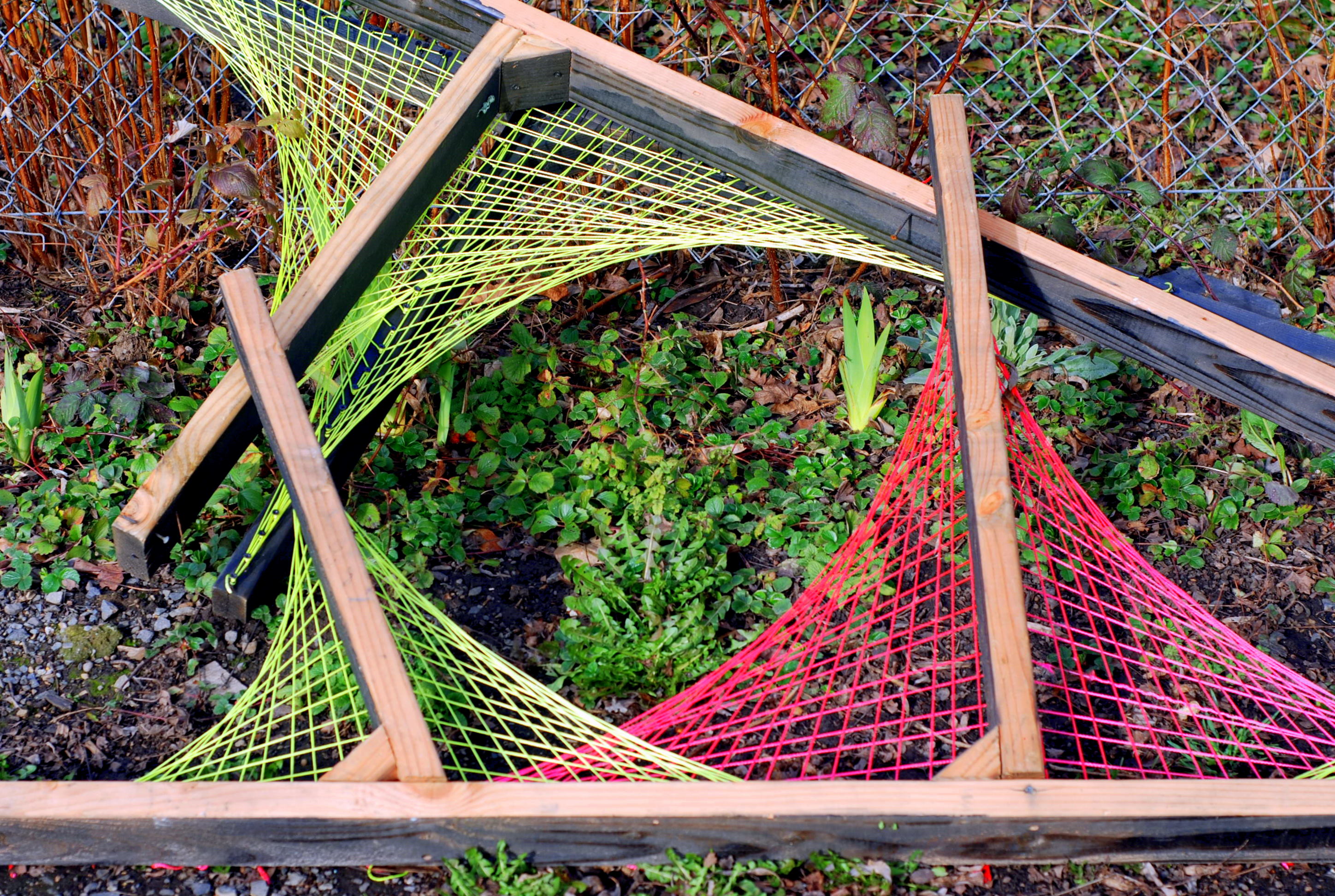
I dare you to be playful – that is my
insistent challenge to the architects.
I’m lately viewing sculptures in the sky
and dreaming them erect on land. The specs
are arcs and angles – the geometry
of ramping is a puzzle in tight space –
but I adapt the barriers to be
the terms of entertainment for the place.

A ramp’s a slide and scaffolding are bars.
A fence is both protection and a ledge.
I dream of us at play, above the cars,
without the frenzy, musing on the edge
of rules: in homes a spider might have spun,
if spiders thought like builders having fun.

Posted in Poetry, Universal Design | Leave a comment

Fruit Cocktail

     When I was 20 I knew a guy with a weird job. He was a year ahead of me at Cal, part of the group of people I was most likely to socialize with, often around but not an intimate of mine. His name was Scott.

Scott and a friend of his repaired cherry-counting machines. They worked mostly in the summer, mostly in the cannery area near Monterey/Salinas, traveling from one factory to another, fixing or at least fine-tuning the machines.

I’m talking about Maraschino cherries, those so-called fruits which are bleached white until they are dyed red, which taste like un-food and which are found in fruit cocktail (and other cocktails, but I’m not sure those come from the same canneries).

As Scott explained it to me at the time, the cherries are the high-ticket ingredient in canned fruit cocktail. By regulation each can had to contain a specified minimum number of cherry halves. By business economics no can could contain one cherry half more than required. So a machine had to be produced, to monitor the number of cherry halves that went into each can. And once a machine gets produced, an industry of maintenance and repair gets created. Which is the industry Scott and his friend joined.

It was a peachy position (I mean, they sure plucked a cherry of a job). There weren’t others around who could do it, so they were always in demand and appreciated.

I lost track of Scott not long after college. I’m sure he moved on to other employment. But I learned something from his experience. I was tickled at the specificity of his skill. It encouraged my interest in truly odd jobs, whether they are glamorous or not. And it may have primed me to appreciate the strange clerical employment I was to acquire a few years later, and stay with, and come to like, for (now) 38 years.

(Maraschino cherries the most valuable ingredient? Go figure. The fact is, I don’t know anyone over the age of 10 who loves them. The surprising ingredient in canned fruit cocktail are the grapes. After them, the peaches taste best. Then probably the pineapple. The thing about the pears is how much they taste like pears; no matter how you prepare a pear it tastes the same. As far as I’m concerned those cherries are dead last.)

Posted in Food, Lessons | Leave a comment

The Best Revenge

     When I was 54 I was the object of an attempted assassination. It was an attack against my character and it failed, but it rocked me with confusion and pain.

I was betrayed by an individual I trusted. Actually the betrayal had gone on for some time in a passive/aggressive way; that summer was when it hit me and I faced it. I don’t want to provide details here, mostly because this forum isn’t for me to trash others. What I want to describe now is how I coped with the confusion then.

The situation went beyond the one individual. She had a spouse and her own set of advisors and she was too chickenshit to discuss subjects with me that were our business. She took the tales to outsiders, to folks who didn’t understand the players or the play, and then she half-heartedly half-executed their mundane recommendations.

Her tactics were transparent and stupid. But the situation developed and took on additional participants who weren’t even in the room. It got to where I really did feel surrounded by assassins. I didn’t know whom I could trust.

Anyway, I woke up one summer morning in the midst of this mess, and I’d received a gift. The phrase “the best revenge is living well” was floating in my head as I arose, and I paid attention.

I got it. I understood it as I never had before. See, I was hurt and confused but I didn’t want to become bitter or sour about it (and I sure wasn’t going to be sweet). I didn’t want to muck around in trash talk and I didn’t want to be looking over my shoulder. I was blessed with a vision: myself standing tall and walking well, senses open and attitude receptive, proud and happy. I knew that was what I wanted and I wanted it for me; the suggestion of dust-eating enemies was secondary.

So I started taking care of myself. I began improving myself and I increased loving myself.

It worked and there was a benefit I hadn’t anticipated. Living well screws any and all foes. It renders identification of your enemies irrelevant.

They say the best revenge is living well.
My character’s too indolent to plot,
too occupied with other thoughts to tell
who trusts, esteems and honors me, who not.
I won’t attempt to damn or even quell
my enemies – it’s just that they forgot
the deal we made before our triceps fell:
to clearly see ourselves, no matter what.

Revenge is daily dancing, walking, rest
in my expensive bed. Revenge is neat
attention to the way this thought’s expressed,
a facial, acupressure for my feet.
Revenge means I don’t have to comprehend
if you’re my dearest enemy or friend.

Posted in Lessons, Poetry | Leave a comment

UNA

  When I was in my 50s, I got to participate in construction. The small nonprofit organization I helped establish (Hearth – see yesterday) worked with Affordable Housing Associates and architect Kava Massih and Toolworks and too many funders to name, to build University Neighborhood Apartments.

We were minority partners. Kava and AHA could have built it without us, but it wouldn’t have been UNA. For one thing, I named the project. More: we brought universal design and neighborhood support to it.

The plan was affordable apartments of varying size and for varying inhabitants, densely placed on a lot on University Avenue in Berkeley. Neighbors freaked out at the idea of a crowd of poor people moving in. “How often are you going to drug-test?” was the most common question I heard. “Whaddaya mean, less cars?” was the worried query whenever the locals learned we wouldn’t provide much off-street parking.

There were other challenges, besides those folks and the City Council to which they ran. By the time we broke ground the neighborhood was for the project, and the city of Berkeley put more money into UNA than it had ever before invested in land. The other hurdles were about finding the money and explaining universal design.

It broke my heart when funding agencies moaned: “Oh if only you were one hundred percent disabled (or senior, or some other sociological bucket), it would be much easier for us to provide money.” But we aimed at a diverse community. We didn’t want to add to the ghetto-ization of the disabled or elderly. That meant many applications, many masters, added cost to the project. This diffusion resembled a problem that Hearth was experiencing and also the state of San Francisco philanthropy: the attempt to do so much good in so many directions resulted in confusion, loss of focus, and reduced effectiveness.

The other issue was the lack of good press about universal design. Everyone seemed to think we were talking about accessibility. Yeah, but … UD is about visitability. The aim is to build with foresight. The goal is a future without retrofits. Universal design is smart building on the inside. 

UNA got built. It is attractive, durable, and award-winning. And not repeated, yet.

Posted in Universal Design | Leave a comment

Hearth

  When I was 47 I got lured into a nonprofit. It was like a legend, where my every deed led to a new adventure and pulled me deeper into the story.

First a respected retired client lunched with me and shared her dream: to build affordable housing that would integrate a little community of neighbors which included individuals of different ages, races, and capabilities.

I couldn’t discourage that.

So she asked me to set up the nonprofit. That begins with incorporation, which is a straightforward process just about anyone can do with a how-to book or (in this case) one’s own business incorporation papers to use as a guide.

But you can’t set up a corporation without naming it. I spent a weekend walking around thinking about what the organization intended to do. The word that floated to the surface after awhile was “hearth.” Yes. Even if what was built didn’t have a fireplace, we wanted to create that space where people would naturally congregate.

The full name is Hearth Homes Community Building, but I think of it as just “hearth.” What a word: hear and heart and earth in there.

Next up was the nonprofit part. That’s kind of what I do for a living. I get tax-favored status for retirement plans. The arm of the IRS I know was then called EP/EO (Employee Plans/Exempt Organizations). It has now, in that government way of never really settling into its acronym, switched to TE/GE (Tax Exempt/Government Entities). Under either name, it’s the division for nonprofit organizations and qualified plans. I submitted Hearth for 501(c)(3) status.

That brought up two new issues. One was the “safe harbor” for affordable builders, for which Hearth was eligible. Because we wanted to serve poorer folks and families, we were granted immediate but provisional status. We then had a few years to prove ourselves (done).

The other was our “mission.” As with the naming, the tax application required that I give more thought to what Hearth really aimed to accomplish.

I’m still pleased, even 14 years later, with this:

To build a place where
neighborhood is possible
without exclusion

Hey, it lasted a few months. But you know what they say about committees, and the same is true of boards of directors. They began adding words. They turned those 17 syllables into a sociology paper.

Posted in Poetry, Universal Design | 1 Comment