Weird

9.8.08
My mother thinks it’s a derogatory term. Whenever I try to explain to her why I made a decision she wouldn’t have, I describe myself as weird. “No you’re not,” she responds so swiftly it seems automatic.

“Weird isn’t bad, Mom.”

“You’re not weird.”

I beg to differ.

I’m a good speller but like any other English speaker I can get confused about which comes first in a word: “i” or “e.” I remember the mnemonic “I before E except after C, or when sounded A, as in neighbor or weigh,” but that didn’t work for the word “science” and now look at “weird.”

So when I ran across information about the origin of “weird” a decade or two ago, I inserted it into the dictionary I carry in my head. My internal entry says “weird” was originally “wayward.” It collapsed over time because of human mouth physiology, and before it contracted to what we see today it carried an umlaut: weïrd.

Get it? Way-erd from wayward. That makes sense. And that makes me forever understand which vowel comes first in the word.

Now I’ll look for some authority for what I just typed. I was in the library recently and had a few minutes with the Oxford English Dictionary, but I also had eager grandboys about me, so I didn’t have enough time with the last volume. Today’s brief Internet excursion does not support what I’ve penned above (wird, wyrd from Old English, from 900 or so, and involving the supernatural). For now, wayward is my definition and I’m sticking with it.
Posted in Language | Leave a comment

Protest Poem

   Up the street from our house in Chula Vista was the high school, and behind the high school was undeveloped land. It was a place of sand and clayey soil, tumbleweed and manzanita, rattlesnakes and rodents and small birds.

This was the early to mid 1960s and we neighborhood kids used that backcountry for our private meeting places and our climb-and-jump activities, and it’s where the boys hunted.

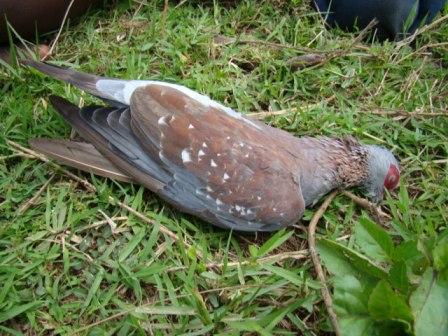
Every household had guns. They were just air rifles and pistols but they could dent a can, put out an eye, mortally wound a small creature. My brothers and the neighbor boys would file out there, followed by pet dogs and sometimes by me with a notebook, and they took aim at whatever flew or scrambled past them.

I hated it. As I recall, they usually tried to find what they shot, the rare times they hit anything, and put it out of its misery. But they never ate what they killed or used it in any way, and they didn’t always find the victim.

Recently I found a poem I composed about it. I called the piece “Vanity,” and dated it July 5, 1965:

Shining feathers ruffle softly
As the bird swoops through the skies,
While the wind is whistling past her,
Singing songs with even sighs.

All below is lulling quiet,
Soft and green and bright from peace.
Nothing harsh or loudly clashing,
Nothing meant to make this cease.

Now the bushes rustle warning –
Next a twig cracks, sharp and clear.
In the clearing stands a hunter.
Unlike others, he brings fear.

Then he scans the land for targets.
Soon he sees the bird above.
He is just a boy with rifle,
Still, he has to get that dove.

She is quite a moving target,
Quite a beauty, is she not?
So he killed to feed his ego,
And left an ugly corpse to rot.

Posted in Poetry | Leave a comment

Taste

   My memory bank contains some odd food entries. I’m sure I put small things in my mouth when I was a toddler, and I remember biting my fingernails and learning the pleasures of reading-and-eating when I was a child of single-digit age, but it was when I was 10 or 12 that I consciously tried items I’ll never eat again.

I learned that raw bacon tastes mostly like butter. I found out that raw potato is surprisingly bad, given how delicious just about any form of cooked spud is. My brothers and I already knew how much like bologna an uncooked frankfurter tastes, but that’s about when my friend Candy and I took to molding bread.

This was around 1960. All houses contained sliced white bread and most housewives stored it in breadboxes, so when someone asked “Is it bigger than a breadbox?” we knew exactly what they meant. Bread companies were big on ads then and touted their advances (Sunbeam’s batter-whipped dough: “Look, Ma: no holes!” and Wonder’s vitamin fortification: “Helps build strong bodies 12 different ways”).

Candy’s house was on a corner. At the curb was one of those green mail storage boxes – you know: shaped like a letter receptacle but with no point of entry for the general public. We already had a habit of clambering up on the thing and straddling it like a barroom bull. That’s when we took slices of white bread to the mailbox with us, munched off the crusts and then compressed the insides (against the green metal!) into unsanitary unsavory bread balls. We ate them or tossed them at boys.

I also remember a love of oyster crackers. I knew they were just saltines in better shape, but I liked to put one in my mouth, split it at its seam, and tongue its inside before chewing and swallowing. And then another. And another. One day my mother carted me and a handful into the bathroom, tossed the crackers in the toilet, watched with me while they swelled in the water, and tried to convince me that’s what was happening to crackers in my gut. Nice try, Mom …

That’s also about when I started Spanish in school. What a smart language: the verb saber means both “to know” and “to taste.”

Posted in Food | Leave a comment

Good Friday, Riding Westward

    John Donne is one of my favorite poets. Most years I read his divine poem on Good Friday, and I send love to the close friends I have who are believers.

I started this sonnet in 1998 and just tweaked it a bit. Perhaps I’ll modify it more in two years, for the quadricentennial of Donne’s composition.

Again I westward walk and then the train
continues under water west to work
on crucifixion day. Again my brain
appreciates a poem by Donne. From clerk
of old to cleric comrades I adjust
my thought, while Easter puts on fresh pastels.
Commuting west contemplative, I trust
myself to filter out the myths and spells.

An awful story climaxes today,
its joyous resolution two days hence,
but few around me seem aware. The way
they walk asleep belies intelligence
of what it means. I pray they wake again
by Sunday, Easter glad to sing Amen.

Here is John Donne’s poem:

Good Friday, 1613, Riding Westward

Let man’s soul be a sphere, and then, in this,
The intelligence that moves, devotion is,
And as the other spheres, by being grown
Subject to foreign motions, lose their own,
And being by others hurried every day,
Scarce in a year their natural form obey:
Pleasure or business, so our souls admit
For their first mover, and are whirl’d by it.
Hence is it that I am carried towards the West
This day, when my soul’s form bends toward the East.
There I should see a Sun, by rising, set,
And by that setting endless day beget;
But that Christ on this Cross, did rise and fall,
Sin had eternally benighted all.
Yet dare I almost be glad I do not see
That spectacle of too much weight for me.
Who sees God’s face, that is self life, must die;
What a death were it then to see God die?
It made his own lieutenant Nature shrink;
It made his footstool crack, and the sun wink.
Could I behold those hands which span the poles,
And tune all spheres at once, pierc’d with those holes?
Could I behold that endless height which is
Zenith to us, and our antipodes,
Humbled below us? or that blood which is
The seat of all our souls, if not of His,
Made dirt of dust, or that flesh which was worn
By God, for His apparel, ragg’d, and torn?
If on these things I durst not look, durst I
Upon His miserable mother cast mine eye,
Who was God’s partner here, and furnish’d thus
Half of that Sacrifice, which ransom’d us?
Though these things, as I ride, be from mine eye,
They are present yet unto my memory,
For that looks towards them; and Thou look’st towards me,
O Saviour, as thou hang’st upon the tree;
I turn my back to Thee, but to receive
Corrections, till thy mercies bid Thee leave.
O think me worth Thine anger, punish me,
Burn off my rusts, and my deformity,
Restore Thine Image, so much, by Thy grace,
That Thou mayst know me, and I’ll turn my face.

Posted in Lessons, Poetry | 4 Comments

Empty Barrel

   When I was 10 or 12 or so, my father said to me, “Empty barrels make the most noise.” I got the meaning from the context – we’d just listened to an egotist engage in bombast (although I didn’t know those words yet) – but that doesn’t mean I understood the phrase.

How could an empty barrel make noise?

I don’t think I asked. Either too much was going on then or more likely I was embarrassed by my ignorance and kept trying to make sense of it on my own. And finally:

Oh! The barrel has to be moving for the saying to be so. Sure. If you roll a barrel down a hilly street, it will make more noise if it’s empty than if it’s full.

But I’m still arguing, because I think it would make the most noise if it were partially full.

Half-empty barrels make the most noise? That is truer: an empty barrel is an imbecile but a half-empty container is ignorant.

Maybe an adage doesn’t work as well as this:

Recently I heard a very bright man, a software engineer, state that while he knew his work was good, he was smart enough to recognize that the work of some others was better. Long ago I heard a very bright young woman state that she was intelligent enough to grasp how much more intelligent she might have been.

In other words, kids, people who are truly brilliant and thoughtful are always humble. Beware of bombast, except for pure entertainment.

Posted in Lessons | 1 Comment

Pandemonium

9.8.08
How can you not love that word? Pan-demon-ium = All hell breaking loose. Clearly and obviously. This should be the shortest entry I ever post.

I think we think of it as a condition – pandemonium in the streets – and the dictionary definition for pandemonium uncapitalized is in fact wild disorder, noise, confusion.

But the word is capitalized in my book, and its other definitions are (at least) a place of wild disorder, noise or confusion, and (most likely) Hell.

First used in 1667. By Milton, for Paradise Lost.

I look on the Internet. There it is mostly the uncapitalized definition: tumult, noise.

My dictionary was published in 1979.

This unscientific sampling indicates that, in the last thirty years, Pandemonium the place has sunk in our conversation, but pandemonium the condition is still with us.

(By the way, and speaking of tumult, Danny once had a school assignment to come up with examples of multiple vowels. He got stuck searching for words with 4 u’s, and asked for help. Eventually we remembered unscrupulous and, better: tumultuous. I suppose if you didn’t want to use tumultuous you could say pandemoniacal instead).

Posted in Language | 1 Comment

Kid Prayers

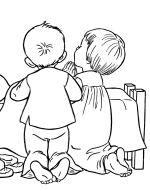
     My parents were not very observant, and although they always belonged to a temple my father expressed consistent distrust of organized religion. Even so, they taught me to pray. Or Mom did, anyway.

She helped me memorize that childhood classic: “Now I lay me down to sleep/I pray the Lord my soul to keep/If I should die before I wake” … WHAT?! Die? Huh?

Those words were a little disturbing. Those thoughts were not sweet at bedtime. I didn’t want to think about dying as I crawled into bed in my pajamas.

I understand child brains are magical until about the age of 8. I see now why it was cruel to bring death and soul-taking into the bedtime conversation when I was very young.

Maybe that’s why I composed my own prayer. I was 10 by the time I did it, and I can’t recall reciting it after I wrote it. In fact, I didn’t recall writing it until I found it recently, in a tattered folder at the bottom of my footlocker.

It ain’t great, but it was my alternative to the prayer I was taught, and I hope it helped cure me of twisted syntax and affectation in my verse.

My Bedtime Prayer

Thank you God for my family,
Thank you for our health.
Thank you that we’re greedy not,
And spend wisely all our small wealth.

Thank you that in Peace we live,
That blood we do not shed.
Thank you for our clothing,
Our shelter, and our daily bread.
-Amen

Posted in Kidspeak, Poetry | Leave a comment

Gauss

  I’m not sure how old I was when I heard the anecdote about Carl Friedrich Gauss, but he was in primary school when the event occurred, and I recall admiring his cleverness and feeling a little humbled, so I must have been older when I heard about him than he had been when he solved.

But that’s the difference between a math prodigy and the kind of bright child I was. I got him, but I wasn’t him.

It was probably around 1787. The story was that he misbehaved and his teacher tried to put him in his place by having him add all the integers from 1 to 100. Gauss replied with “5050” in a matter of seconds. The way I understood it, he saw the problem like a number line in the air. One was at the left end and 100 at the right end, and 50 was right smack in the middle. He immediately envisioned connecting the 1 to the 99 and the 2 to the 98 and the 3 to the 97, and so on. It was obvious that he would acquire 49 hundreds that way, and that the line would still have, unused, that 100 at the end and that 50 in the middle. Thus: 5050.

I love this story because it so sweetly demonstrates how the way you view a problem can lead to an elegant or cumbersome solution. So I looked it up before writing it up.

The first link was to wikipedia. I went there. And not only found the anecdote but even the teacher’s name (J.G. Büttner). I was surprised, however, to read this: “Gauss’s presumed method was to realize that pairwise addition of terms from opposite ends of the list yielded identical intermediate sums: 1 + 100 = 101, 2 + 99 = 101, 3 + 98 = 101, and so on, for a total sum of 50 x 101 = 5050.”

Now the reference goes on to say details of the story are not certain, and clearly we’re not seeing clearly into Gauss’s brain, and multiplying by 101 does lead more easily to the general formula for the sum of an arithmetic sequence, but what do you think?

Do you imagine young Carl Friedrich Gauss added hundreds and then adjusted, or collected 101’s and then multiplied?

Posted in Lessons, School | Leave a comment

Perspective

   Today is traditional tax day. They’ve provided a little extension this year, as if tax returns were term papers, but April 15 is a time when it’s natural to contemplate our system.

Usually I’m not negative. But sometimes I sink a little low. Sometimes my attitude is not optimistic. Sometimes I just think we’re toast.

That’s when I also suspect this isn’t news. I don’t think we’ve degenerated; it’s just that the consequences are catching up with us. It’s always been a matter of spans; economic and historical cycles are different than human lifetimes, so it’s hard to see cause and effect with clarity.

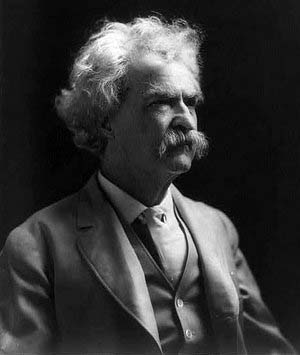
I’ve been browsing through the autobiography of Mark Twain. He is usually upbeat but can be otherwise. I was struck recently by some words he penned on March 30, 1906. Almost exactly 105 years ago:

The prior engagement which I spoke of to Tchaykoffsky was an engagement to act as Chairman of the first meeting of the Association which was formed five months ago in the interest of the adult blind. Joseph H. Choate and I had a very good time there, and I came away with the conviction that that excellent enterprise is going to flourish, and will bear abundant fruit. It will do for the adult blind what Congress and the several legislatures do so faithfully and with such enthusiasm for our lawless railway corporations, our rotten beef trusts, our vast robber dens of insurance magnates; in a word, for each and all of our multimillionaires and their industries – protect them, take watchful care of them, preserve them from harm like a Providence, and secure their prosperity, and increase it.

Gad: add big Pharma and the words could have been written today. Reading them reminded me of a poem I called “Attack from Without, Corruption from Within.” Usually the sonnets I post went through long periods of revision, but this one was jotted in a day and never altered. The day happened to be September 11, 2001:

I saw a man with radiation burns
who speaking from his gurney was as doomed
as Texas guilt, as certain as returns
the night. He looked and spoke like he assumed
a future, but I understood within
he was a dead man – very mortified:
a fire victim lacks sufficient skin
but he was sear-diminished from inside.

Rambunctious we are similarly charred –
we’re blasted inside out by circuitry
in tight array, a micron for a yard.
Apparently alive, our destiny
is certain death within tomorrow’s reach:
as nasty as a center-rotten peach.

Posted in Lessons, Poetry | Leave a comment

Bad Idea

     When I was around 14, I was in like with a girl named Jill. I admired her name, her thick cooperative dark blonde hair, the faint freckles on her face, her athletic medium-sized body. I liked her woodsy home and her casual parents. I enjoyed her conversation. If I’d been oriented toward my own gender I have no doubt my admiration would have grown to a crush. As it was, I recall a few enjoyable times with her, and zero about sex.

Jill’s family had an ice cream maker. It was an old-fashioned machine, the type you had to pack rock salt around and crank, and it produced divine vanilla ice cream. I’m so for chocolate that I suspect friends who favor vanilla might be secret aliens, but that ice cream would convince anyone that the elegant simplicity of vanilla cannot be surpassed.

Even so … one day Jill and I decided to try to improve upon perfection. We attempted lemon ice cream in the most face-forward and foolish manner. We figured we’d just layer the two items: ice cream, lemon juice, ice cream, lemon juice.

Maybe it’s easier to understand when I remind you that our houses were developed in lemon groves. We were surrounded by the trees. We climbed them and we made forts in them and we sucked so many lemons our teeth sometimes ached. Straight lemon juice didn’t put us off.

Even so. To this day I recall the profound clash of creamy vanilla ice cream surrounded by unadulterated fresh lemon juice. Worse on the tongue than fingernails down a blackboard.

Posted in Food, Lessons | Leave a comment