Tenants

I was away from the Berkeley cottage for seven days a couple of weeks ago, and it appears there was a change in tenancy during my absence. Relocation is appropriate at this time of year in a college town.

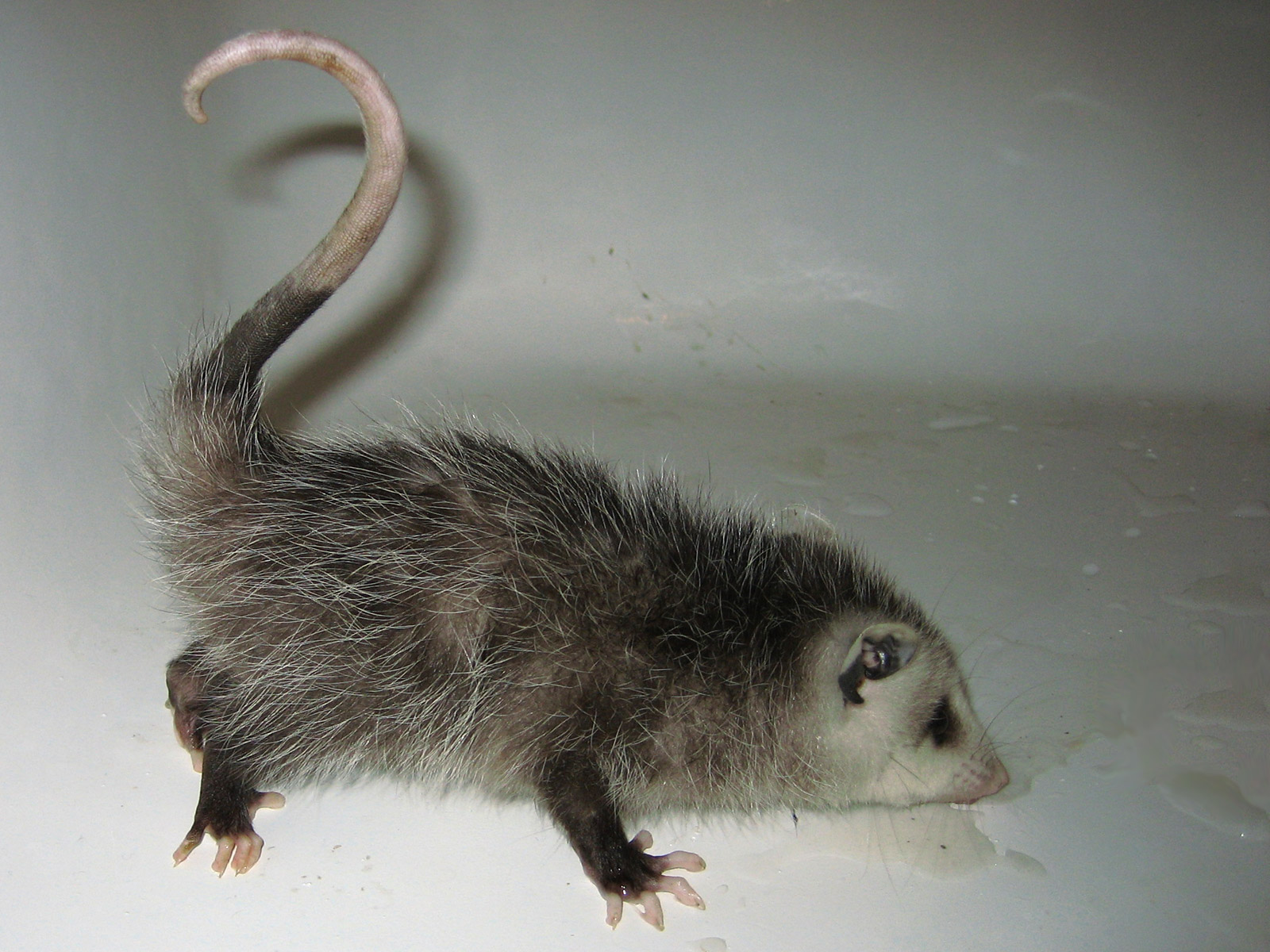
The skunks are no longer apparent. Now I have a family of opossum. They were particularly present on Monday, June 20, right after my return. I heard yard sounds that morning that were heavier than birds and slower than squirrels. I looked outside and saw the white-faced low-slung marsupial, tail extended and butt poochy, ambling across the deck. A few minutes later I saw another. They seemed healthy but disoriented, out too late on a warm dawn, leading each other first to one end of my office and then near the gate, past the water heater closet, back again.

Then I saw the young’n! About a quarter the size of the adults, cuter but not cute enough to my eyes, hunting in that Mr. Magoo manner for its folks. I didn’t consider then how tiny it must have been at birth, or how unlikely it was to be an only child.

A minute later one of the adults walked into my cottage. Uh oh. We both knew it was a mistake, but any attempt I’d make to herd the animal was sure to drive him or her further into the room and into confusion. Oh well: better than a skunk and easier than a bird. I opened the second door so the exit was six feet wide, retreated to my office, and waited for the animal to waddle out.

I haven’t seen the skunks since my return. I think they have either sublet their den to the marsupials or been evicted by them.

And I think the opossums were having offspring issues that day. Maybe it was something about the slow child, the one who wouldn’t leave. I haven’t seen as much or many of them since.

(My recent splashes into opossum research have awakened an awareness about the pouch. Next time you find a dead possum you’re supposed to check for one. It it’s wiggling, there are babies within, and they’ll die unless you act. Wear gloves.)

Posted in Critters | Leave a comment

Tether

9.8.08
I was editing a post recently, and I replaced the word “leash” with “tether.” The act made me conscious about the words in a way I’d never experienced.

Offhand the difference is about direction. Both items are leads and both are commonly made of leather or web-strong strapping. But a leash is for guiding its object along a path from point to point, and a tether sends its subject into a circle with a radius as long as the tether is. A leash usually has a person at one end: a tether not so much (until recently, when electronic devices started sporting tethers instead of carrying straps).

My dictionary says leash comes from the Late Latin laxa (a loose cord) from Latin laxus (loose).

For tether’s origin we have to go back to an Old High German word. The zeotar was the pole of a wagon. I’m guessing domesticated animals were tied to it. Zeotar appears to be cognate with a N. German/Middle Dutch word for cattle: tüder. And that’s clearly close to the Old Norse word tjöðr or tjöthr or tiothr, all of which are just a vowel away from our tether.

Tether means a rope or chain by which an animal is fastened so it can range only within a set radius. Its secondary meaning is the limit of one’s strength or resources. We say we’re at the end of our tether when we can’t take any more. Or we say we’re at the end of our rope but we mean tether; don’t we see our path of stressed effort describing a ragged circle?

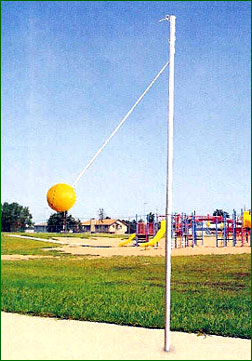
 (When I was a kid every playground included at least one tetherball pole. We didn’t know the rules but we respected the simplicity and power of the equipment. Now that I look around I see none. Tetherballs are available, the Internet shows me, but young kids don’t appear to be experiencing them. Is this absence about safety? Andy remembers a freak tetherball accident from middle school, when a boy broke his neck (and died) after the tetherball he whacked came around the pole and slammed his own skull. I can’t recall a helmet requirement – the game seems to have quietly disappeared from kid sports.)

Posted in Language | Leave a comment

Condiments


They say variety’s a lively spice,
but I think there are hotter condiments.
A stress of any kind makes me feel twice
as much as difference does.
And for immense enlivening,
anxiety’s the seed
more mustardy,
the pepper
without pod,
the bark more bold
than cinnamon,
the weed abrupt as dill
but sharper and more odd.

Anxiety evokes the sourest sweat.
The most obnoxious headache’s born of stress.
The two are symbiotes,
and so upset the stomach that it makes the mind a mess.
They’re like infatuation.
They insist so forcefully
I’m struck where I exist.

Posted in Poetry | Leave a comment

Desserts

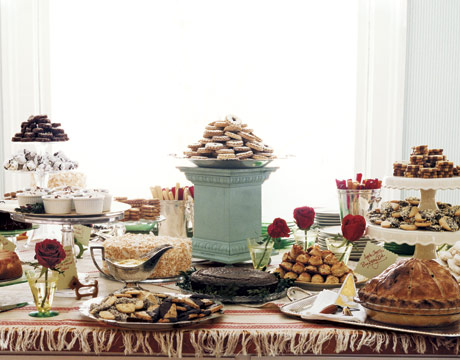
     I had an amazing dessert recently, which reminded me of two other memorable sweet courses. I was struck by the quality they all shared – absence of chocolate – and that got me wondering.

I adore chocolate. Seldom does a day pass without some: usually dark, bittersweet, and embedded with nuts. So how can my three best desserts not contain my favorite ingredient?

The first best dessert was an apple pancake, prepared tableside at Luchow’s restaurant in New York. I was around 20. I shared it with my Aunt Shirley, a beautiful full-figured woman who liked food, and she shocked me when she put her cheek next to mine, chewing the sour/sweet cinnamony confection, and described the experience as “an alimentary orgasm.”

The second time I ate a best dessert I was in my early 50s and visiting Santa Fe, New Mexico. It was a little place called Café San Estevan. The menu read “goat milk flan,” and I shared an order with Charles. Well it was absolutely perfect. Like the Platonic form of flan, it was precisely what flan is meant to be. Charles and I had to fork-etch a line across its top to keep each of us on our own side.

The third time I enjoyed a best dessert was just a few months ago, near my 61st birthday. There’s a mediocre restaurant at the San Francisco Ferry Building called the Market Bar, and they make a goat cheese tart there. It’s the best cheesecake I’ve ever had or imagined.

As I type I see an answer forming. It’s not true that the best desserts had no chocolate, any more than it’s true that 67% of best desserts contain goat dairy. Rather, it’s that I’ve been blessed with an abundance of great chocolate dishes. So many that no one or two or three stand above all others. I need a smaller realm from which to pick favorites.

Posted in Food, Lessons | Leave a comment

The Job

  “I’m not a-skeered o’ you,” I declare to my offspring, even though she’s now almost 418 months old and he’s nearly 349.

Talk about whistling in the dark – they terrify me. My children are passionate, capable of expressing strong emotions including coldness and disapproval. When either gets that way I cringe inside. I wince and an edge of my heart sloughs off for a bit, leaving jagged awareness of vulnerability. “I’m not a-skeered o’ you,” I repeat, and it starts to be true. I’ve gotten used to the terror and can encapsulate it.

It appears I’m not alone. I once read of an exiting Berkeley High principal, who observed that our society cherishes its young but fears its teenagers. Really, she asserted, these kids are mostly doing what you’d want them to do, and better.

Maybe the condition was taught by our parents – I remember how crazed they became in the early 1960s. We got good at ignoring them, didn’t we? And then we made all those promises to our own babies, which were impossible to keep but which act as barbs now to trigger our guilt, which then creates hesitancy?

Parental love, I remember hearing once, is the only kind which, if properly executed, leads to separation. That’s it, you know. You have to keep the object in mind. Continue releasing the tether, but with eyes open and arms ready to pull back. Breathe through the fear. Get used to the disdain.

It’s a job and it’s important. It’s okay to forget yourself at times, but not the objective.

I had to question everything I’d seen
or heard about the way to parent well.
Instead I read my memory to glean
the elements of truth I told and tell.

I disagree with those who advocate
enriching kids with lessons after school,
distracting them from boredom, toting weight
for them, implying fairness is a rule.

What kids deserve are truth and empathy,
for they’re enduring challenges momentous,
difficult and strange: each has to be
(for 20 years) a human being apprentice.

The fact is if you want the best results,
instead of rearing children, raise adults.

Posted in Lessons, Poetry | Leave a comment

Urban Trails


I fell on the sidewalk two months ago. I was walking to BART on a warm day, and I tripped on some uneven pavement.

I went down hard. I smashed my knee and tore some muscle or worse near my ribs. Six weeks later I was still feeling the injuries.

It’s not that I’m particularly clumsy, and I have pretty good balance. It’s about exposure. I walk for transportation, so I have more chances to fall than most people I know. And nine times out of ten, my stumble results in an awkward running dance of recovery, and I don’t hit the pavement. Of course that means when I do hit, I hit from a running dance instead of a walk; the impact is considerable.

I refuse to let the fall intimidate me. I will not be one of those older folks who so fears a fall that she won’t venture. But I want to learn from this.

Okay: I wasn’t wearing walking shoes. My feet don’t like confinement; I had them in sensible sandals. And I have to admit the sandals contributed to the accident. They have arch support and walking soles, but they are open in front. The toe freedom also means that the front sole of the sandal can start to turn under my foot when it runs into a ledge of uneven concrete. Which is how I fell.

I think I get it. I’ve been deluded by the concrete. It has led me to assume there’s something safer about sidewalk than about a hiking trail. I understand now that I have to approach sidewalk like any other trail experience. I have to pay attention to the terrain and to my footwear.

Wait a minute: wasn’t there regular advice from my parents, about sensible shoes? Sometimes it takes a few decades to get it …

Posted in Health, Lessons | 2 Comments

Carrot

9.8.08
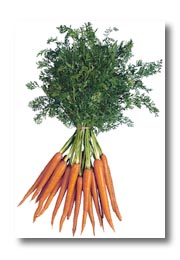
Let me tell you about carrots. I had no idea they were going to feature so prominently in my life.

Danny loves them. I think he has always wanted at least a pound a day, and he has often achieved his quota. He likes them big and raw and unpeeled; when he was young he ignored the orthodontist’s advice – he ate big carrots and he bent several retainers.

He’s a good choker, like most in the family. He never gagged on a carrot bit. I read recently that the roots give up a lot more of their nutrients when mashed, pulped, or cooked, so I hope he’s taking the time to chew them well.

Danny’s skin is congenitally olive but environmentally orange. He has the sharpest night vision of any grownup I know.

I spent a little reference time on the vegetable recently. At first I saw no connection between carrot and karat, but eventually I understood Bugs Bunny’s wisdom. I gathered a few facts along the way.

Daucus carota is the horticultural name, and the plant was native to Europe and southwestern Asia. It appears to have come out of what’s now Iran and Afghanistan, and became part of our diet around the 8th century.

We eat the taproot, although carrot was first grown for its leaves and seeds, like its relatives parsley, fennel, dill and cumin. The plant is in the celery family. It’s a biennial, and it tries to grow the big taproot to support its second year flower, but we take it for food

If left to flower, the white blossoms attract pest-consuming wasps. There’s evidence that carrots will increase tomato yield if the two plants are intercropped.

Sauteed with onions and celery, carrots form classic mirepoix, which is a good basis for any broth, soup or stew.

Like potatoes, carrots got a bad rap from the glycemic index, but there are problems with the glycemic index, and maybe that’s a subject for a future post.

As for word origin, we get carrot from the French carotte from the Latin carota from the Greek karōton (καρότον), all of which seem to have come from the Indo-European root ker (horn). At first the word karat (carat) looks unrelated – from the Arabic qirat, which came to mean the weight of four grains – but that turns out to have descended from the Greek keration (fruit of the locust tree) which also came from ker.

The word for carrot in Spanish is zanahoria. I like its sound. Obviously it’s not ker. It’s from Andalusian Arabic (saffunnárya).

Posted in Food, Language | Leave a comment

Retirement Savings

     Don’t shoot me if I sound insensitive. I know many of us are living off savings or otherwise struggling to get by. But my job is about retirement plans for small businesses, so I interact regularly with people who have jobs and savings accounts.

What I’ve learned: yes, of course, save money. But plan to spend it while you live. I talk to too many who have accumulated decades of hard work and thrift, and now they are hesitant to spend their money. Their thrift habits are too ingrained. They are almost paralyzed, financially. I recommend for them financial flexibility classes.

Because if they persist in their ways, they do their kids a disservice too. They sap their children of the drive to earn.

Didactic sonnets are the least attractive type, but here’s a recent attempt to summarize what I mean:

I meet a lot of people who are rich
as much from when they lived
as how they worked and saved.
It’s just as if they rode a stitch in time;
they made some hay while trouble lurked –
the nation had 200 years when will
could conquer and when diligence could win,
but we’re exhausted now and we’ve a bill
we cannot pay for all we wasted then.

I witness folks endeavoring to hold
their wealth
and pass it to their kids untaxed,
for that’s the plan that’s sensible to do.
I say they’re incorrect –
they should be bold enough to spend;
it’s time that they relaxed,
and let their children sweat and triumph too.

Posted in Lessons, Money Stuff, Poetry | 2 Comments

Symbiosis

  Sometimes I compose a science sonnet. In my opinion the form is not limited to love poems or landscape descriptions. I like the rules of containment that sonnets carry: how the limits make me drill into the subject and enter its essence.

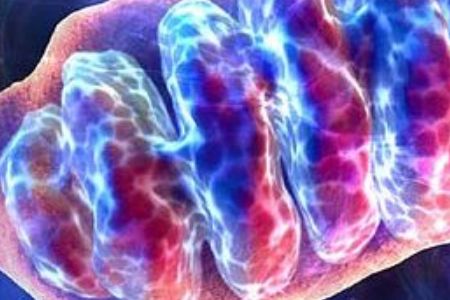
I started “Symbiosis” in 2004, shortly after exposure to the subject of mitochondrial DNA and the suggestion that it isn’t inherently “human.”

I polished it in 2008 and saw it published online, in a literary e-pub called cyclamens and swords (still alive and a nice place to visit).

From mitochondria, inside of us,
the scientists can postulate our mom.
It’s Eve in Africa they talk of, plus
they mined analysis and found a bomb:
The mitochondria within each cell?
They’re really other creatures than are we.
We co-exist and co-evolve; we tell
each other back and forth redundantly
the way to live.

I lodge that symbiote,
and wonder what the number may comprise
including dreamers,
or the spark that wrote this poem,
or solving only using eyes.
I lately seem a colony at large,
and though I can’t control, I’m yet in charge.

Posted in Lessons, Poetry | Leave a comment

Oatmeal

  Maybe it really does stick to my ribs. They say oatmeal fills you up and keeps you going all morning. I’ve never been a breakfast eater – I simply don’t feel hunger till I’ve been up for a few hours – but as I get wiser I understand that sometimes food isn’t a treat so much as it is medicine, or fuel, and I have to ingest it even if I don’t desire it. So I’ve been forcing a small breakfast in, and I have observed that oatmeal lasts longer than yogurt or cold cereal.

But what impels me to type these words isn’t the nutritive properties of the porridge. Eight weeks ago I fell down, hard, on the sidewalk. I walk for transportation, so I have many opportunities to trip on uneven pavement. Usually I do the stumble-and-recover dance, and don’t smash my body on the concrete, but accidents will happen. This time I whacked my right knee and pancaked the nerves between the skin and patella. It’s like stroking a stranger’s knee. I have full movement and no pain, but it will probably be a year before I regain feeling.

In addition to the knee impact, I suffered the side wrench. I felt something give in my left rib area and about two days later it revealed itself as a bad pain. It hurt to breathe deeply. I couldn’t sleep on my left side. I even saw the doctor about it; he thinks I tore muscle.

I’m getting better. But while in the ow-y phase I discovered that the act of ingesting oatmeal produced immediate relief in my side. It was as if the cereal went straight to the wound and applied itself as a poultice. Ahhh!

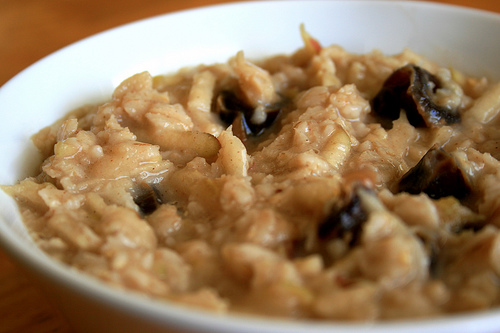
It’s easy to make great oatmeal. If you don’t cook it, you won’t create lumps or gooeyness. Use regular rolled oats (quick oats are too flimsy and steel cut are too hard). Boil a cup of water per serving. When the water is hot, add half as much rolled oats as water, stir, cover, and turn off the heat. Walk away for 15 minutes. The steeping oatmeal will absorb the water and plump into nutty, lump-free consistency. It’s true that it won’t be very hot at the end of the 15 minutes, but that’s when I add raisins and brown sugar and buzz the brew with heat while stirring. The raisins plump, the sugar melts, and the oatmeal warms.

I pour my breakfast into a bowl and add a splash of milk. I throw in a spoonful of chopped nuts if I have any around. Seriously yum.

Posted in Food, Health, Lessons | Leave a comment