Fair Market Value


“The only place the word fair appears in the Internal Revenue Code,” Al intoned, is “immediately before the phrase market value.”

Al has since retired, but I’ll never forget his words. He was responding to some complaint I voiced about an audit result. I’ve quoted him several times to grumpy clients and made every one of them smile and alter perspective.

We’re required, in the retirement plan recordkeeping world, to report assets each year at fair market value. That’s easy with stocks and bonds and mutual funds, but it isn’t so neat with limited partnerships and other investments that aren’t readily traded.

The folks who wrote the Internal Revenue Code also gave us a nice way to assess market value: it’s the price at which a reasonably sophisticated seller, under no compulsion to sell, would part with the item to a reasonably sophisticated buyer, under no compulsion to buy.

Sweet, huh? I think if you put two people and the asset in a room together, it will take about 30 seconds for them to agree on fair market value.

Aristotle said man is a political animal. I think he got part of the truth. I say man is a commercial animal. We invented the marketplace; we created written language for it; we are made for it.

Linguists argue that we have evolved with a predisposition for language, and it’s not hard to get how that has helped us survive. It’s equally not hard to see how being born with innate commercial sense is a survival advantage too.

There are several senses besides the famous five. Like sense of balance and sense of place. I submit we have a valuation sense: a sense of fairness, if you please.


Posted in Lessons, Money Stuff | Leave a comment

Eeps

9.8.08
Recently I got into “eep” words. It started with keep, and moved on to creep, sweep, weep, peep, and steep.

They all come from Middle English words which developed from Old English. Most of the Middle English words rhymed too – kepen, crepen, swepen, wepen – but peep and steep were exceptions. Peep comes from ME pepe, and the adjective steep was steap in olden days. But steep as a verb comes from stepen, so I guess you can describe cold tea as stept.

Back to keep. What a diverse word. How quickly it looks alien.

As a verb with an object, keep means to hold or retain in one’s possession.

As a verb without an object, it means to continue, in an action, course, position, state.

As a noun, it can mean support (earn one’s keep), or the innermost part of a medieval castle, or even a specific game with marbles (Keeps).

Kepen (Old English cēpan) meant to observe, heed, watch, await. It was probably related to an older word that meant to look or stare. Like many words from Old English, it’s strong, solid, basic and bold. I think keep should be kept.

Posted in Language | Leave a comment

Characters

It’s been said before and today it’s my turn. When you create fictional characters, they’re likely to make decisions and proceed in directions you didn’t anticipate when you started them. It isn’t that they act perversely – rather, you didn’t get far enough into them, before working with them, to consider their ramifications. They are like actual children. They demand their own consistency.

In love with characters that I conceive
to populate my fiction,
I’m amazed they use their own extremities,
believe in their own fantasies,
become as crazed by circumstance
as any valued friend.
They cannot contradict themselves with grace.
They’re always as consistent in pretend
as in the flesh,
in moment as in place.

I dreamed the creatures,
just as I was dreamed.
I made them out of rampant energy.
Converting immaterial
I screened it for evocatives.
In time I see the characters,
but space they don’t engage
beyond the thin dimensions of a page.

Posted in Lessons, Poetry, Writing | Leave a comment

Snubbin’ Cousins


If you go back just a few generations in anybody’s family, the tree widens. Folks tended to have more babies last century, and even if fewer (percentage-wise) survived to adulthood, enough made it that everyone had cousins, and many came from blended, adoptive, or fostering clans.

If you poke around in the histories, you find plenty of opportunities for argument, from disagreement to disowning. And maybe this is an evolutionary thing, but you find less examples of forgiveness than of feuds.

My father’s father, for example, was one of four children. According to what I remember my mother saying, only two of them spoke to each other as adults. My grandfather then married a champion grudge-holder and they spawned five kids who were readily indignant (at best) and not above shunning one another when things got sticky.

Even now, among my first cousins on Dad’s side, J doesn’t really talk to her brother S, and SJ stopped speaking to P over a missed bar mitzvah invitation. That’s kind of funny, given how little P ever cared about religious rituals or about SJ. But it’s not that weird – SJ stopped speaking to our other cousin A decades ago, right before A left the area and the family himself.

Dad moved away from his family too, which may be how I lucked into growing up on the forgiving side of the brood. Like my parents, I would never go to the awkwardness or trouble of not speaking to someone; that would be harder on me than on whomever I wanted to punish. And I don’t know whose idea it was, but my parents taught us never to go to bed mad. For me it was connected to that “now I lay me down to sleep” idea – what if I never woke up? What if I didn’t have a chance to make it right?

The thing about people is we’re the only species that says goodbye. We’re the only ones apparently aware that we might not get another chance. That’s why it makes sense to forgive what’s necessary as you go along. No clogs. No regrets. No elephants.

Posted in Lessons | Leave a comment

Reveille


I started this sonnet in 1998, saw it published in the online zine Cyclamens & Swords last August, and have just dallied with edits and played with line breaks, for here. I don’t know what breed of bird it was, but I’ll never forget that morning serenade.

I heard a bird whose song was like a bell
of silver,
like a ringing glockenspiel,
like water falling on itself.
I tell of it for beauty’s sake,
again to feel that lightness in my ears.
The creature sang,
it seemed to me,
of liberty and spring.
Upon a wire overhead
he rang the world awake.
He took in every thing.

Ingenious people,
we reduce our view with our inventions,
while the days are tolled by birds.
Our windshields frame our sight;
our thoughts are bound in plasma screens.
The pixels skew and limit us.
The tempered glass is cold.
A song explodes the strictures we have wrought.

Posted in Lessons, Poetry | Leave a comment

The Truth about the Tortoise and the Hare


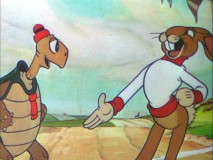
It’s a great fable and it made a cute cartoon. But is it honest? We all get it: that to win the race one should stay focused and avoid cockiness. But under what circumstances, really, would the tortoise win?

Clearly this was a life race. There’s no way such dissimilar creatures would make a casual wager. But I don’t care how much you distract the bunny – he will win.

The fact is, and I can sense a heretical future post a-borning, that we select the cottontail, that we value the speed over the steadiness, every time.

I tried to come up with a likelier odd couple of contestants: terrier vs hound; minnow vs dolphin. Better, but still not close enough. Kitten vs cat does it, though. Or puppy vs dog. The mammalian young have the vigor to win, but are too easily distracted.

Of course this now suggests that, evolutionarily, we’re still distractable puppies. Which may not be false. The question is: will the species survive to maturity?

Posted in Lessons, Question | Leave a comment

Blasphemers and Heretics

9.8.08
Well it just goes to show you. A few weeks ago I thought it might be fun to look up blaspheme. And before I did that I knew I’d also have to check out heretic. But I expected blaspheme to be the more interesting of the two words.

I couldn’t have been more wrong.

They both come from the Greek language. I’ll admit I studied it at Cal 40 years ago, and I still have my lexicon.

Blaspheme comes from blasphēmein, (to speak evil of) and means especially to revile, curse or abuse sacred subjects. The blas part comes either from βλάζ (slack, stupid) or βλάπτω (distracted) and the pheme comes from φήμη (voice, fame).

Ho hum.

Heretic, on the other hand, is one who engages in heresy, which comes from the Greek hairesis (a taking, selection, school) which is a form of the verb hairein (to take). Heresy is a doctrine or opinion at variance with established or generally received views. Heretic (αἱρετικός) means one who is able to choose.

See? It’s rude to be a blasphemer. It may be desirable to be a heretic.

Posted in Language | Leave a comment

Multitasking

One day two years ago, Lisa asked why we think it’s good to multitask, and her question stopped me cold. I couldn’t come up with a good answer.

I’ve given the subject more thought since, and I am boggled at how proud I used to be of my ability to handle two phone lines while thumbing through a file and smoking a cigarette. I think I boasted a few times about those evenings when I helped with homework while preparing dinner, conversing with spouse, and planning my to-do list for the next day.

I have concluded that multitasking is a gauntlet reserved for young adults. They’re stuck with it. They have kids, several jobs, little money to hire help. It’s a good thing they have stamina too.

Multitasking is not a skill. It is a necessary evil. It is a habit that should be discarded as soon as it is no longer required.

But it’s a hard one to lose. There are endorphins that feed it – I can feel them – and make it one of the more addictive conditions we impose on ourselves. I’ve been attempting lately to listen to my voicemail messages without simultaneously checking email or mousing around the Internet. I’ve been trying, at home and at work, to do one thing at a time.

It’s a project.

Attempting not to multitask,
I aimed my effort at one venture till complete.
I focused then in order –
having named a job I jumped on it with willing feet.
I tried to keep both heels upon the floor.
I fought the tendency to cross my legs
and notice while I worked that there was more
to do;
my basket could take added eggs.

I have to concentrate to concentrate.
This project is a marathon for me.
Impatience is my trait –
I hate to wait –
I look ahead and work impulsively
but now I have to hesitate and ask:
remind me why it’s good to multitask?

Posted in Poetry | Leave a comment

The BART Effect


They don’t give out full information, but I just happened to ride the escalator with the responding emergency personnel, so I knew it was one septuagenarian who took our BART train out of service.

“It’s her hip,” the station agent explained to the fireman who rode two steps above me. “She twisted it or something.”

“Where is she?”

“Still on the train. They’re holding at the platform.”

After I passed through the station gate I heard the fireman on his communication device behind me. He was using the verb broken about the passenger’s hip, though he hadn’t seen her yet.

I entered the middle of a standing nine-car train, and passed through most of it toward the back. Passengers appeared resigned or exasperated – clearly they’d been holding for awhile.

Shortly after I took a seat, the driver announced that the train was going out of service. He didn’t say why. He told us a San Francisco train would arrive on the opposite platform. He repeated the message until we’d all exited and filled the space between the tracks.

In the five minutes we waited I heard folks around me conjecturing and then concluding that the train had mechanical problems. “Not so,” I thought, but I kept it to myself. “It was the power of one woman’s twisted hip.”

As reality would have it, the incident had its effects on some. Of the 800 passengers riding that train that day, that hip twisted the lives of three.

One guy was late for a job interview. He was 23 years old, his name was Felix, and the call he made to report his situation and excuse his tardiness made him stand out enough that he got a design job he would otherwise have missed.

A 38 year-old Certified Financial Planner had a life-changing moment as a result of the train delay. If she’d been on time Gail would have made it to her office long before the transformer blew. It was another PG&E maintenance oversight, and the rocketing manhole cover missed her by a matter of inches. To say it shook her is an understatement. She quit her job that day, and went into partnership with her best friend Annie to open their restaurant.

And one pair of true lovers failed to meet. If the train hadn’t been interrupted, Gary would have stepped off the Embarcadero escalator just in time to collide with Laura. Each would have stuttered an apology while continuing to dance together in that way that lets neither proceed. They would have laughed self-consciously and Gary would have managed then to stammer out an invitation to coffee, and one thing would have led delightfully to another.

Too bad. They wouldn’t have had their fifth date at Gail’s restaurant, designed by Felix, but this would have been a better story.

Posted in Fiction | Leave a comment

Indelible


I knew a man once who had a couple of sons, and he loved them with all his heart. But he viewed his boys as the sort of noble savages folks say Rousseau described – he figured that, left to their own devices, his sons would naturally choose the best food, friends, and bedtimes for themselves. He asserted that school was mostly damaging and guidance about living wasn’t needed. His job as a father was to love love love.

I exited the friendship before the sad result. I could see something bad coming, but I had to admit that I was completely incapable of achieving any change. I let the relationship end. I’m sorry to report that one of the sons didn’t survive his early adolescent adventuring.

I’ve written about those years before and I’ll probably publish some about them in the future, but for now I’ll just print the sonnet I started in 1997:

The image is unchallenged teens at theft,
their resin-coated fingers in a can
of currency, their eyes conspiring left
and right as they betray an addled man.
An argument for arson tumbles past
that silhouettes emphatic truancy.
The attitudes are frozen in a cast
of kids without a script or fluency.

There’s no one home to guide the children now.
They wake in rigid leather and they limp
through wasted days. Nobody tells them how
to lay their chains aside. Their emblems crimp
their futures and their anthem blocks their song,
but no one’s there to show them right from wrong.

Posted in Poetry | Leave a comment