Awful Us

A month ago I was alone for a bit with my two brothers, and it didn’t take long for us to start joking inappropriately. I don’t know whether it’s called black humor or just weird, but we have been known to laugh hard at ideas offensive to others.

We were in Steve’s truck, waiting while Becky bought coffee. The date was September 11, 2011. The tenth anniversary of the attack on America. You remember: the media was full of the subject, and there were a few of us willing to admit we were tired of it.

I think I get credit for the idea. I blurted from the back seat: “Hey. How about if we build an amusement park at Ground Zero? We can start with a zip line over the area …”

Steve and Andy jumped in. Immediately the truck filled with ideas for costume rental, heroic posterboards with face holes cut out for souvenir photos, ash-ball, and more. Terrible. Horrible. But we laughed till we cried.

It reminded me of the time the kids and I tried to come up with relevant Olympic games. This may have been in 1996, or perhaps ‘92. Someone commented about how dated many of the sports were. Who knew a discus thrower? How many fans were there, really, for Greco-Roman wrestling? We decided to make suggestions.

Our best idea, simple and elegant, was for a game of classic tug-o-war. The competition would be between teams from countries who are currently disagreeing about something, and the pit would be filled with the grossest, slimiest mess of mud and muck we could configure.

From there we elaborated. We came up with ideas for competitions in panhandling, drug dealing, gang building and carjacking.

Danny added a special area where any kind of performance-enhancing (or other) drug would be allowed. Why not? Choosing the right drugs is also a modern skill.


Posted in Uncategorized | Leave a comment

Puzzle Words

9.8.08
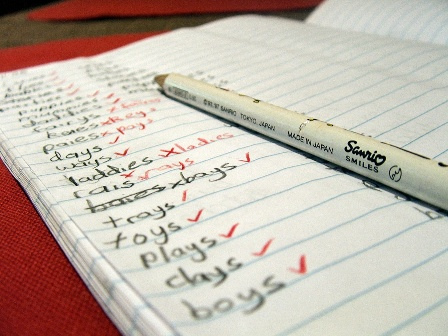
I like word puzzles. From an early age I enjoyed crosswords and codes, in college I began unscrambling letters and solving acrostics and diagramless varieties, and I have engaged, chronically I see, at backwards reading and mirror writing. I have developed a facility for recognizing odd or recurring combinations of letters.

Three words I want to appreciate today are idea, that, and people. There are many others (like always and enemy, every and understand), but I have a word limit.

Idea is not the only four-letter word that starts with i and ends with a (iota), but it’s the one you’ll find most often in quotes. In fact, it’s the most commonly occurring a-ending four letter word I’ve encountered.

That starts and ends with the same letter and is similar to the. So it’s often the key to a quote in substitution code. Look for it.

And people? People talk about people all the time. The word crops up in many puzzles. See its p and e recurrence? That’s rare (similar to George).

The word idea came to us from Greek via Latin. It originally meant “a form, the appearance of a thing as opposed to its reality,” and it’s from the verb idein (to see).

People seems to have acquired its spelling while in Middle English and Old French mouths (peple, puple, pople, pueple). It was Latin populus and my old dictionary asserts it began as the Latin plebs (commonfolk) and the Greek polys (many).

Posted in Language | Leave a comment

Pedestrian Path

I used to turn the corner to my street
with dread reluctance mounting in my heart,
preparing for the tensions I would meet
within my own front door. That stress was part
of every evening when I lived with him
I chose to let select me for his wife;
his willful neediness, erotic whim,
and emptiness had colonized my life.

I didn’t know then what I do today:
if I had walked another hundred feet
instead of turning left, I’d see the way
pedestrians can reach another street
through perfect quiet beauty. That’s how near
enchantment lay, beyond distress and fear.

Posted in Poetry | Leave a comment

Crazy Corks and Wedding Wings


We’re terrible. We have no sense of decorum. These are some of the sentences my family has laid upon itself.

Of course those are hyperbolic. We’re not that bad. We are not malicious and we do not vandalize. But we can appreciate funny when we see it, and we might not be able to control our laughter.

Looking back, we were particularly feisty at weddings. All rituals seemed alien to us, but at weddings Mom was happy, the occasion was joyous, and tolerance was broader.

Dad was our ringleader. Mom never seemed to think things were as humorous as he did. She was more likely to grimace, hush us, or pretend she was actually seated with others.

The first riotous wedding memory I’ll describe was when my cousin S married T. It was around 1970, summertime in Burbank, in my aunt’s back yard. I remember her house was directly below a flight path to the airport; the occasion was overwhelmed at regular intervals by low-flying planes on landing approach.

The ceremony took place toward the rear of the small yard. There were rows of folding chairs facing the fence, and tables laid with food and champagne were set near the house. On the way to our seats Dad decided to be helpful. He untwisted the wires around each champagne cork, so the bubbly would be easily available after the ceremony. Even now I believe his intention was pure.

It was a hot day and the vows went longer than we expected. Shortly before the bride and groom became husband and wife, the champagne started popping. Bottle after bottle released its cork straight into the air. As loud as gunshots.

But the best was yet to come. Several years later a different cousin S married E. This was in San Francisco. The rabbi had a speech impediment. I’m not making this up; the man spoke like Elmer Fudd. He referred to himself as the “wabbi” and to the young couple as “bwide” and “bwidegwoom.” My father and brothers and I exchanged smiles, began to snicker silently, showed eyes shining with tears of suppressed laughter.

We did okay at first. We were pulling it off. Then the wabbi suggested that the couple exchange wedding wings. Starting with Andy and cascading upward with age, we lost it.

Posted in Uncategorized | Leave a comment

Extension

This week I’m putting up two poems from 17 years ago, from time with the kids. In case you don’t know them or the story, both of my children were a challenge to raise. Each of them spent too much time in principals’ offices, on suspension, under behavior contracts, in recommended or required therapy. I think they were similarly recalcitrant and delinquent, but the school authorities took Danny more seriously. As far as we could perceive, that was simple sexism.

This sonnet commemorates the year of what we called his evolution.

The other night, she asked her little one,
who’s near as tall as she at twelve years old,
“So now that you’ve become the perfect son,
what shall we work upon?” And then she told
the therapist as much, so all agreed
to meeting less, and with a happy sigh
she thought “My job is done – there isn’t need
for more from me – it’s okay if I die.”

That perfect son last night put off his math
to watch a show and play, and facing it
with little time, he leaked a bit of wrath,
responded to her helping with a fit,
and finally he called his mom a jerk.
He showed her they’re not done. She still has work.

Posted in Poetry | Leave a comment

Indignitis

There’s a strong strain of indignation in my family. Most of us are quite comfortable proclaiming outraged disapproval, sardonic or stern, about conditions we encounter. If one were speaking negatively, the term “rager” could be used. We’re not physically abusive, but as Danny said, words can hurt if they come from people who are supposed to love you.

Katie invented the term “complainatory” to describe that volcanic critical feeling that so loves to be voiced. Some of us only notice the lawn when it needs mowing, or the other drivers when they screw up.

I’ll confess I’m not without a tendency to righteous indignation myself.

But lately, as I get old enough to talk like this, I’m seeing conditions more generously. Sure I notice the stupid drivers, of course I witness the pedestrians who are paying attention only to their handheld electronic devices but, given how unbrilliant most people are, I’m struck with amazement that we don’t collide more often.

Recently I’ve started to consider how unwise it is to let the indignation grow. I think you want to avoid inflammation. Nobody wants indignitis. Gentle satire or caustic wit is fine and maybe admirable, but you don’t want to make your indignation gland swell.

Because un(at)tended, indignitis can lead to an indignoma. And we don’t have a cure for that.

Posted in Lessons | 2 Comments

Pronunciation

9.8.08
I remember my surprise about that word. I was probably in 7th grade, and it made no sense to me. We say “pronounce.” Why not “pronounciation?” It was a mystery similar to how a flute was played by a flautist instead of a flutist.

I started to get it after awhile. I began to understand how a word could change its internal vowels by shifting to another part of speech and acquiring a prefix or suffix. I started learning Spanish and flauta became flute. But some pronunciations continue to surprise me.

Chief among those is “desultory.” I’ve read widely. I’ve seen that word a lot. I’ve known that it means passing from one thing to another in random, disconnected, unmethodical manner, but I never heard the it pronounced until recently. In my head, it was always “des-UL-tor-y.” Not so. The accent is on the first syllable: DES-ul-tor-y. That changes how the “s” sounds.

(By the way, the word comes from the Latin desultorius or desultor, both of which refer to the circus performer who leapt from one horse to another).

Pronunciations can change. When I was in college I once said “secretive” with the accent on the first syllable and a professor corrected me. “You mean ‘se-CRE-tive’” he said. That almost made me laugh. It sounded like something oozing out of my pores instead of a concealment. But I thanked him, proceeded to the library, and looked it up. He was absolutely right. Ten years later, when I bought a big home dictionary, I checked again. Se-CRE-tive was preferred but was followed by “often SE-cre-tive.” If you consult online dictionaries today, you’ll see that the word now carries that first-syllable stress.

Posted in Language | Leave a comment

Homework

I was browsing through old poems recently, and came across two written 17 years ago but in the same week, about life with my kids. I was 44 at the time. Katie had just turned 18 and Danny was 12. Richard was the fourth around the table.

We wrote collective poetry last night.
For Katie’s class in writing verse, we made
iambic phrases into lines of tight
schematic rhyme. We wrapped around and played
with what we found upon the table top
(the sauce and salsa, threads to tickle lips
or, twisted, tease the dog who wouldn’t stop
at tug-of-war for ice cream or for chips).

We built a silly sonnet. Everyone
selected common phrases as our theme,
and for an hour took a type of fun
that leads to laughter, learning and esteem
for language, woven, chosen word by word,
that fortifies our love of the absurd.

Posted in Poetry, Writing | Leave a comment

How Could You

Most of what I write about my father is positive. Mostly I admired and agreed with him. But there were a few areas in which our attitudes did not jibe.

Dad had ideas about appropriateness that I never got. He taught me when I was 13, for example, that rock and roll didn’t deserve stereo. This was back in 1963, when monaural systems were more prevalent and cheaper than the new stereo equipment.

It was okay, according to my father, to pay stereo prices for classical works and even for musicals (provided I bought the album with the original Broadway cast), but it wasn’t worth the extra money, it didn’t make acoustical difference, if I was going to play the Beach Boys.

And then there came a time, much later, when Dad castigated me for putting Perrier in Couvoisier. “That’s sacrilege!” he scoffed. “It’s criminal to dilute good cognac with soda. If you want to mix, use cheap brandy.”

Huh? But it doesn’t taste as good with cheap brandy. I can afford the ingredients. Why would I opt for the less good?

Dad wasn’t alone with this sort of attitude. I remember when my friend Charles told me in no uncertain terms that one always drank red wine with pasta, regardless of sauce (bull: dry white is excellent with all pasta. Dry white is even good with coffee and dessert). Or when our guide Nello, dining with us in San Gimignano, instructed me that in Italy one never puts cheese on tomato (pizza margherita?). Or recently, on “Chopped,” hearing one of the judges assert that it’s irresponsible to serve cheese with fish (it depends on the cheese and the fish, but I’ve enjoyed the pairing, in tacos, on tostadas, with pasta. And then there’s cream cheese and lox).

It strikes me as I type, that all these advisors were male. I can’t recall an occasion when a woman warned me not to mix tastes or to use specific equipment. Mom gave me a few fashion “don’ts,” like not pairing stripes with dots, or black with brown, not wearing white before Memorial Day or after Labor Day, but those rules all died quietly, along with the mandate for a lady to don a hat and gloves in the city.

Posted in Question | Leave a comment

Momentum

They say it takes six weeks to make a new habit. I think there’s truth in that, but not complete truth.

In fact, it takes three days to set a new course of behavior. It takes six weeks to make it routine enough that you begin to have confidence it will be a keeper. It takes a year to lock it in.

The first three days are crucial. The first day you’re geared up for the challenge, self-discipline armed and ready to work. It turns out to be easier than you thought it would be. So you enter the second day a bit cockily, and of course it proceeds to be more difficult. By the third morning you’ve leveled, you’re at work with two days of progress behind you: you have entered the zone.

Like raindrops running down a window pane
to make a puddle on the lowest sill,
like yarn that’s raveled in a curly chain
to form a knotless cloth against the chill,
like beads pulled one by one upon a string,
together building jewelry out of spheres,
like minutes massing into months, that bring
us spinning through the incidental years,
so I need triple days to form a trend.
The first a point, the next a line implies.
It takes a third to make the series bend
and give direction where intention lies.
I therefore name today the glad director
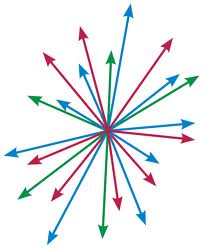
that indicates my three days form a vector.

Posted in Lessons, Poetry | Leave a comment