Profiling

Eugene’s Mahlon Sweet Field is one of the nicest airports I’ve ever used. It’s like Oakland’s in the 70s: small and friendly and easy to understand. I spend time there nowadays, and I collect little experiences.

In mid-October I was there, with descendants, to pick up our ancestor (Mom). We endured a cascade of mishaps: dead battery, flat tire, all with a van full of barefoot unjacketed kids (we thought it would be a quick pickup). We came away from the adventure laughing, grateful to Dave and his gear-packed tow truck, proud of ourselves for staying calm, and thoroughly amazed about the individual who helped us charge the battery before we discovered the tire.

It was a she. She wasn’t young and she arrived in one of those motorized ride-on chairs. Most of our car assumed she was an older disabled traveler who just happened to steer her chair too close to our van.

We were delighted when we realized how wrong our assumptions were. She wasn’t disabled. She was aiming for us. And she knew exactly what to do with a dead vehicle battery.

A week later I was back at Mahlon Sweet and this time my people-watching expectations were satisfied. I was at gate A4 awaiting my little plane to SFO and I took a seat opposite a man about my age. He was white-bearded, sparse-haired, big-bellied, dressed in casual western clothes and accompanied by a backpack and a jacket. He looked like an aging hippie.

A few minutes later he started chatting. He told me this was his first flight in 12 years. I had to observe: airport security sure has changed in that time. Yes, he agreed, and he went on to share: he just discovered he left his glasses at home, so he wasn’t going to be able to read on the flight; he was going from SFO to Chicago and then on to South Bend, to see the daughter he hasn’t been with for 12 years; he wasn’t sure how he was going to handle the layover and security in SFO, but he was determined to have a cigarette (his chronic cough made that no news); and he’d just hurt his back, preparing for this trip.

I answered his questions and listened to his complaints and then it was time to board. He struggled to his feet and began hobbling toward the jetway. He was bent forward at the waist and obviously injured.

“Wow,” I observed, “that looks painful. I guess you need eyeglasses and narcotics.”

“I don’t take pills,” he asserted.

I was pleased to discover that his seat was about as far from mine as possible in the small plane. I didn’t want to hear that story.

Posted in Uncategorized | Leave a comment

Avalon

9.8.08
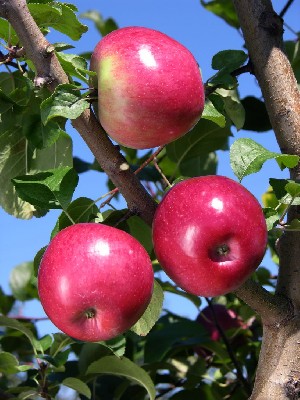
I wondered awhile ago about the word “apple.” I looked it up recently and I have a few comments.

It’s as fundamental and basic as we all suspect. The word means itself and may figure in every significant culture. Or maybe not.

Apple means “fruit” or “apple” and by extension just about anything round. The word was appel or aple in Middle English, æppel or æppl or æapl in Anglo-Saxon and Old English, and probably something like ab(e)l in Proto-Indo-European.

It’s a pomaceous fruit (from the Latin pome for fruit or – guess what? – apple) and the plant is in the rose family. It may have been the earliest cultivated tree.

It originated in Western Asia. The first hybrids were developed in eastern Turkey. Somewhere near Eden.

Because apple can mean any kind of fruit and just about any fruit can be called an apple, we don’t know if the golden apples of Greek myth were onions and we don’t know if the forbidden fruit of the Bible was a pomegranate. We’re probably wisest assuming something like a Platonic form of fruit.

(And I want the Edenic tree to be more majestic than an apple: a giant sequoia perhaps, or at least an oak.)

Apples aren’t as good for you as other fruits. They’re relatively low in Vitamin C (although they have a nice level of other antioxidant compounds). They’re a good source of fiber if you eat them unpeeled, but you can find better. One of their advantages is durability; apples last awhile. And everyone knows how an apple’s flavor transforms when it is heated. That’s one of the basic miracles of cooking, like what happens to onions, or to flour-and-water.

Now that I’m spending more time in Oregon, I’m occasionally in apple culture. I learned recently, from an old grower, that you should always refrigerate apples. Not only will the cold preserve them, but they taste better chilled.

The Old Welsh for the fruit was aballon. Insula Avallonis is Latin for Apple Tree Island.

Posted in Food, Language | Leave a comment

Dragonfly

I am attracted to the dancing rhythm of alternating 7-beat lines with 5s. Sometimes I indulge that attraction. I started this one when I was 43, recollecting 20 years ago then.

I remember Feather River camping in July.
Creek and river meeting in the heat.
Privacy together. Love uncovered to the sky.
Manzanita, maple and mesquite.

The only thing unfortunate about those precious days
of sun and solitaire and sex and drugs,
was how at dawn and sunset – even through the midday blaze –
we had to share our paradise with bugs.

But if I took a sun-warmed seat along the river’s side,
upon a jutting rock that edged the beach,
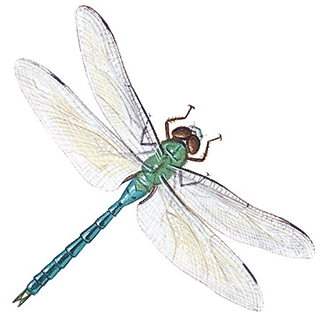
the dragonfly patrolled the water with its sweeping glide
and swallowed every insect in its reach.

A stick of iridescence on a wing too fast to see
eliminated all that bothered me.

Posted in Poetry | 2 Comments

Entropy

If I’m ever going to be bilingual, and it’s a semi-goal, my second language will be Spanish. I spent formative years in Chula Vista, where my exposure was so consistent that I could read it at an elementary level, and I even dreamt in it a few times. I bought the Rosetta Stone program some years ago, and I’m lightly reviewing it now.

Recently I scanned a lesson that had pictures showing the correct and incorrect ways to do things. There were scenes depicting people trying to cook with repair tools, study in trees, sweep with the broom upside down. I noticed something that’s true in all languages but only obvious when learning one. There was one correct way and a lot of incorrect ways. The definite article is used when the picture is right and the indefinite article when the activity is wrong.

Yes, of course: the correct manner; an incorrect manner. I never noticed that before.

In fact, as elegant as the simple exaggeration is – one right way and an infinite number of wrong ways – the truth is more like this: there are a few correct ways of addressing an issue and a remarkable number of incorrect ways.

Now that’s obvious. And when I think about it, I realize that, given the greater number of ways for something to not be right, it’s just a matter of time before wrong swamps right. The probability of incorrectness is so much higher it just needs time to demonstrate.

There aren’t many ways to shape damp sand so it makes a castle, compared to all the ways the same sand can be lumped together without plan and design. The correct way has low entropy; an incorrect way has high entropy. It’s obvious why entropy always tends to increase.

In fact, viewed this way, at first it seems a miracle that anything is correct. How is it that we can all walk and feed ourselves and build? Until I step back and consider how far and widely selection has proceeded. How many incorrect ways it explored, and killed, to get us here.

Posted in Lessons | Leave a comment

Construction

I made a little cottage out of straw
and then I raised an edifice of sticks.
They each accommodated natural law,
and nothing stood until I built of bricks.
For straw is fodder for the beastly cud,
and sticks are food for fire’s appetite,
but what can eat a brick? It’s clay or mud
that can’t be used unless it’s fired right.

Adobe is the stuff of my abode
and mortar is the manner of its size,
for they’ll together bear the biggest load,
and I have learned to look without my eyes
at structures made of visionary tricks,
so I construct my innerness of bricks.

Posted in Poetry | Leave a comment

The Key to the Kingdom

Once upon a time there was a kind and prosperous king, whose only child was a daughter. The king had a queen who doesn’t figure into the story very much, except that she lived long enough never to saddle her daughter with a stepmother, and she only had the one child (this was before we understood the male contribution to fertility problems).

Anyway, by the time Princess Agatha was 20 and without a sibling, the king knew she was his only heir.

The princess was lovely, and she was as good as she was beautiful. She had no lack of suitors. But she failed to fall in love with any of them. She agreed with her father that she wasn’t getting any younger, that she’d want children, that she could use a partner when she had to step up and sit on the throne. She told the king she would accept the man he chose for her.

That was a puzzle for the good monarch. There was a country to govern and a woman to please. He devised a challenge.

He told the suitors that he would award the hand of his daughter and the inheritance of the kingdom to the guy who could accurately summarize Agatha. In her father’s opinion, there wasn’t a pigeonhole that could contain her; he challenged the callers to try.

The king ignored any who tried gross generalizations like female, or white. He disdained the superficial; suitors who suggested Capricorn or liberal or green were shown the door. He was a bit more tolerant with some who suggested agnostic, domestic, thrifty, honest. And he was impressed enough to meet twice with the three who tried combinations: Anglo-environmentalist; a 5 with Scorpio rising; Introverted/Intuitive/Thinking/Perceptive. But he couldn’t see marrying Agatha to any of them.

It was a year and a day after the search began when Amos arrived. He’d traveled a long way, motivated by the story he’d heard about the beautiful rich princess, but delayed by weather and circumstances. He spent so much time en route that he collected some wisdom. When Amos writes his memoirs he’ll tell the stories about the kind scorpion he encountered when he lost his way, the raging gazelle with the anger management problem he counseled, the thrill-seeking opossum’s stories and that one indolent but resourceful beaver. They were all sweet experiences and they taught Amos the ways of the world. So when he met with Agatha’s father he found it simple to speak.

“I look forward to getting to know your daughter,” he said to the king. “But I can tell even without meeting her that she can’t be labeled. Because no one can. No categories are accurate enough to be worth perpetuating. Pigeonholes serve no purpose for people, except maybe to manipulate them. And that’s not how I want to spend my time.”

I’ll bet you can guess what happened next. That king recognized a good son-in-law when he met one, and he took the necessary steps to unite Amos with Agatha.

What you can’t guess is what transpired after the wedding. Oh, the young couple lived happily ever after all right, but they didn’t keep the kingdom. They turned their efforts to the establishment of an orphanage and school (K through college) and eventually left the country to govern itself.

Posted in Fiction, Lessons | 2 Comments

Sleep Scenes

9.8.08
I wondered while walking, a few weeks ago, about the origins of our words dream and nightmare.

It appears that dream is one of those elemental words, that means itself. You know: the succession of images that pass through your mind as you sleep. Or something like that. Dream means dream, whether spoken today, in Middle English dreem, as Old English drēam, Old Norse draumr, even Old High German troum.

You’d think the word for a bad one would be as elemental, and actually it is. What we call a nightmare was originally just a mare (12th century), or in the several Old tongues: a mera, mara, mære. All of those mean incubus. The Proto Indo European was mora, probably from a base “mer,” meaning to rub away, harm, seize.

You can certainly have a daydream while awake, but unmodified the word suggests sleep in the dark. I wonder why we chose, as our language evolved, to say nightmare instead of just mare, yet never to say nightdream.

Posted in Language | Leave a comment

Evolution Valley

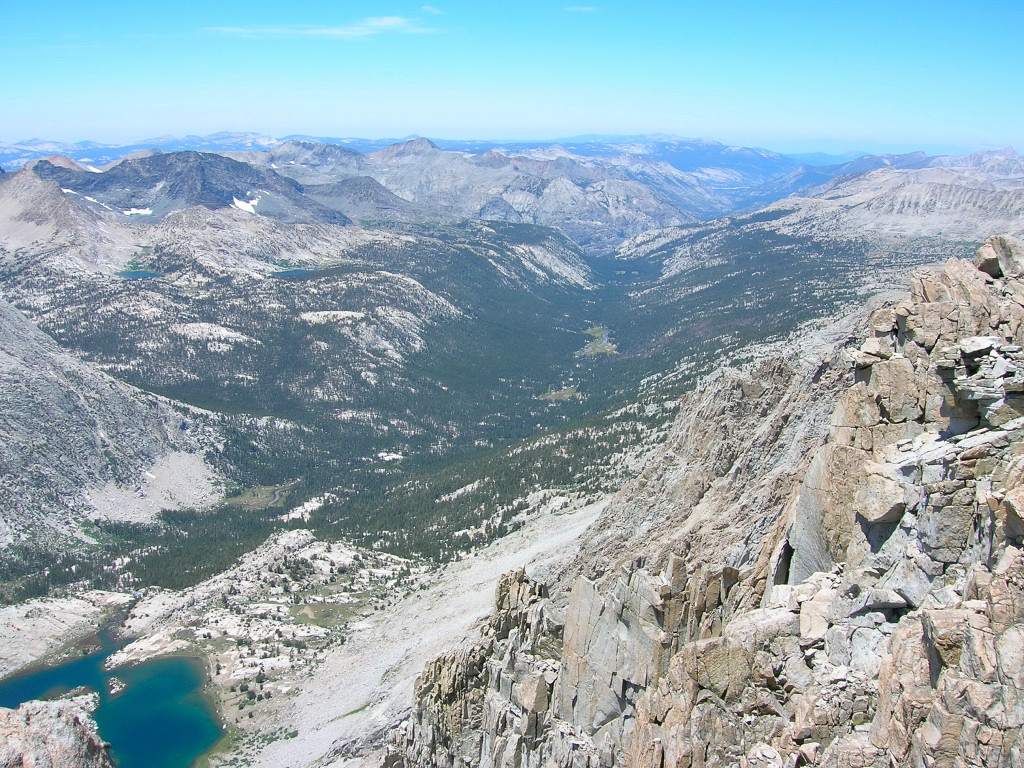
I’m sitting in a valley in the sun,
indulging heels that brought me to this place
where folks are few and media are none,
and all around the planet shows its face
to me, with patterned walls of rock and snow
and evergreens that arrow to the sky.
The snowmelt feeds the creeks to overflow
and feeds my ears with water’s rushing sigh,
while pink and purple flowers sprout from stone,
and yellow blooms with grasses from the ground.
I sit in wild beauty all alone
while somewhere else a billion lives abound.
But here the news is I arose before
the light of dawn could sweep the valley floor.

Posted in Poetry | Leave a comment

Wondering

They say whatever doesn’t kill you makes you stronger. They say bad news often works out to be the best thing that could have happened to you. They’re often right.

I suspect I was born fierce and skeptical, but maybe I acquired those qualities through infant experience. Whichever: I’ve been these ways as far back as I can remember. Attempts were made by relatives and teachers and even me to eliminate or at least modulate these characteristics, mostly without success. I tried to tone it down, I attempted to hide the light under a bushel or whatever the expression is, but that always turned out to be boring. I found the unleashed operation of my mind to be quite entertaining and I didn’t want the show to stop. When given the choice to conform or go to my room, I opted for the room. I still do.

So I didn’t have role models. The women around me didn’t act like me, and I didn’t want to be like them. The men were quite accepting of me but I couldn’t be one. And after a compelling conversation with my comp lit professor, in 1969, I stopped writing like one.

It was a chore, raising me by myself, but the work got done. And ever since, when I’m confronted with a problem, I try to understand it and solve it. I don’t look for how it was handled before. Oh, I’ll check out history once I have an initial perspective, but I like to view the issue all by myself, in my literal or virtual room, before I consult resources.

I’ve noticed that’s not what most people do. What I usually see is that look around the table, followed by: “Well, what have other organizations (or people) done?” Men especially seem to view everything as previously solved, and look for the mentor. I’ve known so many bright guys whose quests seem to be, in truth, the search of an acolyte for the expert from whom he can learn. That’s been the deal-killer for me, in a number of romances.

I don’t want to single out men. I’ve observed too many examples of a smart capable woman subordinating her opinion, will, attention, and time to her boyfriend or husband. Good grief: as it is written, the man attends to the higher power and the woman attends to the man, and I watch the connections and wonder, wonder, wonder.

Posted in Question | Leave a comment

Subsonics

This poem describes why I used to go camping. Nowadays my urges for quiet privacy are satisfied by spending time in my one-room cottage.

Can’t you sense pathetic undertones
whenever you associate with men?
And can’t you hear the women’s hidden groans
and screaming whispers? There: they sound again,
like hisses from within the heart of earth,
disruptions as the mantle strains and tears.
I’d like to think them signs of growth or birth
but no one in this clamor grows or bears.

The city is a storm of furtive voice
within an urgent hurricane of need.
Whoever hears must listen – we’ve no choice –
to each and every screaming whisper plead
for our attention, seek an inner ear,
until we’re driven far away from here.

Posted in Poetry | Leave a comment