B & W

doom

Damp, the heavy air depresses trees
and pushes on my shoulders as I stride.
Each molecule seems large enough to squeeze
it like a sponge, with fingers modified
to make of morning fog a syrup pool,
to juggle water traveling in air.
Today is normal overcast and cool,
and water is suspended everywhere.

The bay and train and sky are steely gray,
and leaves are cloaked in grayish overtone.
If water should be blue, then we today
are living an old movie. Monochrome
our setting is, our camera black and white,
but for July and here the tones are right.

Posted in Poetry, Weather | 2 Comments

Love Letter to a Cottage

Atrium at 7 PM July 4

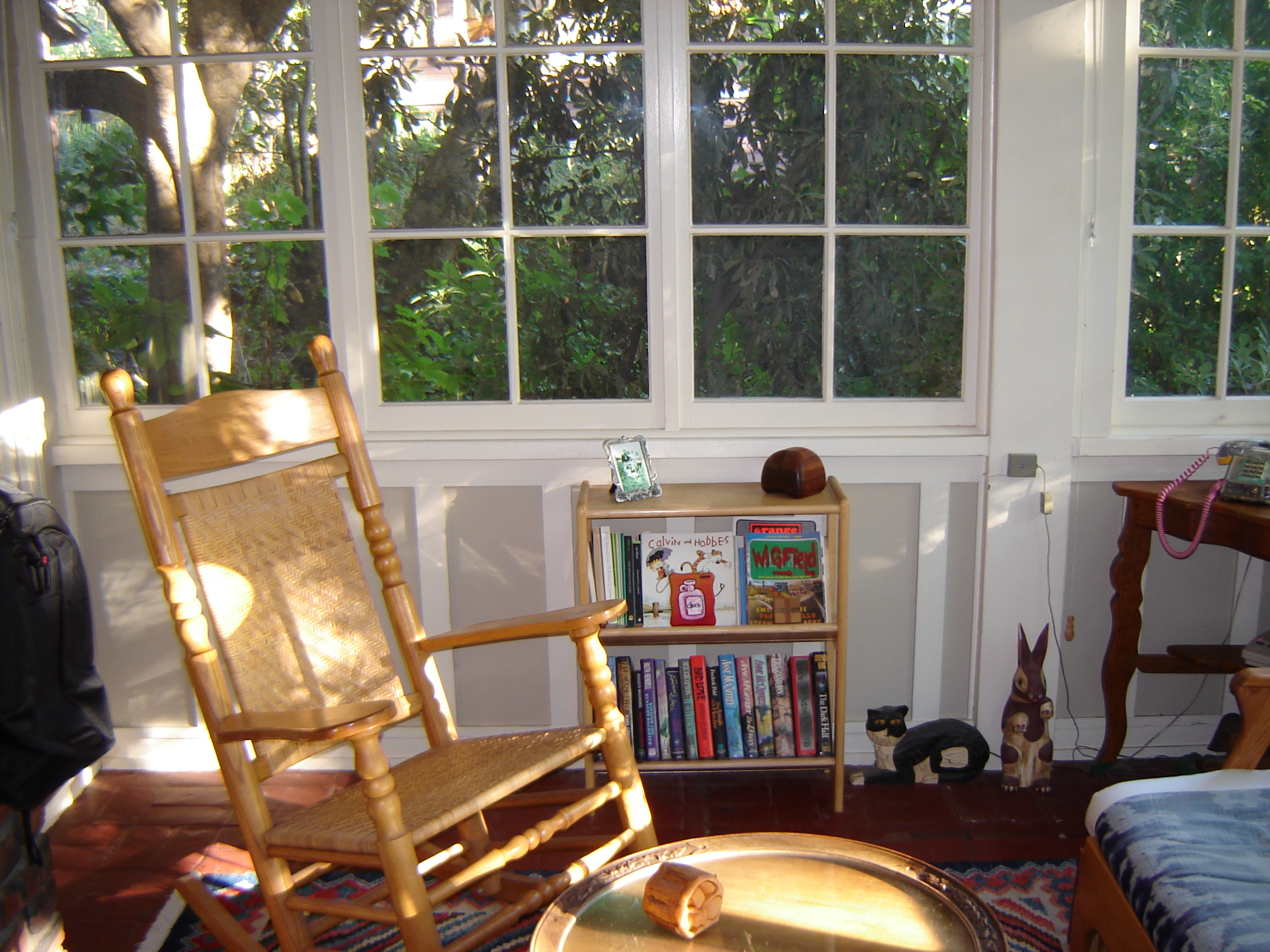
I dwell inside a draftsman’s wooded dream.
A spirit-cradling cottage shelters me
that hunkers in the elbow of a stream
that serenades its shaded property.

A year and some ago, when first I found
the house and walked into its grained embrace,
when I beheld its depth of fertile ground,
I felt that I was home. I’d gained a place
that knew me like it waited patiently
asleep for me to find or rediscover
security. Now I could let it be
my friend, protector, confidant and lover.

Perhaps I lived here in another life,
but if the place were male I’d be its wife.

Posted in Poetry | Leave a comment

Kurt ‘n Pete (Part 3 of 3)

School_Building_21611_7[1]

There was quite a brouhaha about that swastika. It was 1960 then, not that long after the war to end all wars. Eve’s parents came to school and impressed everyone with their directness and civility. That made Rita pay a little more attention to Eve.

“She really is bright,” Rita reported to Joan. “She’s been having these headaches and they make her obnoxious. But I had her vision tested yesterday, and she’s getting glasses now. The headaches should go away. I don’t know, Joanie,” Rita conjectured, “but I think that girl will grow into a fine person. Interesting, anyway. Unlike the others.”

“The others in class?”

“No, just the other three. Isolating them has worked for the rest of the class. But Betty Sue and Kurt and Pete? I tell you: I look at their faces and I can imagine them roughening into adulthood and then sagging into age. I can do that. And I can imagine someone analyzing their childhoods at the ends of their lives, turn it around and look from here at the adults they’ll likely be…

“Betty Sue won’t get far from where she is now. Kurt will probably go into sales and be some kind of corrupt, and I imagine Pete will lead your standard life of quiet desperation.”

Rita didn’t manage to forecast the fights.

There were no incidents of note between the swastika graffiti and early spring. Then Betty Sue had occasion to “call out’ first Kurt and then Eve.

Heard on the playground: “Betty Sue’s a re-tard” and “I’m rubber – you’re glue – whatever you say bounces off me and sticks to you” and “Make me” and “I don’t make babies; I hurt ‘em.”

Reported to Rita by some of her good students: Betty Sue called Kurt out. They met (with their seconds: Patty for her and Pete for him) in the field between school and the community center. Betty Sue provoked Kurt into throwing the first punch but she won. Smaller than Kurt, she was more athletic than he, and she was angrier.

Reported later, by Eve-with-her-parents: Betty Sue called Eve out and Eve tried to ignore her. She didn’t react to the taunting words during school hours, and she started for home with her neighbor Cindy right after the last bell. Betty Sue and Patty caught up with them in the middle of the fighting field. The taunting began again. Eve tried to keep walking. Betty Sue got in her way and snarled in her face. Cindy just stood there. Other kids arrived and formed a loose sympathetic circle, but no one intervened. Betty Sue continued to provoke, with Patty providing unnecessary encouragement. Still Eve wouldn’t fight. Finally Betty Sue exorcized her hostility by defacing Eve’s white cotton blouse. With a number two pencil, she wrote every bad word or phrase she knew on the blouse yoke and back. Eve endured the inscription in silence. She tried to be dignified. She wondered why no one helped her. When she got home and her mother hugged her out of her wrecked blouse, they both saw that the pressure of the pencil had made small lacerations on her shoulders and upper back.

Betty Sue got suspended for three days. She had to apologize to Eve. Eve got shamed by the fight. She had to work her way through that. Rita got to reckon with the fact that she needed to change jobs. She wasn’t doing these kids any good as a teacher any more.

She made some thoughtful forecasts to Joanie at the end of that year. They had already decided that between Rita’s savings and Joan’s earnings she could afford to go back to school in psychology. So what if she was sixty-three: she came from longevity…

She predicted that Kurt would have an okay life. She figured he’d always have an asshole childhood but he’d likely end up a hospitable, semi-educated man. She predicted a boring future for Pete; he didn’t have the oomph needed to even begin to live up to potential. She knew Eve would grow into her brilliance and be a formidable successful personality. She assumed Betty Sue would continue her family legacy of poverty and sloth. She expected she herself would be a satisfied therapist; that’s why she made the big change.

As it turned out, she was wrong about herself and Betty Sue. Rita made it through the program and got the license, but she found her new career disappointing. It was even more repetitious than teaching, and promoted more pessimism.

Betty Sue blew everyone away by making it to and through college (sociology) on a financial-need scholarship, and then through law school on a scholastic one. She was a litigator for a mere six years before starting on what has been a meteoric political career.

Even Kurt ‘n Pete vote for her.

Posted in Fiction | Leave a comment

Kurt ‘n Pete (Part 2 of 3)

School_Building_21611_7[1]

Rita was terribly tired by the end of that first day. Kurt had already balked at everything she assigned, arguing with her or rocking but not doing, while Pete slouched in his seat and watched. Betty Sue’s presence hadn’t inhibited them, and she in turn seemed to be picking some sort of feud with Eve Hoffman, the dark quiet girl who sat in front of her.

“I’m not sure I”m going to make it this year…” Rita said as she entered her house. She expected to find Joan in the living room but the couch was unoccupied. “Joanie? Where are you?”

“I’ll be out in a minute.” Rita heard water running in the bathroom sink.

“You’re not at it again, are you?” Silence. “Joanie; don’t. If you keep shaving your arms the hair will just grow back thicker.”

Joan Selman and Rita McDaniels had known each other for twenty years, taught in the same school for fifteen, lived together for ten. Rita was a decade older, but at their ages that made no difference. They knew each other well. Joan knew that Rita would never stop advising her, and Rita knew that Joan would rarely heed the advice.

“At this point,” Joan said as she walked into the living room while rubbing lotion into her forearms, “the damage has been done. I’ve been shaving for thirty years; if it really does make thicker stubble I guess I’m already enjoying the effect. Want wine?”

“Sure…” Rita expelled the word with a tired sigh as she sat heavily into the couch. “And how was your day?” Joan taught fifth grade, a gentler year than sixth. She previewed many of Rita’s students for her each term.

Joan carried two glasses of red wine to the couch. “Not bad, actually. I may just have a good class this time. So far all sweethearts. Not like last year.” She sipped her wine, set her glass on the big coffee table, and relaxed against the high back of their antique sofa. Rita noticed tiny red bumps of inflammation on Joan’s pale arms.

“Apparently it’s my turn this year. I got Kurt ‘n Pete.”

“No!” Joan sat up strongly. “We have three sixth grade classes. Those two have got to be separated. I complained over and over to Skiles last year…”

“Well the Miller and Lefkowicz families must have complained louder.” Rita’s eyes met Joan’s in agreement about their opinion of Vice Principal Lorna Skiles. “I talked to her at lunch. The two families believe their underachievers will do best together.”

“I’m sorry, Rita.”

“It’s okay. I’ll get through it. I always have, haven’t I?” She smiled for a moment. “Anyway, I’ve also got Betty Sue Stuben, and I put her between the boys. That should make for something.”

It did. As the days shortened through September and October, Kurt rocked and mocked, Pete slouched and smirked, and Betty Sue got irked and harder. Eve began to speak up in class, which surprised Rita. She knew the girl was bright; the school had just skipped her from fourth grade to sixth, and Rita couldn’t remember that happening before. That skip also meant Joan had no advance knowledge about Eve, who appeared shy at first, so Rita was amazed to watch the child blossom and humiliate herself. Eve appeared to be an unbridled egotist, smart and talking smarter, blowing hard about being one of the “chosen people” in a school with few Jews, irritating everyone but mostly those nearest her seat. Hostilities grew between Eve and Betty Sue, Eve and Kurt ‘n Pete, Betty Sue and Kurt ‘n Pete, the four of them and the rest of the class.

For Halloween Betty Sue climbed onto her roof and managed to egg Kurt ‘n Pete. The boys in turn sniped with Kurt’s BB gun from his bedroom window; Pete aimed and hit Eve in the upper thigh but she was far enough away that it didn’t do more than sting. Just before Chanukah a swastika was painted on Eve’s driveway. That really upset her parents, and the perpetrator was never found, but Eve always knew it wasn’t true anti-Semitism and it was Kurt ‘n Pete.

Posted in Fiction | Leave a comment

Kurt ‘n Pete (Part 1 of 3)

School_Building_21611_7[1]

Kurt Miller and Peter Lefkowicz were two among thirty in their sixth grade classroom. They were the bad apples in Miss McDaniels’s thirty-sixth year of elementary school teaching; frankly, she didn’t have the patience any more.

Kurt was kind of ugly and naturally insolent. He wore a habitual smirk, he spoke out (loudly) without ever raising his hand, and when he wasn’t speaking he rocked in his desk chair, pushing forward and snapping back in the small space. Autistic children rock like that, and Rita McDaniels knew it, but Kurt wasn’t autistic. He was too mean to be autistic.

Kurt was fat, freckled, and clumsy. His brown hair was chopped off in a careless home style. He bit his nails.

Pete was rather good looking. Dark-haired and fair-skinned with fine features. His eyebrows would bush out and meet over his nose by the time he was in high school, his features would sharpen, his posture would bend and his hair would grow coarse, but in sixth grade he was handsome. He had a facial expression that looked cutely confused then, but it would mature into a look which was usually sardonic and sometimes mean.

They were only two out of thirty, but Rita McDaniels knew that they’d require attention out of all proportion. They were brighter than average, neither working to potential of course, so there they sat, rocked, laughed, and siphoned far too much of her away from twenty-eight others.

“I’m too old for this,” she thought that first day of the school year. “No,” she amended as she set her bag on the teacher desk, “it’s not that I’m too old; it’s just that I’ve done this for too long.”

She was sixty-two then, and more of an observing psychologist than a teacher. She could run through the sixth-grade curriculum on automatic. Her teaching for the last decade or so had not been inspirational to her students or herself; what popularity she still had came from her reputation. The parents of some of her current students had been in her classes twenty-five years ago; they remembered the dictionary quizzes and current events contests that Rita no longer had the energy to run.

She didn’t get satisfaction out of teaching any more, but she enjoyed forecasting. A long time ago Rita noticed that when she looked at the childhood photograph of an adult she knew, she could see the face of the adult in that child. She figured that she ought to be able to see the face of the adults in the children before her, and she often played a predictive game. The students found Miss McDaniels’s way of sometimes looking at them unnerving; rumors grew about her stare the way they grew about Miss Selman’s stubbly forearms.

She didn’t do much predicting on that first day of school. Rita was preoccupied instead with the seating plan. If she separated Kurt and Pete it seemed to her that she’d have problems in two areas of the room. She decided to concentrate the issue and she seated the boys close but not next to each other. She put Betty Sue in between.

Betty Sue Stuben was… well, trailer trash would have been Rita’s father’s phrase for her and her family. They didn’t actually occupy a trailer – there was no court or mobile home park in the area anyway – but the large family was crowded into a three-bedroom box house on the flat land near the freeway. Betty Sue was the third of eight children; her two older brothers as well as her alcoholic father came and went in that household so that they were sometimes an unsupported seven and at other times an in-fighting ten.

Rita didn’t think Betty Sue was stupid, but she could tell the girl wasn’t bright either. She had stringy mousy brown hair, nondescript features in a pasty face, a firm average-size twelve-year-old body. Most of the other sixth graders started the year at age eleven, but Betty Sue hadn’t been sent to kindergarten and had only been enrolled in first grade when she was seven and a representative from the school district came calling. No; Betty Sue wasn’t bright, but she was feisty and wouldn’t tolerate Kurt’s and Pete’s habitual hostility.

Posted in Fiction | Leave a comment

Honesty

books[1]

Delicious ambiguity is mine.
So the aspiring poet thought to muse
and muse responded, quick and by design,
that neither wit nor wisdom will excuse
attempts at bright dishonesty. Look here:
select your phrases carefully; compose
them of the words that render vision clear.
Make poetry as accurate as prose –
as accurate but better at its part,
for you equip your poem with rhyme and feet:
the first to let it sing within the heart;
the last invites the head to hold the beat.
If rendered well a poem’s a perfect note
of nothing, with no market but a quote.

Posted in Poetry, Writing | Leave a comment

Independence Day

flag[1]

Independence day has passed again.
It found me in a contemplating mode,
beguiled by thoughts of freedom even when
my own has reached the point of overload.
For freedom equals choices equals stress –
the chore of choosing all the time can bring
me to exasperation. I confess
I’d like to take a break from everything,
but choosing is a right and obligation,
distinguishing a person from a beast.
Instead of looking for my next vacation,
I guess I’ll sort some syllables at least.
I’ll animate the stress and let it fill
the peristaltic pathways in my will.

Posted in Poetry | Leave a comment

Footpounds (2 of 2)

feet

“Toss me that butter.” Emily doesn’t know why she says that, but then I realize it’s to get the butter away from Carmen, anyway away. She looks at me-and-me for a second with a slightly puzzled expression; then she smiles widely and underhands the box. The package stays together even though it’s open, even though it lands in Emily’s grabbing fingers with an authoritative mass. It’s probably traveling at six or so feet per second when it stops. I note how heavy a pound seems, accelerating across the kitchen like that.

“Let’s just take coffee upstairs,” Emily says while setting the butter on the counter. “I need to talk to you.”

“We can talk here, while I…”

“No. I want to be in my study. Come on.” Carmen was a tagalong little sister and she still has the habit of obeying. She pushes herself to a stand and follows.

When Emily is seated at her desk and Carmen has taken the rocking chair, I sip my coffee and report. “I’m going to break up with Jack.”

“Again?”

“For good.” Pause. “I mean that both ways.”

Carmen puts her coffee mug on the Masonite pull-out shelf that extends, gangplank-like, above the left bank of desk drawers. She sits forward on the chair so her feet can rest on the floor, and she considers her big sister with her big blue eyes. “Tell me about it,” she says.

“He’s suffocating me.

“He wants to spend every night and weekend day together. He wants us to want to do all the same things. He likes to talk about how “we” feel about things. I can’t tell you how much it bothers me when I hear him describing what he calls our opinion about something to some friend. Ga-a-a-h.

“He’s too much work. Oh, he’s nice enough, but he’s a bore, and that makes it an effort to be with him without insulting him. Somebody said a bore is someone who deprives you of solitude without providing the benefit of companionship. That’s Jack.

“And I don’t want the sex any more. I don’t know, but it’s like we don’t fit. No, not that way, silly,” sardonically grinning; “I mean we can’t seem to cuddle for long on any type of bed, without his arm or leg going numb. And we’re always getting my hair caught beneath my back: you know?”

“Hold on a minute.” Carmen sips her coffee. “Am I hearing you right? You’re complaining about, what? sexual ergonomics? Then how about the height difference? You and Jack are like me and Wayne that way: kiss or fuck? We sure can’t do both at the same time.” It’s true. Wayne is a foot taller than Carmen. At six foot three, Jack is almost that much longer than I.

“There you go! You’re hitting it on the head. I need a lover who’s more my size. Who can wrap his body around me instead of trying to enclose my soul. And little guys have bigger dicks. Apparently, anyway…” Starting to giggle as she shifts from this speech to her coffee, I drink too quickly and fuzz my tongue. “O-o-o-h…”

“What were you doing up here when I arrived?” Carmen is gazing at my blank computer screen as she asks.

“Dancing. Listen…” Emily pushes play and within seconds the tiny Bose speakers are sending thick ska/soca/reggae rhythms into the small room. “Nice huh?”

“Who are they? I could get into this.” Carmen taps her toes on the floor for a few phrases and then pushes her palms against the arms of the rocking chair and rises. She begins to sway, standing, to the music.

I join her. By the end of the first number Carmen and Emily are moving around the room, keeping time, getting into it. Another minute passes and Emily unzips her robe and shrugs out of it.

Carmen takes her cue. As she warms to her dance she sheds her garments one by one, less practiced than her sister. Shoes are easy; she steps out of loose loafers. She has to stop dancing to get her sweatpants over her ankles and feet. She pulls off her big tunic and her underwear with more grace.

Her body is big. Her elbows jiggle and her knees have bags of flesh that tend to move perpendicularly to the motion of her legs. Her thighs are everywhere pocked and everywhere wobbling. Her breasts are each larger than her face and their movements are pendulous; her back is now an undulating cascade of gill-like folds.

Emily’s body moves to the music while her eyes are transfixed by the sight of my baby sister dancing in the breaking light. The sun overcomes the coastal fog, sending its midmorning stream obliquely through the study’s southern windows, gilding the drapery of Carmen’s abundance. She is utterly strangely beautiful.

Carmen doesn’t notice any of this because her eyes have closed. She is deeply into dancing. The idea is about to occur to her to take up dance on a regular basis. But for right now, she’s just dancing.

Emily dances, too, while I think. I-and-I and Carmen refract the daylight with our moving bodies, dancing naked for all we’re worth.

Posted in Fiction | Leave a comment

Footpounds (1 of 2)

feet

Emily dances naked most mornings. It isn’t part of her regular exercise program but lately she has been thinking about formalizing the practice.

It happens, when it happens, after her shower after her half hour on her stationary bike. She’s wearing her hooded robe and her slipper-socks. Her dark hair looks black because it is still wet. She presses the play symbol on her computer keyboard. There’s always a dancable disk in the drive. Her hips move before she’s aware of it, and the rapturing rhythm rivers from there upward into the center of her torso and downward through her thighs. Emily commences her personal mix of dance/stretch/centering and soon she’s too warm for her clothes. She tries to keep the rhythm as she toes the heel of one slipper then another, pulling each dancing foot out while her other foot pins the wool to the floor. That usually takes an extra beat or two but she doesn’t break time. Unzipping the robe and shrugging out of it is easier. Then she’s unencumbered. Moving freely. Dancing in her small windowed study, surrounded by the sight of her shaded garden, amid the morning-white atmosphere of her coastal town. I know how she feels. I am Emily.

I and she. I and I. The Rastafarians use the term to describe oneself and the significant other. First person plus second or third equals I-and-I instead of we. Me-and-me instead of us? Me me me me me… music.

Emily wanted to make an I-and-I of herself and Jack. Jack wants we. Emily has so far concluded that she can only make I-and-I of her and herself.

She rolls her hips to the music. She stretches as if she would mill her bones or snap her ligaments. I couldn’t dance this deeply when I was younger. I hopped around on the surface of the music, my feet flying with the agility of a songleader. Popped and pepped with no idea of a groove. Emily bumps. Pow. Emily grinds.

The front door opens. It’s downstairs on the other side of the small house, but it rumbles when it moves, and the rumble vibrates throughout the place. Emily feels it and wonders who can be arriving. The kids left for school an hour ago and Jack isn’t due until after noon. She reduces the volume on her computer keyboard but she can’t hear anything. She pulls on her robe and reluctantly leaves her study.

It’s Carmen. It shouldn’t be but it is. Emily’s baby sister is supposed to be at the spa for another three days, but I can see her blue Honda outside as I pass the stairway window, and from the noises coming out of the kitchen, Carmen is helping herself to breakfast. Her too-round body is revealed, butt bulbing as she bends into the refrigerator, when Emily pushes through the swinging door. She turns around with a carton of milk in one hand and a box of butter in the other. “Hi Em,” she states.

“How come you’re back so soon?”

“I couldn’t take it.” Carmen sets the milk on the table. She ignores the pull-strip on one end of the butter box, with its parallel bracket-shaped cuts; inserting two fingertips at the other end she pops the glue and opens the flap. She starts to tip the box but pauses before the cubes slide out. “This is a pound,” she marvels. “It doesn’t sound like anything when you have a hundred to lose, but when you hold it on your palm like this, it’s something. Shit…” She sinks to a seat, still balancing the butter box on her hand, talking to it. Her auburn hair is beautiful, as always. Her teardrop face looks thick with emotion.

“Shit,” she repeats. Carmen inhales deeply, looks up from the butter, and continues. “The place was too damn strict. No butter or cream on the premises. Fences all around. Daily public weighings. Acting like a one or two pound loss was something. If they’d had some butter around, they might have showed us just how much a pound is. It might have seemed like more of an achievement. And maybe they could have taught us how to use butter and not get in trouble, you know? It’s hard to believe I can never use it and you can. I don’t believe it.”

“You can use it again.” Emily speaks the words quietly. I’ve had a lot of practice speaking quietly, with Mom all my life, with Carmen all hers. With the kids, with the husbands, even with Jack. Speaking unquietly doesn’t work. Speaking rarely works. But quiet is more effective than its opposite. Emily continues. “The Crannel Program just wasn’t the right one for you. And you don’t have to lose a hundred… just enough so you aren’t threatening your health. You look fine.”

The last sentence is a lie, but I-and-I don’t feel dishonest. Carmen was a chubby baby and a plump teen but she slimmed down as a young woman. She started growing sideways about a year after she married Wayne, and she gained 20 pounds with each pregnancy. The enlargement has been slow but steady: now age 45, five foot two inch Carmen weighs about 230.

She has beautiful blue eyes and naturally curly hair. Her cute nose doesn’t reveal its deviated septum. The extra fat on her face makes her far less wrinkled than thin women her age, but it also gives her chipmunk cheeks and forces her earlobes sideways. She has silky skin. Her breasts and butt are gargantuan. Her heart and kidneys are struggling in a crowd of fat. The doctors have told her the weight is literally starting to kill her; if she doesn’t get smaller through diet, exercise, and the pills they prescribe, they’re going to send her in for a gastric bypass.

Posted in Fiction | Leave a comment

Slut

words

I used to make at least three poems a week,
on alternating days, on foot or train.
For thirteen years I gamboled on a streak
of rhyme composing stressful rhythms rain
or sun, in fact on weather often writ,
in fourteen lines, five-footed, sprung to air,
till I became expert with requisite
facility as natural as my hair.

Less often now I sing that formal way.
I liked and left too many tunes to tell
true love from momentary amity.
Inclined to dote on story now, the day
can be imagined when my love will swell
to fill a book that doesn’t tire me.

Posted in Poetry, Writing | Leave a comment