Sign

signage

Gretchen thinks Madeleine and Carol might as well be gay. “Jeez, you’d make a great dyke,” she’s said more than once to Madeleine, after listening to one of her anecdotes of independence or watching her in a feisty feminist moment. Madeleine always calls Gretchen on that – she hates the way lesbians try to co-opt strength and feminism – but she also jokes that she’s a lesbian trapped in a straight body. She admits that homosexuality would be convenient for her. Men her age still fantasize about sex, but they dream of fucking twenty year-olds. Gay women on the other hand, attractive gay women, lately seek Madeleine out.

As for Carol, Gretchen and Madeleine more or less agree that she’s mostly asexual. Sure she’s married, to a very nice man whose 74 years is the antidote for her 47; no one believes they have sex. And while it’s true that Wayne is supportive and loving and too tired to compete with Carol intellectually, so he’s no bother at all as a husband, it’s also true that Carol would go farther in academia if she were gay. There’s a network.

The inconvenient fact is that both Madeleine and Carol are straight. They’ve each been married twice, and Carol is set to stay married. Madeleine is happily divorced but starting to look around; now that her nest is emptying she can see loneliness ahead, lurking in ambush around a not-distant corner. She’s still not ready to subscribe to a matchmaking service but she’s no longer waiting to be found by someone perfect enough to seek her. Tonight she is going to dinner and opera with her friend James, and she’s inclined to try viewing him through fresh unassuming eyes. He’s single, she’s single, they’re at least conversationally compatible – why not?

The three of them sit around Madeleine’s kitchen table now, but Gretchen is about to leave to make dinner for her partner, and Madeleine is expecting James in an hour. Carol is staying the week with Madeleine, on a brief hiatus from husband and Harvard, and she’ll have the house to herself soon.

Madeleine and Carol go all the way back to high school together, and they know Gretchen from college; the dynamics between the three friends are now hard-wired. Gretchen is graceful and physically modest, with fingernails that keep breaking because she cleans them so often. She can’t abide the sight of any darkness under them. She discovered her sexual orientation late in college, after a few catastrophic attempts with guys, and she believes since she was actually gay all that time, all women must be. Even as she’s getting her things together to leave now, she’s advising Madeleine to forget this James guy and try Susan, perfect for her, who just joined Gretchen’s church.

Carol is dark, petite, lovely, and brilliant. She’s completely intellectual; she seems to have no sense of her body. She can’t ride a bicycle. She is thrifty and efficient and cannot tolerate a bad taste in her mouth. Gretchen and Madeleine each attempted to room with her when they were young, and each was driven to a studio apartment by Carol’s incessant tooth-brushing and admirable, irritating tidiness. Right now Carol is preparing her own dinner. She’s chosen to make polenta with a mixed mushroom ragout on top, and there’s a third of a cup of the ragout left after she spreads an even layer on the corn meal. Anyone else would either add the remaining ragout to the dish, or eat it as cook’s treat; only Carol seeks out the perfect container to preserve the stuff in the refrigerator. When she finger-digs the detergent scum out of the sink dish to clean the pot, Madeleine can’t stand it any more. “Good grief, Carol.  I have scouring pads.” Her tone of voice is all out of proportion to the event, because she’s letting off a bit of repressed exasperation and there’s still plenty more in her, but Carol and Gretchen are accustomed to Madeleine’s passion; they no longer look for extra meaning in her expressive face.

Madeleine is the most libertine and liberal of the three. She’s a woman who knows how to get her hands dirty. Actually, she can’t stand newsprint stains on her fingers; she appreciates the non-smearing ink most publishers are now using. And much as she loves dogs, she really can’t put up with their smell on her fingers. But she’s always been the one of them to roll up her sleeves and get a necessary but unpalatable job done.

“Oh, I’m sorry,” Madeleine now apologizes to Carol. “I don’t know where that came from,” she adds, leaning back in her chair, the last of the three to be done picking at the snacks they’ve been munching with their tea. One plate has half a stuffed grape leaf on it. Another has two partially-torn pita. A third supports maybe a quarter cup of hummus, and the last has four olives and eight pits. “I must be nervous about tonight or something. But no,” she continues with a lifting voice to Gretchen, “I am not interested in trying out Susan or any other woman. The jury is out about whether I even want a man…”

“Okay, okay, I’m going,” Gretchen says. Before she gets to the door she turns around. “I’ll back off on the Susan thing, but it’s high time you had someone.  A little romance can be a good thing, you know.” Gretchen and June have just come back from a long weekend at Disneyland. Gretchen had never visited the magic kingdom before, and she was enchanted. “We certainly had a great time. I wish every place were as tidy and well-organized.”

“Yecchh. I can’t believe you said that! Don’t get me wrong,” Madeleine declares, “because Disneyland is a bit of wonder, but after a few hours the place gives me the creeps. Wherever I go I feel subtly manipulated and directed. Once I made the trip there with Anne and my mother – I think Annie was around ten so it was a dozen years ago now – and my mom, who’s been addicted to gum ever since she gave up cigarettes, went searching for some Trident. She never found any, because the Disney folks don’t permit gum to be sold anywhere in the park or hotel grounds. You guessed it: too hard to clean up.”

“But that’s exactly what I like about it. No gum on the pavement. No litter. No weeds. Nothing out of repair.” Gretchen glances at Carol as if looking to her for arbitration, but both Gretchen and Madeleine can see that Carol has no opinion. She’s never been to Disneyland and she isn’t likely to go. She may not know who the President is, and she certainly doesn’t know the current TV lineup. She’s completely historical, classical, devoted to a life of study and contemplation. She’s also irritating Gretchen and Madeleine now that they notice her, because she’s taking meticulous care to wrap up each item they haven’t eaten. They can understand her packing away the pita pieces and the four uneaten olives. But they get antsy when they see her try to scrape the tiny lump of hummus back into its plastic container, and they grow impatient when Carol starts to wrap the piece of dolma in a scrap of used foil. Who’s going to eat it? their facial expressions seem to ask. And they both know the possible answer is Carol, for breakfast, along with two teaspoons, perhaps, of the leftover mushroom ragout, which she’ll then recover to eat more of later.

“Have I mentioned the latest with my office toilets?” Madeleine tries to divert them from watching Carol. “You know how they work, or don’t?” she asks Gretchen. Carol has never visited Madeleine’s office. She continues to tidy the table.

Gretchen understands the question. She’s sensitive and observant about toilets, especially public ones. If a restaurant ladies’ room doesn’t look right to her she’ll avoid the restaurant. She knows that the toilets in Madeleine’s office ladies’ room won’t flush unless pressure is maintained on the handle. They’re the type with the metal lever sticking off the big pipe – the kind you use your foot to flush – and in Madeleine’s ladies’ room you have to stand over the toilet bowl, left foot on the lever, until the flush is completed.

Gretchen doesn’t like that. She doesn’t boycott Madeleine’s office but she tries not to use the toilets there. She once read that the unhealthiest place to be is right over a flushing toilet. She learned that the whirling water goes down while the whirling germs fly up. She’s heard of more than one person who couldn’t get rid of an intestinal problem until she started closing the toilet before flushing, and storing her toothbrush inside a cabinet. She keeps telling Madeleine to demand toilet covers of her building management.

“Well, you know how some of the ladies fail to complete their flush?” Madeleine continues her anecdote. “I guess someone on the floor got annoyed about the yellow or pink or brown that we sometimes find our toilet water, but last week a hand-lettered sign was taped up next to the paper towel dispenser, announcing that we all work there and have to use the same facility, and firmly requesting that flushes be completed.

“If anything, that sign triggered an increased tendency not to flush. So yesterday a batch of signs went up. One behind each stall door, one near the towels, one on the mirror. All of them computer-generated and printed in red ink. The representative of the building management threw a minor fit (‘It’s an office bathroom, not a bulletin board, for heaven’s sake,’ she grumbled as she removed the signs), but I managed to get one before she arrived. Wait a minute; let me quote it correctly…” Madeline takes three long steps to where she left her briefcase, and returns unfolding a half-sheet of paper, printed in all caps.  “INSTRUCTIONS FOR FLUSHING TOILET” is its title, followed by its three points:

  1. PRESS LEVER DOWN – HOLD DOWN FOR 1 MINUTE.
  2. BEFORE LEAVING THE STALL MAKE SURE THE CONTENTS IN THE BOWL HAVE FLUSHED.
  3. EXIT BATHROOM.”

She’s laughing by the time she finishes reading the list. Gretchen says “A full minute? Does she have any idea how long a minute is?” at the same time that Carol suggests item two point five might involve hand-washing. “Do I have to exit immediately after flushing for a minute?”

Now all three are laughing. They look younger like this; their faces broaden, and their eyes are delight-shut, tears of merriment squeezing out at the corners.

“So Madeleine, is there going to be a thing with this James?” Gretchen continues to postpone her departure.

“I think not. I keep trying to talk myself into him – he’s extremely appropriate for me – but there’s just no spark.”

“How so, appropriate?”

“Oh, our age, widowed, childless, moneyed, cultured, not unattractive, streetable… but somehow to me not masculine. I don’t know… there’s no chemistry.”

“And when exactly was the last time you felt chemistry with a man?”  Gretchen’s tone is a bit snide.

“I know. I know. It’s been nearly ten years. But it’s not like I feel it for a woman either.” Madeleine twists in her seat to face Gretchen. Carol has finished putting the food away and is watching both of her friends. “What can I say?” Madeleine continues. “His fingers are shorter than mine. His shoulders slope down, and they’re too narrow. He has a beard but it’s sparse. The arms of his rimless eyeglasses press into the sides of his head. All of this gives me the creeps.”

“Maybe you’re overly fastidious,” Carol comments as she steps momentarily out of the room.

“This from the one married to a 74 year-old,” says Madeleine to Gretchen. She raises her voice to Carol: “Maybe I am, but what can we do about it?” and finishes by commenting to Gretchen, “I just can’t imagine his pale narrow butt pumping between my thighs. No way.”

Gretchen is about to respond when Carol walks back into the room, brushing her teeth. One look in her direction and Gretchen leaves with a “…talk to you two later.” As the door closes behind her Madeleine heads for her bedroom and notices me on the porch.

“Anne! What are you doing tucked in there? I thought you left an hour ago.”

“I was going to, Mom. But as I was getting my stuff together I had an idea for this paper I’m supposed to write. So I’ve been sitting here jotting notes.”

“It’s fine, honey; I was just surprised. This is the writing assignment for your seminar?”

“Yeah. I still don’t get why we have to write and take math for an MFA… But whatever. I’m off now. Have a good date.”

“Oh, it’ll be fine, thanks. But nothing’s happening. James has old man fingernails and nightly heartburn.”

We kiss/hug and I leave. Gretchen may be right. Things probably would go better for Mom if she were gay.

Posted in Fiction | Leave a comment

NightQuiet

blindfold

It’s 25 past midnight, and the earth
is quiet now while I prepare to sleep.
As if fatigued from having given birth
to yet another yesterday, we creep
together to our rest, environment
and I, arrange our wraps of fog or down,
salute the sky with mute intelligence,
appreciate the gravity of ground.

Today I walked through rhythm-scented air
with songs as light as lint propelling me.
I teemed with melody; I almost seemed
a harvester of elegy and prayer,
composting an organic symphony –
but then was loud, and now it’s time to dream.

Posted in Poetry | Leave a comment

Neighborhood Pick-Up Day

bulky_img1

My legs are tired and my mind’s fatigued.
I need a psychic nap and muscle rest.
Commuting I have tried to be intrigued
with birds and blooms; instead I am impressed
by household offal piled at the street:
torn mattresses, sprung chairs, and broken stuff
of kitchen and garage. My plodding feet
are taking me by rusted people-duff.

I marvel how my neighbors throw away
appliances I’d never want to own.
My mother said I’d care to shop some day,
but she was wrong. I hold no telephone;
my household and my walk are gadget-less.
I cannot get a purchase on more stress.

Posted in Poetry | Leave a comment

Alien

Cuckoo_bulbul_egg

She’s always been an alien within:
a cuckoo incubated in the nest
her parents built. Beneath that olive skin
exists a creature other than the rest,
diverging early in her history.
She’s waiting yet to recognize her peers
and thinks she’s ready for their company,
but she’s been looking now for 60 years.

She recollects when she was 2 years old
(and learns that others don’t remember then),
she thought unlike her parents. She controlled
the little that she could, and sought for when
a cuckoo grown, mature and barely masked,
she’d answer all the questions no one asked.

Posted in Poetry | Leave a comment

Heart’s Desire

Angelo_Bronzino_Det_004 - Copy

I met Carol in college. I was a sophomore. I already had an impressive reputation; I’d cut a swath through the hearts of coeds my first year, ensnaring them myself or manipulating them into infatuations with my friends. I’d learned a lot at my mother’s rounded knee, lapped in her silvery laughter. She taught me the pleasure of touch when she cuddled me young, the skill of questions when she teased me toddling, the art of pleasing her as I grew up. If he who laughs last laughs best, then I laugh better than any other man my mother has known.

I spent my freshman year fulfilling general requirements and seducing girls. I summered with Mother as usual on the island. My mother is always beautiful, memorably lovely like Loren or Taylor, and she’s never more ravishing than in her summer silks and silky tan. But I swear, Carol outshone her. Of middle height, athletically formed, Carol has pink and white skin creamy as a lily, a direct gaze out of leaf-green eyes, plum lips, soft, abundant dark hair. And she has that additional quality of charisma, or magnetism, or charm: she attracts people.

I probably would have gone after her immediately, but she roomed with two intolerable females. Both of them were named Patricia, but one went by Patsy and the other used Trish. The three clustered together at the orientation mixer, the way women always do, and I guess I tarred Carol with her friends’ brush. Patsy and Trish rated the guys like meat, and I was particularly offended at the remarks I overheard from them concerning me. I know I’m attractive, but I am not a hunk of anything.

So I didn’t approach them. My buddies gave me shit about that. They said even I couldn’t get a woman as spectacular as Carol. They ragged me about it that first night, and they continued all through the next week. I was just about to bet I could hook Carol, when Mother paid her first visit to my new apartment. She scoffed at my intention. “Not enough,” I remember she said to me. “Sure, you can enchant her with yourself, darling. But to really prove your skill, you need to make her love someone unattractive.”

She had a point, and I’ll admit I warmed to the project. It isn’t that difficult to make people start to love one another, provided they’re young enough or lonely enough. You just implant in each the idea that he or she is found attractive by the other. Immediately each is more receptive. Immediately their pupils dilate when looking at each other. Our species finds dilated pupils to be inviting, vulnerable, open – babies have dilated eyes, and that’s one of their qualities that adults find compelling. If one is lonely, or teenaged and ready for romance, that’s all it takes to start something.

I picked a guy named George Arkin to be Carol’s first college love. I’d met George in my dorm the year before, and he hung on the periphery of my crowd. He was actually a nice guy and not stupid, but he had a cleft palate with its consequent speech impediment, and he walked with a limp. I guess George had had a rough gestation. He wasn’t fat but he wasn’t muscled, and he was shorter than Carol. They’d make an absurd couple.

My little scheme backfired about every way it could.

I got them to like each other all right, but not that way. My intimations made them notice one another, and they became friends. Carol immediately knew George was gay, and George recognized Carol for the rare individual she is. I personally was blown away to discover his orientation; he didn’t come on to me, so why would I assume he wanted guys?

In addition to starting a strong friendship, my own machinations ensnared me. The more I talked to Carol the deeper I fell. But it had never happened to me before, so it took me awhile to realize it. By the time she and George decided to study Greek together, I was smitten.

Worst of all, my manipulative conversations earned me George’s contempt and Carol’s deafness. I think he saw through me. And she never even noticed me.

I was miserable. For the first time in my life I was depressed. Mother didn’t make it any easier, calling me every other day to ask whether Carol and George were an item, filling each call with her irritation about Carol’s increasing reputation for beauty.

Meanwhile, Carol wasn’t getting any dates. Part of the problem was she was just too beautiful; most of the guys assumed she’d be grabbed up each weekend early and by the most popular. The few men who had the nerve to approach her also knew how hung up on her I was, and they weren’t going to go against my anger.

I soon learned that she was getting lonely. Her friends Trish and Patsy were dating non-stop (they were skanks, those two), and even George was getting some now and then, but Carol was dateless. Trish and Patsy egged her on until one night when they were all together, they called some “psychic friends” network. As I overheard it (George told his then boyfriend about it at a table next to mine in the dining commons), all Carol gave the tele-psychic was her first name and date of birth, and she got back generally accurate comments about her past and some prediction that she was destined to hook up with a powerful monster. There was even a playful instruction to get herself to the “convocation on the heights.” The psychic didn’t explain that phrase, but Trish and Patsy interpreted it as the party my building was hosting that weekend; after all, my place did sit on top of the highest hill around campus.

By that time I was out of control with desire for her. I fantasized about her continually. I wasn’t able to enjoy other women; hell, it got to the point where I couldn’t even perform unless I imagined it was her body. I vacillated from tender thoughts of her, with the sweetest, slowest sex imaginable, to extreme anger and jealousy, when my mind actually went to images of kidnap, bondage, rape.

I had it so bad that I made the mistake of telling Mother. Her reaction was appalling. Time has given me perspective about that night; to put it in a few words, my mother tried to seduce me. She’d gone over the top in jealousy; all her life she’d been the beauty in any room, until Carol arrived on the scene, and when I revealed my obsession with her rival she just put on her wiles and went for me.

The horrible thing was that it almost worked. I came to my senses in the middle of a deep kiss, but I had been responding, no doubt about that. Mother kind of woke up immediately after, and we were both horrified, embarrassed and confused.

That was the moment I realized there was something wrong about the way Mother and I related. I started a journal and as I wrote I knew I’d have to deal with it. But right then I was focused on the upcoming party; I went back to my apartment and tabled the subject of Mother and me.

The evening was successful. I was gentle, and careful, respectful and attentive, and the result was that Carol and I began a relationship. For the first time in my life I was genuinely involved with someone, and I showed her a tender side of me not even I knew I had. I didn’t reveal anything about Mother – it was all too raw for me to talk about – but other than that I gave Carol all of me. As for my issues with Mother, I talked to my journal in solitary moments, and I hid the text well.

I think Trish and Patsy couldn’t stand it that Carol was happy with me. They always tended to resent her for (as usual) her astounding good looks, but I guess they’d taken some solace from her loneliness. As soon as she and I were an acknowledged couple, Patsy and Trish began working on her about my privacy: What did I do in that room of mine? What did I put in my desk? What did I write in that book Carol told them she saw, that first time she opened my door without knocking?

Maybe unconsciously she wanted to be caught. Carol is honorable, and although her friends finally worked her up to invading my privacy, she may have felt bad enough about it that she was incautious. Anyway, I caught her at it right out, and my sense of violation can’t be described. I threw her out of my place, yelling about trust and betrayal. I devastated us both.

Right after we broke up, along came first Patsy and then Trish trying for me in their graceless ways. Bitches… I still feel perfectly justified in the way I led each on and then shattered her little self with my acid comments about how ugly her pussy looked, or how gross she smelled.

It didn’t take long for me to come to my senses. There I was, ranting about how Carol violated my trust, when maybe she was just trying to learn something about me that I was hiding from her. Who wasn’t trusting whom? I started seeing her motivation as adorable curiosity rather than betrayal. I wanted her more than ever.

But before I could get to her, Carol went to visit my mother.

At the time I wished she hadn’t. I was ready to forgive and move on. But as I learned later, Carol was desperate to talk to me. She knew I was close to Mother and she was ready to do whatever was necessary to make Mother like her and help her.

Mother received Carol with a lot of surprise and a minimum of warmth. She said “I see” to everything Carol explained, and she didn’t make the visit easy. When Carol stopped speaking, Mother considered in silence for a few moments. Then she told Carol that before she’d promote a reunion between us, she needed to see how good a mate Carol would be.

She told Carol to clean the kitchen. And Mother’s kitchen was a mess. In addition to the usual dust and grime, she’d spilled four different types of grain and five different varieties of beans, and she wanted all that silage sorted by nightfall.

Carol’s no fool. She knows a number of tweaker students who engage in meticulous crafts, like Rapidograph pen art. She herded up nine of them, got them high, and gave them the sorting challenge. While they picked, she did the normal cleaning. The kitchen was spotless and orderly an hour ahead of deadline.

Mother acknowledged that Carol had accomplished that task, but said she hadn’t intended Carol to have help. She gave her a job to do on her own. Mother’s an excellent seamstress and wanted some new miracle fabric that wasn’t yet in stores; she sent Carol to fetch a usable swatch of a new viscose made from waste cotton stems.

That was easy. George was majoring in textiles, and he had access to all the latest fabrics. Within an hour Carol had two yards of the desired stuff in an awesome shade of olive green.

“Okay,” Mother said to that. “I have just one more task for you; if you accomplish this, I’ll help you.” Then she told Carol that all the recent stress had produced imperfections in the skin around her eyes and nose, and she sent Carol into the back alleys of nighttime Chinatown for some curative face powder that none of us had ever heard of or seen.

Carol followed the circuitous directions. She found the shop and haggled with the proprietor until she had the desired jar of loose white powder. As the proprietor handed over the jar, he warned her not to open the stuff before giving it to Mother.

She almost made it home. But her curiosity got to her. She rationalized her action by telling herself she had been stressed too, and she was about to be with me again, and she could use a little help to be beautiful for me. She opened the jar.

Mother is a party woman. She’s too attractive to be alone and she’s too spoiled to be faithful. Mother likes admiration and romance, and pleasure in all forms. So Mother knows drugs.

The heroin in that jar was so pure that Carol got ripped by inhaling it first when she opened the jar and again while she applied it to her perfect face. She passed out on the train home, and I don’t know what would have happened to her, drugged and lovely on that late night run, if I hadn’t gotten the story from Mother and gone after her. As it was, two assholes were hovering over her disarrayed self when I found her. I chased them off, gathered Carol in my arms, and kissed her back to consciousness. Fortunately, she came to and we got home without involving the authorities.

I was big-time mad at Mother after that. She not only gave full approval to our union, but she humbly and readily entered therapy with me. We’ve still got a long way to go, but there’s reason to hope. And Mother’s relationship with our daughter is healthy.  Hedy is only eight years old now, but she promises to outdo all her ancestors in emotional health.

Posted in Fiction | Leave a comment

Venus, On Cupid Grown

Bertel_Thorvaldsen_-_Cupid

An eddy of belligerence within
a lake of love – that’s how my joy arose:
my offspring sprung from me, with satin skin
and silken curls and grace that only grows
in him more potent with each passing year.
From stolen love my boy was born to be
an emblem of desire: sweet, sincere
and powerful in masculinity.

And though I gave him birth without travail
(for no event till now has carried pain),
I vainly spent my power to control
a boy maturing into full-grown male.
He listens less and not when I complain.
I helpless witness him exert his soul.

Posted in Legends, Poetry | Leave a comment

Rivulets

tape

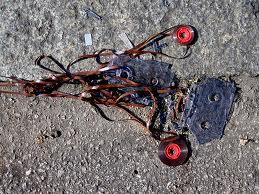
Like muddy rivulets, the tiny streams
of tapes unravel in the shaded curve
of freeway. Here a slingshot bungee seems
a snake, a creature flung by someone’s swerve,
synthetic roadkill cast among the shapes
of concrete fossils, hubcap shards and scree
from rusting cars or cases that held tapes
of hip-hop, rock&roll or R&B.

Beneath a pewter sky, upon a road
of pale concrete, around a stagnant pond
below a roaring overpass, we flow
with traffic off the bridge, due east beyond
the reach of natural shadows, down along
these rivulets of tape-recorded song.

Posted in Poetry | Leave a comment

On June 25, 1998

elnino

Each day I must remind myself it’s June
already; nearly half the year is past.
El Niño gave us winter as monsoon,
and spring has been unending overcast.
Now I’m surprised to see that school is out,
announced vacations startle me, and pink
and purple blooming gardens round about
astonish me, admonish me to think
on time, to locate me, identify
the instant as I alter it of course –
(whenever I express, I modify
my object though I’m not applying force),
to wake me to the 25th of June,
2 hours 30 minutes till high noon.

Posted in Poetry, Weather | Leave a comment

What We Learned on Baranof

cedar

Rehearsing the order of forest while walking,
we learned
that first grew the ALDERS,
and then came the SPRUCES,
until
they toppled for HEMLOCKS
to rise where they’d fallen or burned,
and finally CEDARS survived them
to blanket this hill.

Posted in Poetry | Leave a comment

Paralysis

220px-House_Dust_Mite

Emma tore her toe on the metal threshold at Jake’s doorway. It happened on the February Tuesday when Jake’s asthma and dust allergy were diagnosed, three hours after Dr. Blankman gave her the pamphlet with the picture of the grossly-enlarged dust mite and the terrible tales about carpets and curtains.

Of course she should have waited for help before de-installing the wall-to-wall in Jake’s room. But Emma is energetic to the point of impatience, so eager she is called impulsive. She changed into sweatpants, pushed up her sleeves, and started ripping. She lugged heavy rolls of the musty stuff down to the garage. She sweated and sneezed, but she got all that mite-harboring blue junk out of her son’s bedroom before dinner.

The job exhausted her. After she dragged the last of the carpet pieces out to the garage she was so tired that she finally stepped in the dog shit she’d been avoiding through all prior passes. Her own retriever had left it there that afternoon, fresh and soft. It stuck in her textured sole like butter on a cold waffle. She bent to untie her shoes, nearly keeling over with fatigue, and then she went barefoot back upstairs.

Unshod, tired, it was easy to shuffle. She lifted insufficiently as she passed into Jake’s room, tearing her right big toe on a nail that protruded from the metal strip that used to hold down the bad blue carpet. She was surprised at how much it bled. She was also surprised at how much it hurt, until she inspected the nail head and saw its dull edge. Walking was painful and awkward. An inconvenient injury.

No sooner had she finished the carpet removal than Betsy arrived and it started to rain. The events were unconnected but both made Emma happy. She was always glad to see her friend, especially on their regular Tuesday evenings and Sunday afternoons. She  loved rain, and today the weather made her glad she’d already dragged the carpet pieces into the garage; if she had left them in the driveway, as she thought of doing at first, they’d be getting wet and heavy.

As it happened, Emma came to regret both events. Maybe she was irritated by all the carpet-pulling and her bleeding toe, but she didn’t have any patience for Betsy’s rambling mysticism. She didn’t want to hear about her friend’s recurring dream any more than the usual astrology. “I don’t know, Bets,” she said more caustically than she felt, “but it seems to me it’s too easy to push one’s dreams around, interpretation-wise. Kind of like the old Ouija board; you always knew someone at the party was steering it, you know?”

“No.  I don’t know that.” Betsy’s fair complexion reddened with emotion. “I for one have had some true predictive experiences with the board you’re disparaging. And I certainly am not pushing my own dream around. I’ve had it so often that I know what it contains.”

“But that’s just it. You’ve had it so often. Don’t you think your dreaming self could be recognizing some familiarity and then some part of you could be filling it in so you recall it as identical?”

“Look, Emma. Since I was a little kid, I’ve dreamed about this one house. I’m not too sure about the outside, but I can draw you a plan of its interior. And the thing about it is, there’s a windowless room in the center of the place, off the kitchen, hidden away. Each time I have the dream, I rediscover the room. And each time I find the room, I become sad that I haven’t been using it. I vow to remember it and use it.

“But I think I’ve figured it out. I think the room is a simple metaphor for a part of me that I’m not using. I have to find my own interior room and live in it.”

Emma knew she should retreat at that point. But her toe was still bleeding and she was still irked. She distrusted dream devices in books and movies, and she wasn’t much more receptive about them in a friend’s narrative. Instead of smiling or nodding and changing the subject, she mumbled something about dream interpretation being as useful as astrology.

“What’s with you tonight?” Betsy got up then for a glass of water, and didn’t sit down right away. She continued talking as she paced Emma’s kitchen. “Don’t try to tell me there’s nothing to astrology. I’ve invested years in its study, and there’s so much to it that I’ve barely begun. I can pick a person’s sign after fifteen minutes of conversation. How could I do that if there’s nothing to it?”

“Because you’re dealing with a bunch of people who know about astrology! Let’s find an island somewhere, where no one has ever heard of the ‘science’ and therefore can’t act his sign. Then I’ll bet you have trouble.” No sooner were those words out of her mouth than Emma regretted them. “Oh, I’m sorry, Bets,” she said. “Sit down. You want a stronger drink?”

But by that time neither had the energy to retrieve feelings. They shared a few minutes of delicious criticism about their friend Pam’s continuing cosmetic vanity (the woman was getting into “toxic” facelifts – injections of botulism bacteria that temporarily paralyzed small muscles and thus prohibited wrinkling), but Betsy left for her own place without sitting down again.

Emma fed Teddy the dog and Jake the fourteen year-old boy. She wasn’t hungry herself, but she nuked a Lean Cuisine and chewed through it. She tried not to walk on her toe, but stepping around on her right heel didn’t work very well. She went early to bed.

At 3:30 in the morning her bladder woke her up. Stepping out of bed right foot first, she forgot about her injured toe until she put her weight on it. At the same moment that she felt the pain, she felt the liquid.

Her first idea was that the dog had peed. But Teddy was a middle-aged retriever with good control; he never went inside. “What the?” Emma said aloud, as she limped to her lamp.

She had stepped in a four-inch wide stream of water coming from under her bed toward the fireplace. She hop-stepped over it and around the bed, to discover that the stream originated under one of the French doors to the small porch off her room. Under the door, across the Pakistani rug, beneath the bed, toward the fireplace. The water was definite evidence that her floor wasn’t level. It didn’t take long for her to find the bent metal weatherstripping under the door.

“Why now?” was her next frustrated thought. On her knees with her emergency flashlight she couldn’t see the problem, but she felt with her fingers the rippled edge of old metal. For who knew how many storms, that strip had held wind-driven rain outside the door, but some critical event that night, some perhaps hair-thin, feather-weak force, had pushed the stripping just far enough to let rain in under the door to flow across her room.

She fetched old towels. She wiped the floor, blotted the rug, created a roll of terrycloth threshold where the weatherstripping had surrendered. She limped to the washer with the wet towels, and then returned to bed, but she didn’t settle into good sleep for the rest of that night.

She and Jake managed to repair the weatherstripping the next afternoon, after he returned from school and she came home early from work. She and Betsy spoke that evening and normalized their relations. In fact, except for the continuing every-other-step annoyance of a toe injury, Emma felt better. She recovered from the frustrations and fatigues of her Tuesday.

On Saturday morning, however, she woke with a stiff neck getting stiffer. She knew she carried her stress there, and she did the exercises to relieve it, but throughout the day her mobility decreased and her discomfort grew. By that night she could barely turn her head, and she was irritable and drowsy. She considered her condition for some time before deciding that the pain merited prescription relief. She got into the Vicodin in the medicine cabinet and slid, eighty minutes later, into a pleasant restful sleep.

She woke Sunday morning on a soggy pillow. There was a slime of saliva on the pillowcase, below and around her mouth; she didn’t know why she had been mouth-breathing without a stuffed nose, but she assumed she’d slept mouth agape and drooled steadily from her left side.

As she raised her face from the pillow she realized that her neck stiffness had increased overnight. She was not happy. She struggled to an upright posture and continued to drool. She began to speak her frustration and found she could barely flex her jaw. She couldn’t enunciate. She panicked.

She woke Jake and managed to communicate the urgency of her situation. Grunt-talking and gesticulating, she made him understand enough that he called 9-1-1. Then he called Betsy. She normally came by on Sundays, but on that day her visit started early and went long, at the hospital.

Luckily Emma had had the prescribed series of tetanus vaccinations as a child. Unluckily, when she stepped in the bedroom water it had been far longer than the recommended ten years since her last booster. She became very ill, and her initial statistical chance of survival was less than eighty percent. But the doctors reacted promptly. They’d never treated a tetanus infection, but they loaded Emma with antibiotics, dosed her with muscle relaxants, and provided respiratory support for the brief time she needed it.

They conjectured that the source of infection was the rust- and germ-bearing water that flooded past the old weatherstripping and into the cut on the bottom of her toe. They read that the incubation period averages ten days but can be any number from three to twenty-one, so onset four days after exposure was not improbable.

What was improbable was Betsy’s reaction to her friend’s infection. She didn’t introduce crystals or candles or incantations to the sick room. She brought reference materials. Something about the event made her softly scientific. She was able to explain the infection to Emma (“It’s a little bacterium, called Clostridium tetani, which is actually a nerve poison.”) She was even able to entertain them with her knowledge (“Dig this! You know how your problem is Clostridium tetani? Well, Pam’s Botox? Those were injections of Clostridium botulinum – one of the eight bacteria of botulism – used to temporarily paralyze small facial muscles so they can’t contract and the face can’t wrinkle. Isn’t that weird? Isn’t it a trip that a cousin of what tried to kill you is ‘helping’ her?”) Emma would have voiced responses to these and others of Betsy’s comments, but lockjaw isn’t conducive to speech. She would have nodded but her improving neck still didn’t permit easy movement. She used her hands and eyes on Betsy to convey her appreciation.

Emma recovered fully. She was out of the hospital in five days and after another ten there was no sign that she had been ill. Within three weeks of the Tuesday night exposure, it was like the accident never happened.

But Emma-and-Betsy were changed by the infection. Betsy’s ventures toward science continued; before long she could talk about her own digestive problems with authority and confidence. Without abandoning most of her mystic interest, she added some with scientific method.

As for Emma, she’s remembering her dreams now. She wakes up most mornings and jots down her impressions. She finds there’s a recurring motif in her nocturnal visions. Emma is dreaming about thresholds.

Posted in Fiction | Leave a comment