
I try to observe all holidays. Religious, national, even commercial. I hear folks disparage Valentine’s Day, or Mother’s Day, as being promoted by retailers, but I don’t care. I think it’s nice, to take a May Sunday and make it about family.
My ancestors have different ideas about Mother’s Day. Neither my mom nor my grandma make a big deal out of it, but I just learned how unalike their personal attitudes are. Big surprise: Mom and Grandma don’t agree about much.
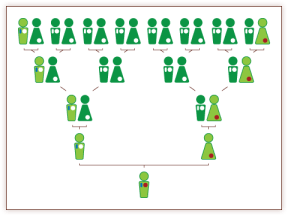
I always knew about my great-grandmother’s untimely death. Her name was Esther, and she came to America from Poland when she was 12. That was around 1902. She worked in a New York sweat shop to earn passage for her family. She slept in a corner of a cousin’s kitchen and spent her time cleaning the cousin’s house and cooking, when she wasn’t laboring for a pathetic garment industry wage. She married at the appropriate age, bore five live children and raised four of them to adulthood (my grandmother Miriam was the youngest), and died of a major heart attack when she was 60. She left four married children and seven grandbabies. My mother was then in utero.
The heart attack happened on Mother’s Day. My grandmother had just learned she was pregnant (with my mom) and Esther had arranged to accompany her to the first prenatal exam the following day. Esther wouldn’t let Miriam see her on Mother’s Day because the family was gathering at my great aunt’s and her baby daughter was sick. Esther took no chances with a pregnancy.
On the drive home from my great aunt’s house, my great grandfather crashed the car. The accident brought on the coronary event from which Esther didn’t recover. Late that Mother’s Day night, my grandmother lost her mom. Grandma always lit a Yahrzeit candle on the calendar anniversary (May 7). It wasn’t till two years ago that my grandmother told my mother the death occurred on Mother’s Day.
So Grandma had a mixed pregnancy with my mom. She was healthy and happy about the baby, but she was stricken with grief about losing her mother. She named my mother for her mother (Eve, with the same initial E and the same Hebrew name), and she raised my mother (and probably herself) under the banner of Esther’s perfection and tragically short life.
It really was short. Esther lived from 1890 to 1950. My grandmother Miriam was born in 1925 and is still going strong at 90. My mother Eve arrived in 1950 and at 66 she’s far younger-seeming than Esther ever was. Mom had me in 1976.
Esther was traditionally Jewish in the Ashkenazi way. She didn’t wear a wig and her marriage wasn’t arranged, but she kept Kosher, her first language was Yiddish, she was submissive to her husband, she lived for her children, and she was an encyclopedia of old-wives’ lines and superstitions.
Miriam was much more modern. Born in this country (the only one of Esther’s kids to be delivered in a hospital), Miriam was an American Jew. She understood Yiddish but spoke English. She tried shrimp and bacon in restaurants. She married a Jewish man less Yiddische than herself, bore three children, ran a Jewish household but only took the kids to temple on high holy days. She worshiped Esther’s memory like she was a saint. My mother Eve was Miriam’s only daughter, and Miriam filled Eve’s ears with tales of Esther’s selflessness and sayings.
Eve was second-generation American and acted it. She was raised in suburbs and attended college. My father converted to Judaism because it made more sense to him than his lukewarm Mormon heritage, and we didn’t have a Christmas tree in our house, but I think that was less about a religious decision than about Eve’s disdain for holidays, symbols, and rituals. My mother says they’re all forms of emotional manipulation. She abhors being told when to gather and what to feel. I’m her oldest. My brother is five years younger.
And then there’s me. I identify as a Jew, but I don’t look it. I inherited my father’s blonde/blue coloring and his Anglican last name. I married a Protestant man who’d attended Catholic schools. My husband was never observant, and what with being raised in the bay area and hooking up with me and my family, he is now more Jewish than anything else. Our three sons have Hebrew names in addition to their American handles, but they’re not circumcised and they haven’t seen the inside of a synagogue. But we love symbols and rituals. We do all the holidays. We’re an inclusive Jewish family.
My mother’s heritage is as much “Estherish” as Jewish. She heard stories about sainted Esther all her life. According to Miriam, her mother had the world’s biggest heart. She always did for others and never thought of herself. She rarely hugged her children but they all knew they were her sun and moon. She didn’t praise them to their faces but she wouldn’t allow others to criticize them. Over and over Eve heard her mother bemoan the fact that Eve never met Esther.
Funny how time is. Esther only lived 60 years. She’s been dead 67. But she’s still a vibrant member of Miriam’s family.
Mom and I have questions. Mom says her paternal grandmother was such a self-centered phobic bitch that she has no doubt she would have preferred Esther, but she’s always wondered what Miriam would have been like if she hadn’t lost her mother so young. If she hadn’t spent her whole adulthood amid the Esther legacy. Mom has told me things that cast a little shadow around my great grandmother.
Miriam was a lovely child and much younger than her siblings. In her orthodox family environment, she saw uncles who were never around women except relatives. When Miriam reported that one of those uncles showed her his penis, Esther didn’t go to battle for her daughter. She shushed Miriam. It happened again a little later, after a stranger exposed himself to 10 year old Miriam in the neighborhood park. Again Esther wouldn’t allow Miriam to give her details. She told the little girl to stay away from that park.
“So let me count,” Eve has said to me, more than once (Mom tends to repeat things. She says duplication is better than omission. But she’s also a story-teller, and she’s always trying out material). “So Esther didn’t hug her children or praise them to their faces. She didn’t support her little girl when Miriam was sexually approached/molested. She never stood up to a demanding husband – thus modeling a nasty form of submissiveness. Sure doesn’t sound like saintly behavior to me.”
A month ago, Mom and I took Grandma on a visit to see family. Miriam, Eve and I flew across the country to a cousin’s bat mitzvah in Richmond, Virginia. Grandma Miriam was the youngest in her family of origin, so she became an aunt at age 11. She’s still close with her nieces, and the bat mitzvah girl is the granddaughter of the oldest niece.
It was a lovely service. The Torah portion was from Leviticus, when Moses hands down the Kosher laws. The bat mitzvah girl told us that her household doesn’t keep Kosher, but that the passage really isn’t about the specific rules as much as it is about mindfulness in general. A sweet conceit, which was more than borne out when we got to the after-party. Featured food included a mountain of oysters, a pile of prawns, crab cakes, fried lobster pops, and pulled pork.
I savored the diversity along with the food. I was tickled to see that the family now includes Catholic cousins, Asian cousins: many more skin tones and symbols than in the past.
But the moment that really resonated for me was when Mom asked her oldest cousin about Esther. After all, Lydia is just 11 years younger than Miriam. She had 14 years of knowing Esther.
“So tell me about my maternal grandmother,” Mom asked.
Lydia looked receptive but confused. Mom said, “My mother has been telling me stories about Esther all my life. About how lovely and selfless she was. About how much I missed by never knowing her.”
Then Lydia seemed to look back into her own head for a moment. “Esther was nice,” she commented. “But you should have met my other grandma. Sophie.”
Wow. That put a whole new complexion on the subject. Especially when Mom asked Miriam who Sophie was and Miriam waxed lovingly about her. We learned that Miriam had to live with Sophie for a bit, between the time when her older sister and baby moved in with Esther during the war and when Miriam married. Sounds like Sophie was the sainted one.
That encounter took place a month before Mother’s Day. A few weeks before Eve told me that she secretly loves the holiday. She hides it from her mother – she’s always careful now to show respect for Miriam’s sadness – but Eve has appreciated Mother’s Day for 31 years.
See, Miriam and Eve each underwent hysterectomies when they were 35. Miriam’s was necessitated by a fibroid tumor the size of a grapefruit. Eve’s was more dangerous. She ruptured an ovarian cyst and then, unknown to her doctor, bled internally until her body had amassed a large hematoma that got infected. By the time the doctor opened her abdomen, there was little viable tissue for a clamp to grab. Eve survived but none of her reproductive organs could be saved. Poor Mom has a vagina that’s just for sex now; it leads nowhere.
She was in the hospital for two weeks. She was critically ill for much of that time. It was the morning of Mother’s Day when her last surgical drain was removed. She was alone that early morning, before visitor’s hours, and that’s when she cried tears of cathartic, powerful relief. That’s when she understood that she would survive the episode. It was almost like being reborn. Mom isn’t into restaurant meals or cards or flowers on Mother’s Day. But she always acknowledges it with gratitude.


 Sputterpub's Blog
Touching story
Awesome. Thanks. That was a goal.
Well you nailed it