Coneheads (Part 1 of 2)

From the textbooks: two points suggest a line; three establish a plane.

The triangle, elegant and easy, is the most stable, supportive form. The first shape. The image of a person, upright. A natural mountain. Tepee.

Two is productive but flimsy. On/off. Black/white. True/false. Binary numbers, electricity, all those computers. Lacking perspective.

From the lessons: Semites and Sumerians are not alike. They have different understandings of space and time. They have different home planets. They can’t produce offspring. Dogs and Semites share 90% of their DNA. Sumerians and Semites have less than 84% of their genetic material in common.

But the two peoples look alike. They’ve lived and worked side by side now for five thousand years. The visitors, far less plentiful but much longer-lived, aware of the situation and careful like vampires to guard their real identities, and the indigenous opportunistic fecund folk, fruitful and foolish.

It’s time the story was told. I know I’m risking resentment by some and scorn by many, but I’ve had a long life and a full career and, anyway, continuing this way has become intolerable to me. I must speak:

About three thousand years before the beginning of the Common Era, this planet was seeded by Sumerian scouts. Only a few places in Asia, the Middle East and Africa were actually populated then, and the property between the two rivers had oft-flooding waterways and a little agriculture, so the Sumerians inserted themselves into the Tigris/Euphrates region.

The indigenous Semites were making some progress toward civilization there. Swamps had been drained; canals had been built and were maintained. People were beginning to cluster together in bigger groups, with consequent politics. The Sumerians were able to slip a few of themselves into those proto-cities, and to introduce constructs that helped them become city-states.

Sumerians have trinary attitudes. They think in terms of on/off/other, where other goes in the direction which is perpendicular to the on/off axis, the line which takes the issue into three dimensions. Their intergalactic travel is based on a type of teleportation that rides that “other” line. Their best reproductions involve three parents. The epic hero Gilgamesh, for example, was a true Sumerian, and a hint of that sneaks out in the poetry, which describes him as two parts god and one part man.

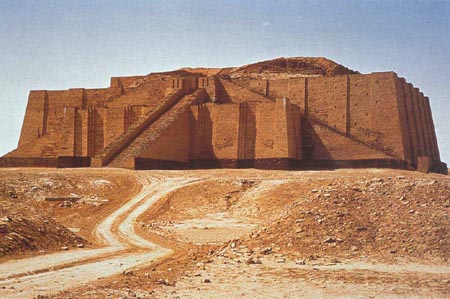
On close examination, a Sumerian skull is a little pointed on top. The fontanelle closes differently than on Semites. It wasn’t accidental that Sumerian brains invented writing based on the wedge shape, or came up with ziggurats for shrines. They also brought the wheel, which was of course not triangular in shape, but they were forced to adopt that because it was so much better than a sledge at transporting goods. Sumerians introduced arithmetic to keep track of trade, and contrary to popular thought, base ten was used not because it happened to be the number of a person’s digits. It was simply the best pyramid number – one, three and six were too small, and fifteen was too big.

Sumerian “civilization” didn’t last that long; a thousand years is a Sumerian life span, and that’s about the extent of their rule. But their developments were adopted by the succeeding dynasties of Semites. Written language continued, the wheel was refined, arithmetic was advanced. Their pantheon became the basis for all the region’s religions; their law, with its attention to contracts and revenge, became the foundation for western civilization.

Some Semites got the message better than others. The Hebrews had an apparently innate affinity for trade; they were such commercial “naturals” that the Sumerians more or less chose them as spiritual successors, and the Hebrews (coincidentally?) chose the intersection of two equilateral triangles as the symbol of their culture. Other sects had less mercantile attitudes (and symbols made of straight lines or, romantically, curves!), but everyone caught on to the benefits of organized manufacture and distribution.

Posted in Fiction | Leave a comment

Pepper Tree

A pepper tree ahead of me appears
a graceful drape above an antique truck,
reminding me of Chula Vistan years
when our suburban hormones ran amok,
when we were husbanded like citrus trees
in Cinderella homes on furrowed blocks,
our courses tract in cul-de-sac degrees
designed for safety, bumpered against shocks.

Of trucks Ford built in 1952
I am reminded when I look on us:
in need of restoration, and a few
indulgences, by patch or paint or truss.
Inside yet drives a questing reach in me,
revitalized beneath a pepper tree.

Posted in Poetry | Leave a comment

Skunk Skool

I think I’ve mentioned the skunks before. One or more seem to inhabit my yard full-time, although I only see, hear, and smell signs of skunks now and then. We try not to bother one another. I don’t mind the odor (in moderation). This is fortunate, because I might have trouble if I tried to get rid of them. My shallow research indicates they have no natural predators except an owl or two, and I haven’t seen owls in my part of Berkeley. I’d probably have to moat my shed/office in steel to keep the little diggers from burrowing under it.

I read that skunks den alone except when dealing with babies. I think I saw a coming-out party last month.

It was a mild Saturday night. As usual, the main door to my little deck was wide open and I was semi-conscious on the loveseat I use as a sofa. I became aware of significant critter noises. I rose from my inclination and looked through the open door at a litter of skunk kits.

There were at least five babies. They looked adorable and curious. I was not comfortable! Curious baby mammals, just feet away from my open door. Little stinkers who probably had not yet learned restraint. I figured I was moments away from contending with unpredictable visitors.

I made some noise. They heard me and moved a bit in response, but not away. I made more noise. They made a little more movement.

It was a few minutes before they’d backed away enough that I felt okay approaching the door. I closed it from the hinge end (no way was I stepping across the inch-high threshold). I watched them for a few more minutes through the glass door, and then they romped out of my sight.

I was up early the next morning. And there they were. First on the deck and then under the trellis to the small patch of lawn. Now I could assess them. Six kits and here comes the mother too.

It was a show. For about three-quarters of an hour I watched half a dozen clones of that skunk mother, as they gamboled and investigated, grubbed for bugs and tumble-writhed over/under/around one another. The mother was about twice the size of the kits, but otherwise they looked identical to me. All glossy black, with twin white swaths on their backs and a thin stripe down each face, all rodent-flexible with semi-transparent bush-tails aimed at the sky.

There must have been variations among them that they recognized, but to my eyes the skunk parents had managed to produce perfect, precise renewals of themselves.

And to my observation, they were all perfect at being skunks. All seven creatures seemed fully and naturally occupied at finding food, enjoying existence, and avoiding violence.

I don’t think they returned to their den. When the party was over there seemed to be one more wrestling writhing huddle, and then the litter dissipated. I haven’t seen, heard, or smelled them since.

I hope the babies made it across whatever streets they found. They seemed so good at being skunks.

I wish people were as good at being people …

Posted in Critters | Leave a comment

Xenometry

A hypercube is called a tesseract
and can’t exist in three or four dimensions.
It floats imaginary and exact,
an edifice of logical extensions
that I can neither build nor draw nor see,
nor picture in the certainty of prose,
nor capture in the bars of poetry,
but I can hold the image no one knows:

I can wrap my mind around that shape,
and enter it to sample and explore.
I can use its windows to escape
or let its lines illuminate a door
to passages that beggar all description,
and wisdom just beyond our definition.

Posted in Poetry | Leave a comment

The Book of J (Part V of V)

The afternoon of Joel’s impromptu visit, we took a stroll. We left Emmet with Laura and wandered the perimeter of the place. We ended up in the small eucalyptus grove near the cow barn. I remember the dialogue vividly and inexactly, for it has become my own private example of complete miscommunication.

We walked on leaf-laced dirt beneath the trees. Joel was to my left, naturally taller but bouncing shorter with his compressing energy.

I’d already tried to break it off by telling him I wasn’t ready; he said he’d wait. And I’d attempted the non-exclusive, non-possessive argument, even to the point of screwing Ari the young soldier. Joel saw beyond all that and still loved me. Finally I tried cruel mockery.

“If you’ll just give me a little more time,” I petitioned with a whine. I tried to make my tone wheedling, like his sounded to me, as I threw his own words back at him. “I know I’ve been selfish and not completely honest, but I really want to change.” I cut my glance toward him. He paced beside me, gaze downward. I added with what I thought was a sneer: “I need you to be here for me.”

Suddenly he was in front of me. He executed one of his bounce-moves and there was his firm chest blocking my way. He cupped my shoulders with his hands and peered earnestly into my face. “I can’t tell you how long I’ve waited to hear you say that. I love you so much. Of course I’m here for you.”

I was simply flabbergasted. I never imagined he wouldn’t get my sarcasm; I suppose if I dreaded anything it was him lashing out, hurt, to hit me.

I think I became parental then. Firm. “Uh unh, Joel. No.” And while I’m sure he continued to contend, I think he finally started to get it.

He spent the night anyway. It was already dinner time when we finished our walk, and that scooter was unquestionably not roadworthy in the dark. After a quiet meal we went to my room.

When we first arrived at the kibbutz, Mary and Laura and I were assigned to a nice address. The volunteers and soldiers slept in wooden barracks instead of the stucco rooms that housed the residents, but the barracks walls were sound, the windows were screened, and there was cold water available from the sink at the end of each row.

Further up the slope were the shanty-barracks. They weren’t needed so they weren’t kept in repair. Their walls and window screens had holes in them; their plumbing was shut off. But they were the only place to go when Laura and I decided we could no longer live with Mary.

It wasn’t that Mary talked in her sleep, or partied too much, or failed to clean up. In fact it was as far as possible from those. The obnoxious thing about Mary was her quiet, zealous fastidiousness. Incessantly tidying. Making use, somehow sometime, of every little bit. Brushing her teeth after each and every postprandial nibble of a cookie from the tin we kept in the closet – a snacking and brushing that occurred on average six times an evening.

Laura and I would have been happy to live together except there weren’t any decent rooms, and we also knew we’d hurt Mary’s feelings less if we went off separately – as if the problem, really, was our simple need for more space. So like homesteaders we staked out our places in the wild territories. We went up the slope and found rooms we could make acceptable, and then we swept, dusted, patched, and furnished them.

They were never better than barely adequate but they were home. Straw mattresses on iron frames, spool tables and box drawers. The winter cold penetrated the worn slats of the walls. But Laura and I each managed to be cozy enough. That’s where I took Joel.

I’ll never be sure if he was a hero or an agent of mischance that night. I do know nothing was at risk but my row of barracks. My room burned and the fire was started by my heater. Joel woke me and helped me out of the smoke-filled noxiousness. I’ve always assumed it was his jitteriness, an edgy insomnia, that placed him where he could sense the fire and save me. But maybe it was his usual harm-filled karma that allowed the heater to tip. I won’t argue that those kerosene contraptions are safe, but many have slept with them burning, to no calamity.

(Of course you can wear the scalplock. You might want to take care of it, for Joel’s sake, but that was 30 years ago– he’s already made whatever he has of his life).

Posted in Fiction | Leave a comment

The Book of J (Part IV of V)

Joel was in all ways manipulative, and he played the kitten card with exquisite skill. He’d managed to hear little Emmet’s mews exactly when they served to interrupt us on a slide into old argument. He had left me and my weary exasperation, for just a moment, and he hunted out the striped gray bundle of warm mammal that he later named Emmet (Truth). I fell in love with the kitten the moment I held him, and after we took the cab to the shelter, learned it was not a no-kill place, took another taxi to a vet, and paid a fair amount to have Emmet debugged and vaccinated, by the time we got back to Joel’s place that evening, I’d been lured into continuing with him, for a little more, just to co-parent the kitten.

I would have told Joel to turn around and go back to Jerusalem when he showed up without notice at the kibbutz, except that I was so pleased to see Emmet. Joel got to stay the night.

(You’re wondering if we were still having sex. I’m a little ashamed to say yes. I didn’t intend for it to continue, but we usually got to talking and arguing and then agreeing, and he was a very compelling kisser. But I made it clear to him that he wasn’t the only one. I had a week-long affair with an Israeli soldier on the kibbutz, partly to emphasize to Joel and to me that I wasn’t committed to Joel (and also just to do it with someone whose language I didn’t share, which was a strange trip)).

Our kibbutz was a poor place. Kibbutzim are affiliated with political parties and we had applied to the most radical. We wanted to try socialism. We were assigned to a small place inland from Hadera, which is about midway between Tel Aviv and Haifa. Our kibbutz only had about 200 residents and a few dozen soldiers and studentim (us), and none of the gardens or swimming pools or language classes that the larger and more moderate kibbutzim offered. We raised cotton, avocados, and apples, cows for milk, and chickens for market. Our common dining room served as our meeting hall and theater. The residents lived in stucco duplexes and we young folk had uninsulated plank barracks. Kids lived apart from parents.

We didn’t have a camera with us, so my memories are more like dreams than photographs. I recollect a water tower at the top of a slope, with a small athletic field near it, the ranks of poor barracks terracing that slight slope, the trees from which bats flew at sunset. I remember the cinderblock shower house near the kitchen. There were always frogs squatting in the far dark corners, and the acoustics were so satisfying that Laura and Mary and I sang Motown there while we shampooed. Just outside the shower house was a big kerosene tank, where we filled our cans to cart to our rooms to fuel our little space heaters (everyone assumes it’s always hot in Israel, but Jerusalem’s a mile-high city that gets snow every few years, and the kibbutz weather was like Southern California’s – definitely chilly in the winter). I remember how impossible it was not to spill some kerosene near the end of the fill, and how that spilled stuff wrecked the gum soles of our sensible shoes.

Over on the other side of the kibbutz, beyond the kitchen and the chickens and near the big circular drive at the entrance, was a grove of eucalyptus trees, the cow barn, and the hay loft. The loft was actually just a roof on big posts, seeming about three stories high and stacked with bales of hay dried from peanut plants. Laura and I liked to climb up the bales on rainy afternoons when our work shifts were over. We made nests for ourselves at the top of the loft, talked and smoked cigarettes while we poked through the hay for unharvested peanuts.

(Yes, we smoked in the hayloft! We heated our rooms with open kerosene fires. We snorted strange white powders and smoked hash with unknown Arabs. Once I rode from Tel Aviv to Jerusalem on the back of Joel’s scooter, and even though he informed me that we were only able to proceed as long as he held two bare wires together, circumventing some short but continually shocking himself, I was by then so blase about the perils of Joel that I managed to fall asleep, actually nap, while riding behind him. We were Disney-generation kids, raised in a culture that told us if we stayed in line and followed the rules, we’d be okay – life is a ride on tracks – and we’d landed in a perfunctory hazardous place, yet we were somehow protected, like morons or teenagers.)

(to be concluded tomorrow)

Posted in Fiction | Leave a comment

The Book of J (Part III of V)

It was under the influence of that powder that Joel confided his secrets. There’s no telling if any of them were true. It was another mild evening, we were again in the Old City, and we’d been separated from our friends. I think they all just kept walking when Joel stopped and bounced off a wall. Being gymnastical and energetic he would do things like that – take a run at a wall and jump off it from two or three feet up – landing lightly, grinning, and then telling some story. I remember he went into a perfect squat and started describing the rigors he’d undergone in order to be adopted by the Apache tribe. I honestly can’t recall if it’s the details I’m supposed to guard or the scalplock, for that’s when he gave me this loop of brown suede thong, from which depend, on common cotton thread of gold and taupe, two nondescript feathers, a wooden ball, several short strands of colored glass beads, and another length of the brown suede thong (I’ve had the thing 30 years, and for the last decade it has hung exposed to air and sun in my study, and the only age it shows is the stiffening of the brown suede). According to Joel, he’ll lose his soul if I divulge his stories, or maybe it’s if I discard the scalplock. Luckily I can’t remember the stories so I can’t tell them, and I’m keeping the scalplock just in case. I don’t believe in that kind of soul-deal, but the subject’s so important that I won’t play around. I remember one time a woman walked into the Med on Telegraph Avenue in Berkeley, around 1968, and announced she’d just made some Faustian deal with the devil. I did not find that funny. That was affectation beyond the pale.

Anyway, the scalplock is kind of cute.

Joel also gave me a pendant, of pot metal or maybe pewter, in the shape of a tomahawk suspended over an open oval. It’s not unattractive, actually. I think he gave it to me as a symbol of his Apacheness, in which I didn’t believe, and of his love, in which I did.

(Isn’t it remarkable, how we baby boomers seem driven to preserve the stories of our own extremes? How many times have you heard of this golden age, between the invention of the Pill and the advent of AIDS, this era when civil and even rude disobedience worked? We’re like Vikings on Iceland, writing sagas to get it all down. We’re like Austen etching elegancies of estates and esquires while the fences encroach and the merchants usurp. We’re like any dying civilization, grasping at art to self-record…)

I can’t remember ever agreeing with Joel, and I didn’t agree to love him. I liked his energy, I loved his agility, but his jitteriness made me nervous, and I couldn’t disregard the feeling that his hyperactivity brought attention to us and bad luck upon us, and that the relief we achieved when we talked our way out of whatever hassle our conspicuousness brought us, didn’t compensate for the overall feeling of wasted time.

I thought we would come to a natural end when Laura, Mary and I left Jerusalem for the kibbutz. I thought the kitten episode would be the last story. But Joel surprised me with a visit a week later. He even brought Emmet, in the basket of his scooter.

(continued tomorrow)

Posted in Fiction | Leave a comment

(Ball and) Chain

I guess I cut an anchor chain last week
and watched it sink to sand without a sound,
but I don’t want a moorage I don’t seek
and longer at that tether would have drowned
respect and swamped esteem beneath a tide
of curling pull. I’m wobbly but I’m well,
and shaking off the brine I’m clean inside,
with room to dance and circumstance to tell.

The tension gone, the chain engraves on sand
its serpent track of temporary lace.
It leaves impression I can understand
who couldn’t see around its dark embrace.
I’d sooner drift away than sink below
the weight of love that can no longer grow.

Posted in Poetry | Leave a comment

Egocentricity

The candle in my belly is a light
beneath my heart, a battery my feet
imbibe, a pole of ribbons lancing height
as I expand extremities with heat
self-generated. Higher now I grow,
forever stretching energy I spin
above the tender flame. My senses know
the miracle that flourishes within.

I stand a tree between the earth and sky.
I move a bolt connective on a wave
of cresting sound. A metaphor am I
of molecules and space, a shape as brave
as God constructs to be a self-aware
phenomenon of attitude and care.

Posted in Poetry | 2 Comments

The Book of J (Part II of V)

Joel was from Indiana (you never know what motifs will fill your life – for some reason mine has been salted with Hoosiers). He said he’d studied several martial arts, which could have been true, but I doubted his claim to hold black belts in all of them. He told us he was in Jerusalem on a scholarship, but I later learned that no one outside New York had been awarded any money that year. On the other hand, Joel had irresistible energy in bed (behind me in the morning, around me all the night) and he knew the Old City better than anyone else I met.

His roommate was a very decent boring guy, Mark from Sacramento. In the next room were Vil and Larry, who evolved into the dorm leaders. Vil’s full name was Willem Vilna-Schärf and he said the “Vil” was from “Vilna” and not a Germanic pronunciation of his first syllable. He was red-haired, willowy, and Christlike in gentleness. He said he’d been raised by ultra-orthodox parents until he left home at 16 and ended up in the Village, kind of adopted by Allen Ginsberg. We were all attracted to him, and no one got further than extremely sensuous, under-the-influence hand-to-hand caresses.

Larry was a jovial big slob, a John Belushi type, and he became Laura’s lover. Through her, he shared my hairbrush and even my toothbrush. Through them, I got lice and gingivitis. The kibbutz treated Laura and me for the lice, so aggressively that I began to wear my hair short and then shorter, till I settled on the cut I have today. I took care of the gingivitis myself, with Tetracycline lifted from Mark’s shelf in the dorm bathroom.

For drugs were involved. In addition to the Tetracycline and our plastic wheels of birth control pills, beyond the realm of Midol and aspirin and, in Laura’s case, diuretics, we mined veins of sticky Old City hash and we secured, from someone known to somebody, what was described as laboratory-pure PCP, from Tel Aviv.

Joel told me hash was legal for Arabs but not for anyone else. Israelis would get jailed and we could get deported. So it was risky business, buying hookah hits in the back rooms behind the heavy carpets. Our host could smoke with us and then collect a bounty for fingering us as we left. Even so, we sometimes indulged. Occasionally we chatted with one of the merchants and then joined him in the back room for mint tea or syrupy coffee. I never negotiated it but sometimes Joel or Larry would haggle and converse with the merchant, and that usually resulted in the entrance of a big, minaret-shaped pipe, and our shy greedy hits on hash. It slammed against the base of my throat and triggered a convulsive cough but I didn’t turn it down. We never came close to getting busted, but Joel always made it exciting with his jittery vigilance.

The PCP was a much deeper experience. I wonder what it really was. After I returned to the States I indulged in street PCP once, and it was a whole other drug than what I snorted in the Holy Land. In Ukiah it knocked me out of my head and nearly off my feet. I was there with the band, playing the high school senior prom of all places, and we all tooted it in the coach’s private bathroom, in the boys’ gym, which is where we were told to put our gear. I don’t know how the guys managed to make music on that stuff; when it hit me I had to go outside and hang by my fingers from the chainlink fence just to moor me to the planet.

The white powder in Israel was not the same drug. It was gentle, profound but sweet, a rolling ride like a canter to a wider view. Once Joel and I climbed to the top of the wall of the Old City and lay on our backs on the still-warm Jerusalem stone, gazing at the dotted velvet sky while we absorbed the thick mingled energies of all the people who had been there before us. The walls are cot-wide; our arms fell relaxed to our sides and our fingertips curled perfectly at the edges.

(continued next Tuesday)

Posted in Fiction | Leave a comment