The Introvert’s Birthday

birthday-candles

The air this morning sparkles now the storm
has passed, that left a wake of weather here
as clean as cloud, as still as fog, as warm
as western dusk. Another racing year
surrounds a life today and starts a run
to gather in its circle 54.
Within its yellow signature, the sun
spills moving pools of warmth upon the floor.

A year from now we’ll look upon the course
begun today, and marvel at the change.
Your birthday gift, self-made, is to divorce
your quiet desperation. What was strange
was hibernation. What was shame and sin
was stilling all the symphonies within.

Posted in Poetry | Leave a comment

Stop

stop

I lately get the luxury of black
and white instead of teasing tones in gray.
I’ve too much on my plate – I see a stack
of jobs, but there’s a path as clear as day:
I have to move a mountain, pail by pail,
and I can meet the challenge, I opine,
by focusing minutely. I’ll prevail
provided I just allocate the time.

Amid that discipline a gap appeared.
I rushed to catch the bus at scheduled speed
and reached the stop too soon. I sat in shade
upon a public bench; the public neared.
A beagle wagged her tail. A poodle peed.
Behind the bench a barefoot child played.

Posted in Poetry | Leave a comment

O U Kid (Part 3 of 3)

redwood sorrel

“You may be right,” Paula said. She took a few paces in silence and added, “When you think about everything a person has to learn from birth to adulthood, it’s a miracle if the kid has any good days at all.”

“That and the days are so long,” I agreed. “It’s enough to make me distrust all recollection, any history reports. I want to think more on it.” But Paula changed the subject. She said:

“I can’t believe Peg got the contract with the county.”

“You mean, after the reference you wrote?”

“Yeah.” Paula even kicked a little trail dust as she exhaled that syllable. Peg is a therapist, and she listed Paula as a reference when she applied to the county for a position in mental health. Paula had referred several patients to Peg in the past, and the referrals didn’t work. The patients had let Peg go gently – so gently that Peg managed to interpret the experience in a light quite favorable to herself. She hadn’t learned that it wasn’t okay to take sudden vacations from her practice. She didn’t get it that she shouldn’t argue with her patients about their feelings. “It wasn’t an easy letter to write,” Paula continued, “but I was very clear. I told them that she’s impatient and rigid. That she tends not to let her patients have their feelings. I even said I thought she could be dangerous in the position. I can’t believe they gave her the job.”

“Maybe they didn’t have many applicants? Maybe, even though she isn’t great, she was the best they got?”

“I don’t know…” Paula said with uncertainty. It had been very difficult for her to write those things about Peg. And then to have her hard words ignored…

Peg didn’t do any walking that day. We saw her at lunch (I underate again, with consequent overconsumption of chocolate later), but she felt that at least on her first day of recovery, she shouldn’t be walking at all. She’d enjoyed getting to know Jack during the morning; she was disappointed to learn the guys switched off, and Kurt would drive the afternoon leg. But then Paula discovered that lunch disagreed with her (so maybe it was lucky I underate after all), and opted to ride with Peg, and I ended up chatting all afternoon with Jack who led us hikers.

The first half hour the trail was too narrow for two abreast, and I hiked behind Jack’s long legs and high butt. I liked the look of his wavy gray hair and his natural good posture. His stride was quite sexy. So I was disposed to enjoy his conversation by the time the trail widened and we spoke.

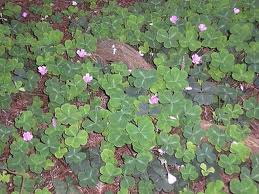
“Isn’t that redwood sorrel?” I asked him and pointed at the big clover-like stuff under the trailside ferns.

“It is,” he replied in a pleasant deep voice, and he slowed his pace a little.

“Then why isn’t is purple underneath?” I knew the plant. I first met it on a visit to Redwoods National Park, and I liked it. Its underside is usually purple, and it turns the underside up when it’s had enough sun for the day. But this stuff wasn’t purple anywhere.

“Wow,” Jack said as he stopped and examined a dozen or so sprouts of sorrel. “You’re right. I’m sure it’s redwood sorrel but I’ve never seen it before without purple. Hmmm….maybe it’s too early in the season? Maybe it purples later, like in August, when the sun is stronger…” He looked directly at me then, blue-eyed and smiling. Our glances connected.

Dinner that night was weird. Peg wanted to talk first about her new contract with the county, which made Paula uncomfortable, and then about her attraction to Jack, which wasn’t fun for me. She went on at length about their morning flirtation. She kept tossing her hair around and looking vivaciously for him in the dining room, but he hadn’t arrived yet. I told her I’d enjoyed the afternoon with him and she asked me if he’d mentioned her. I said no: that mostly we’d talked about past camping experiences and bike vacations.

“Yeah, he mentioned he likes to travel by bike. Well, that’ll have to go if we get together. That’s one mode of travel I won’t do.” That’s just like Peg, already unconsidering his words. I watched her scrape her french bread across the top of the butter tub, and I felt superior for eating my bread dry.

We got Peg off the Jack subject by talking about Paula’s son. David had been a challenge to his mother since he hit adolescence, and that was 15 years ago. Lately, on top of everything else, he’d taken to verbally abusing her over the telephone. Usually she would initiate the call, and most of the time the conversation would quickly degenerate into an epithet-filled tirade from him. The night before we all left on the tour, Paula called David to say goodbye, and he didn’t even wish her a good trip. He was too busy telling her what a bad mother she’d been, how because she didn’t make him study piano from the age of three he couldn’t be a music phenomenon now, how if she hadn’t been so busy working (to support him! after his flaky father disappeared and before husband three came along) he would have grown up strong and right.

“Stop!” Peg put her hand up as she issued the order. “I can’t stand this. Do you realize what you were doing? Do you realize you were voluntarily holding the telephone headset to your ear so that your son could deliver these pearls of poison into you? Hello?”
I looked at Paula at that moment and saw that she was getting it. We all were. Realizing how often we do the equivalent of willingly holding the phone to the ear, the hand to the fire…

“I guess we always have the option of refusing to play,” Paula said quietly.

“A quiet refusal, a gentle goodbye,” I added. Right then, I was proud of all three of us.

The next moment, Jack walked into the room. Peg was still shining-eyed with wisdom, and she greeted him eagerly. In a way it hurt to watch him watch me instead. A very small way. Paula and Peg are both blonde and slim, and Peg has big breasts. But everybody’s got a sissymaker.
Posted in Fiction | Leave a comment

O U Kid (Part 2 of 3)

redwood sorrel

Peg was not hurt, but she’s a complainer. For the rest of the morning hike we had to hear about the chances of delayed symptoms of injury. And although it’s true that after that event, Peg didn’t walk the long option on any other days of the trip, it wasn’t that slide that held her back. Even though the trip information listed extra hiking shoes as a must-have item, even though Paula and I strongly seconded that recommendation, Peg insisted that her one pair of Timberlands would be enough. Her suitcase wouldn’t hold more, and there was no way our stylish friend was going to fly anywhere in hiking boots. The blisters that she started growing on day one ripened by day two, just in time for the mud hike. It may even be that she slid because her foot was hurting and made her step abnormally. Anyway, even with rest and moleskin, Peg didn’t do much hiking after that. Instead she got to know whichever of our tour guides was driving the shuttle. Quality time with Jack or Kurt.

For the remainder of that slippery hike, Paula and I tended to Peg. I tried to look at tree leaves, but I kept returning to thoughts of gender. Reading tree leaves. Remembering how amazed/dismayed I was at how differently people treated my brother and me. We were much alike. Except I was older and smarter and stronger than he. My brother was a really nice kid, but I had more spirit and drive. The only other difference then was between our legs. Our sissymakers. Mom did not teach us different words for our genitals. We both had sissymakers. Through them we made siss. Now, I’ll admit “siss” is onomatopoetic, but I have no idea why our mother decided to depart from convention and consequently (of course) lead us to embarrassment out here in the real world, where people say “piss.” Mom called shit “doody,” or maybe it was “duty,” for “doing your duty;” she never spelled it for us. To poop, in my family of origin, was to fart. Go figure it.

My brother and I both had sissymakers, which looked different but did the same thing. Yet my parents and their friends expected me to be afraid of insects and him to hate dolls. It was assumed that I would be interested in the kitchen talk: babies and food and disease. Actually I wanted the livingroom politics, and I lurked there. My brother was always interested in cooking; it would have been much more appropriate to give him all that kitchen time.

Looking back on it all, it’s no surprise to me that I wanted to be a boy, a lad, a young man. The surprise is that I changed my mind and decided to be a woman. That’s where I got to in my meditations that morning; we reached the crest of our hike and stopped for lunch. I tried to eat light and healthy and I probably overdid my moderation. After all, I was on a walking tour and burning calories; I’m sure I would have felt better and enjoyed it more if I’d just relaxed and let myself go. Story of my life… After lunch we put Peg in the van and Paula and I hiked together.

“I read a book recently and the author kept saying that sycamore leaves are hand-shaped, and sycamore trunks are white,” I commented. “Do you think she was talking about another variety of sycamore? ‘Cause look at these: their trunks are putty-colored. And the leaves aren’t nearly as hand-shaped as maples…” Paula had gotten into botanical and avian identification after marrying her fourth husband; it was something they could share. But she didn’t know any more about sycamores than I.

“I always thought liquidambar leaves looked the most like hands,” Paula answered.

“Oh, no. Not hands. Starfish. Or sailboats after they’ve fallen onto the wet sidewalks: one of their points always upwards like a mast…”

She smiled at me as she imagined that. “We never had liquidambar trees where I grew up.”

“We neither. But we had lots of maples. Remember playing with the polynoses?”

“The seed pods? Yeah…gee: I’d completely forgotten about those… how the hell do you remember all this stuff?”

“I can’t help myself. I don’t know how not to remember. What boggles me is how most everyone else seems to have forgotten.”

“It’s not like you had a really great or really bad childhood, which would – you know – tend to fix things in your memory…”

I said, “I was bored, I was frustrated, and my parents loved me. I wanted every day to count, and I couldn’t stand how much of my time was wasted doing things I didn’t want to do. I couldn’t wait to grow up and have power.

“I knew a lot of other kids, and they didn’t seem substantially happier than I was. Yet all the adults I know now seem to recall these happy childhoods that they want to replicate for their kids. Frankly, I don’t believe I just happened to grow up with the one set of unhappy suburban kids in America. I think my current pals are misremembering.”

Posted in Fiction | Leave a comment

O U Kid (Part 1 of 3)

redwood sorrel

“Once upon a time a child was born. Me. Upon a 1950 time. In New York City.

“I was one of thousands of children born that day. One of hundreds in New York. One of dozens in that hospital. One of several that morning. One of three girls. The only Erica. The only Erica Tucker Washburn. The only child of my parents.

“I didn’t have longer eyelashes than the boy babies. My breasts were no bigger than any other infant’s. The world would learn a lot about sex and chromosomes in the coming decades, and even more about gender and hormones, but none of that was how they determined that the Washburn baby was female. While Eric Washburn sat anxiously in the waiting room, while Ruth Washburn neé Tucker strained and clenched and bore down half-effectively through drugs, the obstetrician cupped my slick head and supported my tiny shoulders with his fingertips and, distinguishing the emergent labia from a scrotum, announced bassily, ‘It’s a girl!’” After saying that I tripped on a tree root, which took some polish off my narration, but my friends were too kind to mock me. The trail was wide enough so we could walk side by side, a little out of breath with the slight hill, and I kept talking.

“A girl. My parents were calling me ‘It’ll’ by the end of the pregnancy. Taken from comments like ‘It’ll be a good sleeper’ or ‘It’ll be a wrestler,’ depending on whether fetal I was quiet or active. The name had grown to ‘Little It’ll’ by the date of actual birth. It was astounding how soon that was replaced by pronouns.

“I was my father’s little princess. I became my mother’s animate toy. All of the baby gifts were pink, frilly and coordinated; little Erica was daily dressed in a precious ensemble. I didn’t have much hair at first. Even with all the pink some strangers thought I was a boy. My parents were adamant and immediate about correcting that assumption. ‘She’s a girl,’ Ruth would inform the erroneous. To ‘What a darling little boy’ Eric would rebut, ‘Girl. Girl. This is my daughter.’ They were acutely bothered when folks got it wrong.”

“You can’t possibly remember all of this,” Peg said in a tone a bit scornful. Peg is abrupt and impatient; she often seems scornful when she’s just being brusque. Paula is slower and more gentle, and made one of her little hums as we three kept hiking.

“Of course I don’t remember this part,” I countered. “But I have some vivid recollections from about age two to five, and stories from my parents, and I’ve extrapolated backwards.”

Peg persisted. “ I can’t believe you can remember that young,” although she wasn’t doubting my honesty. “I don’t think I have more than three memories from before high school.”

I do. I remember. I think it’s what helps me change.

I don’t have many clothes, but what I have range in size from 6 to 14. I’ve been 5’7″ for the last 35 years, but my weight has been every number from 140 to 190. My hair is usually curly, most often short, and may be any color from its natural salt-and-pepper to whatever shade my conservative colorist selects. I have a lot of looks.

Then, for example, I weighed 175. I’d picked up some stressy pounds. I was wearing my hair dark auburn, about chin length, with enough products on it that it fell in waves and ringlets instead of bushing out in frizz. But six months before I’d weighed 155 and had darker shorter hair, showed my belly more, walked younger. That felt better. I was turning the vector around…unh…aw but it’s unwieldy…inert…unh…there!

I’m a (shape)changer but no mistress of disguise. No quick-change artist, me. It takes me awhile to translate me. But I do it all the time.

I was into it then, among the curly-edged spear-leaves of pittosporum, amid the coin-leaves of a big oak, while the white sky peeked through at my effort. I was changing while hiking. On tour.

Not so my friends Peg and Paula. Each keeps coloring her hair the same shade of blonde, wearing the same professional garb, marrying the same type of man, longing nostalgically (gaack!) for romance (oh lordy…)

You may wonder why I’m friends with them, thinking of them as above. The answer is they’re nice women (Paula is, anyway), and being with them sometimes is better than being alone. They’re not always boring.

The thing about Peg and Paula that amazes me most is they have no memories. They don’t remember their childhoods, or how they felt about sex when they were 12, or when they stopped loving their husbands.

Then I said, “I’m telling you: I have some memories from before my brother was born – from before age three – and I know they’re real because they were too mundane for my folks to make photographs or reminiscences. And I very much remember events from age five and six, when I first noticed gender bias.”

My oration was mud-interrupted. The grade we walked had become steeper and wetter, and the ground had enough clay to be slick, enough ruts to be muddy. Peg’s foot slipped and she went down on her left knee. Paula tried to keep her upright and got a wrenched arm for her attempt. I was a bit ahead of them; I stopped talking and turned to see Peg kneeling on her left knee and Paula standing by her with a hand near Peg’s shoulder. I stepped back to them, slid a little myself, and helped Paula pull Peg upright.

Posted in Fiction | Leave a comment

Questions and Answers

Question%20mark%20button[1]

For what is it assumed when I stay home
I do not work, who’s known for working hard?
And why when I report I wrote a poem,
do many dread the jingle of a card?
How came the custom to take Friday out,
if fortunate enough to trim the week,
when Monday is the problem? What about
alternatives? Can’t you see them? Speak!

It’s difficult to fully fail a test.
You need to know your stuff to get it wrong.
Misunderstood and slotted in a nest
of ducklings where I’m sure I can’t belong,
I bow my neck and spread my winds and fly
above the gossamer. I kiss the sky.

Posted in Poetry | Leave a comment

Navigator

talk2

My path of least resistance is of late
a freeway to romantic fantasy.
Imagining the way we’ll punctuate
this talk is irresistible to me.
Continuing our dialogue in mind
the while I walk or work or rest or rush,
I find I think of little else, inclined
to smile of a sudden, and to blush.

It seems you’ve leased a chamber in my heart,
and soon you’ll understand I don’t evict.
You’re moving in my head now. There’s a part
of wonder – stay! – I say, my only strict
requirement, the privilege I implore,
is ask and answer: Talk to me some more.

Posted in Poetry | Leave a comment

Joy (Part 2 of 2)

walkaway

“It’s worked for me.” She startled at my voice. “Working I mean. The first half year I was married to Matt I didn’t have a job. Took to staying home and indulging in unhealthy habits. It got to where I wouldn’t even venture to the little corner store for cigarettes, because that meant talking to the clerk. I got totally nauseated one afternoon, trying to smoke Borkum Riff pipe tobacco in a hand-rolled cigarette. I hate vomiting. That experience made me answer the clerk/typist ad that led to the job that led to the career that – let’s face it – has sustained me almost every way since. So no: I’d say working is good for me.”

Joy hummed a response that could have been realization, resistance, or both: “hummh!” with her lips closed, exhaling like a snort through her nose. “I don’t know,” she articulated. “I wish we could go back to how it was in the beginning. Full of future. Nowadays I don’t even want to have sex with him.” That’s how I figured out she was speaking about her marriage to Matt in particular and not about life in general. Her comment struck me, of course. One thing I thought Matt had always been good at, even when he got dull about each day, was sex. And I remembered him baiting me when he first got together with Joy, making comments about how great it was to be with someone who enjoyed it and knew how to use her teeth.

We were interrupted by the sound of Matt’s Birkenstocks on the stairs. Our son and daughter clumped after him, apparently not eager for this dinner out.

(They find Joy a drag. They’re willing to sit through grace and they try not to interrupt her boring stories, but they don’t want to call her “ma’am.”)

Matt stood at Joy’s shoulder, a shorter fatter bitter version of his younger self. His height was reduced by the back surgery but the Buddha belly has been his own accomplishment. (Our kids take after him and remind me of the man I used to love, but he doesn’t.)

He looked old and tired and tense. Joy looked resigned and unhappy. At least the kids appeared young and fresh. They left and I flipped on the porch light in their wake.

I smiled with a little satisfaction as I climbed the stairs to my bedroom and study. I had a couple of hours to myself and I intended to indulge my passion for home, comfort, and coziness. (Left alone, home is where I’d always be. Cozy’s how I’d always feel. Left to my own inclinations, I would sink back into the eiderdown comfort and suffocate in feathers and my own CO2. But for two hours it’s safe. Home as respite must be okay.)

I smiled too as I recalled an encounter that morning. I was four blocks away from home, almost to the train station, when I passed a neighbor whom I don’t know. He’s a rather homely man, crane-thin, long-nosed and forward-leaning, who lives three houses from my far corner, on this side, and I pass him sometimes on the sidewalk of our block. We’re both reserved. We sometimes smile. We never speak. But this morning, finding each other a full four blocks away from our normal turf, we each exhibited a little delight, a little glee of recognition, and we naturally spoke.

“Hi.

“Good morning.”

It never would have happened that way, if I hadn’t left my house.

Posted in Fiction | Leave a comment

Joy (Part 1 of 2)

walkaway

She said, “People ought to be careful what they call their kids. I’m just now starting to learn how damaged I was by my nickname.”

(Joy. She’s called Joy.)

“I kept trying to live up to it. Always had to be the happy one. It was the role assigned by my family.”

“How’d you get the nickname?” I asked as much to divert the flow of her ranting conversation as to get the answer. But it did seem strange that someone with the full name Jody would have a nickname. Almost as senseless as Jack for John.

“My baby brother had trouble with Jody. Made one syllable out of it. They tell me it sounded like ‘Joy.’ My folks went along with it.”

(I would rather have been alone right then, in my cozy study at work on some problem from the office or puzzle on the Internet. But what could I do? The woman sat at my dining room table, talking depressed. Her husband, my ex, was upstairs dealing with our shared son, and I couldn’t see a way to escape her company.

(In the one picture I’ve seen of Joy young, she looked typically pretty to me, but the small features and large breasts haven’t aged well. Of course she could recapture some of that streaky blonde cuteness with cosmetics, hair color, and a good bra, but Joy doesn’t seem to be into style. Most folks assume she’s gay. She always wears loose trousers and shapeless tee shirts. Her hair is dull uncombed. Her breasts swing like water balloons. She moves from the shoulders when she walks, and her Georgia drawl sounds redneck.

(A week ago my son told me he hates Joy’s body. I thought that was a provocative statement from a 16 year old, so I stopped what I was doing and asked him what he meant.

(“She’s never like this: open and happy” he demonstrated, pulling his chest upward and swinging his arms wide apart so he filled a corner of the kitchen. “She always slumps,” and he collapsed his arms inward, inverted his chest, and closed himself around his torso.)

That recollection made me pay attention to Joy’s present posture: arms crossed above her breasts, right leg twisted around the left, face drooping, eye almost twitching. I didn’t know what to say. I felt like shaking her out of it, except I didn’t want to touch her.

She spoke again. “You seem to be all right: living single,” and she looked at me, clearly waiting for a response.

“I’m pretty happy,” I acknowledged. “But then I don’t get much chance to be lonely, with the kids and all.” That was my attempt at self-deprecation; I really didn’t want to take off on how glad I was when the kids were with them, how relieved after nearly two decades to have a bed and bedroom of my own.

(Maybe if I stopped working so hard and smoking so much pot I would feel lonely, like I do in a hotel room when I force myself to vacation, alone in bed without my homey comforts. But here, now, with my stuff, home alone is like heaven.)

“Yeah, I was okay too, as long as the kids were around. But after my daughter left I started to sink. It might not’ve happened if I’d been working at the time – you know how a job can keep you together – but Bill was still paying alimony then, and I was staying in my house way too much. Smoking pot and tobacco and watching daytime TV.” She paused and twitched around so I knew she wanted a cigarette then, but no way was I going to allow that inside, and she didn’t want to go out (Joy avoids light like a vampire when she is depressed).

“Then I took to going to bars to try to meet guys,” she resumed. “That’s where I saw Matt. Under the circumstances, he was an amazing find.”

(Matt’s okay. Bright, not deformed, able to earn a living. But my ex-husband is fundamentally pessimistic, insecure, and boring. That’s why I didn’t keep him.)

“So we got married,” and she looked directly at me again. I remember Matt was so desperate that he would have proposed to any of many. Joy accepted. “And for awhile, life was great. Moving ‘cross country, being newlyweds, accumulating stuff together. I got a good job at the hospital. Maybe I should’ve kept that.”

Posted in Fiction | Leave a comment

Goose Summer

9.8.08

I looked up “gossamer” some years ago, and I was charmed. But when I prepared to post a piece with that title recently, and searched for a picture on Google Images, no geese came up. I could feel the original sense being lost. I figure it won’t hurt to record it here.

“Gossamer” is an elision of the words “goose summer.” When flocks of geese fly all at once, at each end of their season of migration, so many feathers take the air that the atmosphere is littered with fluff. It’s as if all of us shook winter-used blankets out, in the sun, all at once: the dust motes would prevail around us.

Gossamer is the word that arose from all the seasonal airborne goose-fluff, and we use it now to describe tissue-thin fabrics and cobwebs and mists. But it doesn’t hurt to smile at the sense of goose the word contains.

Nowadays it may be that language is changing faster even than glaciers calve.

Posted in Language | Leave a comment