Friday

220px-Cerebral_lobes[1]

I woke at 3:15 and didn’t fall
asleep again till it was nearly day.
My shoulder hurt a bit. I don’t recall
an injury; it didn’t go away
no matter my position. Then my head
began the monkey-dance of wakeful night:
regretting friends and relatives now dead,
reviewing tasks I’ll tackle when it’s light.

Emerging from my rumpled sheets at 6,
I took 3 aspirin and my measure, too,
concluded that I need a break to fix
my scapula, my rest, my point of view.
I’m skipping exercise. I’m stepping back,
inviting what’s outside to blaze my track.

Posted in Health, Poetry | Leave a comment

Change of Life

220px-Cerebral_lobes[1]

Assuming I inherited the curse
of fierce impatience from my hasty mom,
I tried to justify it. Sure it’s worse
to suffer, I asserted with aplomb,
complaint or pain in silence! Not my goal,
I told my friends, and yet I wasn’t pleased
with how I rushed. Attempting to control
my dash, I soon relapsed like one diseased.

I saw, I diagnosed, and yet I missed
the obvious and big discrepancy
in static Mom and me. I faced a list
when I was young – I teemed with urgency
and obligations daily raced between.
I have the leisure now to be serene.

Posted in Aging, Poetry | Leave a comment

Sis and Cass

two_silhouette_profile_or_a_white_vase

Our dog came to us one year old and already named Sue. Within a month she revealed herself. Sue was a creature of sea-level allergies. She repelled fleas, but reacted negatively to 36 other (mixed blend) insects. We know this because we had her blood evaluated for antibodies, which is a telling exam. The old scratch test only reveals whether the patient will react to certain applied allergens. The antibody study uncovers what the body has already rejected.

So Susie had to take prednisone. She had to be given desensitizing injections. She became untrustworthy around strangers, because of the steroids. She became a bit less reactive to her environment because of the pills and the shots. It was too bad she had to live at our low elevation; most of what her body didn’t like doesn’t exist at 7,000 feet above sea level, and the times we took her camping at altitude, her skin cleared up immediately.

The other characteristic Susie exhibited was her calling. Most dogs are bred for some purpose, and a mutt is no exception. You just have to wait to see what the predominant trait is. Susie looked like a ridgeback but she was no hunter. That animal lived to retrieve. Especially tennis balls.

She’d try to get her mouth around a soccer or basketball. She’d catch a baseball till her mouth bled. But there was something about the fuzzy green variety that really turned her on. There were times she’d yank the leash out of my hand, dashing 30 yards away into a big clump of ivy, returning with a ball only she could detect. She always had at least one tennis ball in her big bed basket. At times she’d pick one out of a dozen and systemically skin the thing, leaving ball-pelt pieces before her. We could never figure out how she determined which balls to skin. We were happy that she didn’t ingest them (our vet told us stories about having to surgically remove ball parts from retriever guts).

Susie was energetic and required exercise. We walked her at least twice a day. The middle school a few blocks behind our house became a favorite destination. It was on that field she’d go after soccer balls. The vacant lot between the school and our neighborhood would become Alice Waters’s first “edible schoolyard,” but in Susie’s early years it was dirt and weeds and patches of broken glass: a good running ground for dogs off-leash. Best of all was the steep asphalt hill that plunged from the parking lot down past the main building to the gym. We liked to sit at the top of that hill and toss the tennis ball for Sue. She’d race down after it, pound back up to us with it lodged where it belonged, and then start her dance of excitement to do it again, still with the ball in her mouth. After a few steps she’d relax her jaw and let the ball drop, but it didn’t stay there where she could pick it up again, and again give us the schizophrenic routine of “Throw it! No wait: it’s mine and I have to hold it! No – throw it! No – I have to bite it!” That ball rolled straight back down the slope. And off went Susie. She’d keep going at self-retrieval till we leashed her and hauled her away. The longest we lasted was 25 minutes and she wasn’t about to quit.

I said it was too bad we couldn’t change her name to Sisyphus. Then I had to describe that character’s fate: how he had to keep pushing a boulder to the top of a hill and every time he got the stone near the apex, it rolled back down and he was compelled to start again.

My kids laughed at me. They told me it was too late to change Susie to Sissy. Anyway, they said, in Sue’s case, the ball rolling back is not punishment. It’s extended play.

I had to put Susie down 10 years ago. She lived a good long life, but at almost 16 she let me know it was time to release her. I remember her, and her lessons, well.

So when I met a fellow recently who described himself as a modern-day Sisyphus, I paid attention. I don’t often encounter people who use that name in conversation. There have been times when I’ve identified with aspects of Cassandra; I was ready to listen to another classics-based personality.

I got a little excited then. But I was soon dashed to disappointment. Because when Orson likened himself to Sisyphus, he meant that he hasn’t gotten anywhere in his life. He meant that no matter how hard he works on his attitude (depression treated with some beer, more cannabis, and most exercise), he doesn’t get anywhere. I think he really meant “one step forward and two steps back.”

Because the truth is, Orson isn’t pushing any weight. And he’s ignoring the fact that Sisyphus’s boulder gig was punishment. The man had cheated death. He’d fucked with the gods.

Not so Orson. There’s no heroism or villainy in his past. Just regular old white-boy, gender-confused, suburban upbringing by needy narcissistic parents. The usual post-WWII sociology.

I don’t care enough about Orson to criticize him. So I’ll turn the scope on me. Look at my Cassandra thing. Didn’t I just grab her punishment and ignore the cause that preceded that effect? I latched on to the idea of the clear truth-teller, doomed to be disbelieved. I loved that concept. I saw myself in it.

But I ignored what went before. Cassandra captivated Apollo. The god fell for her and talked her into sexual congress by promising her the ability to foretell. Then she backed away. She revoked her consent. Apparently, “no” means no on Olympus (unless you’re dealing with Zeus).

Apollo was pissed. But he couldn’t take away the gift he’d bestowed (like the good fairy in Sleeping Beauty could only modify a curse and not remove it – apparently this is one of the rules in the “bless and curse” field). So Apollo said something like, “Fine. Be that way, you tease. I’ll show you. Sure you’ll foretell correctly. But I’m arranging it so NO ONE will believe a word you utter.”

I’m not eligible to use the name Cassandra, classically. And Orson has no claim on Sisyphus. But his affectation has prompted thought.

Camus wrote an essay on Sisyphus. In it he asserted that there is no torture greater than being doomed to fruitless labor. Like futility is the greatest grief.

I disagree. I think we’re born to work and the worst curse is never finding the work you need to do. Destruction of your product doesn’t undo the making. Getting nowhere doesn’t negate the travel.

Susie demonstrated how joyful non-accomplishment can be. She was a living testimony to the idea that the means totally win out when compared to ends. I mentioned this idea to a friend and he said, “Yeah, but a dog has no sense of time. No past or future. A dog lives in the present. So having a dog’s work not result in anything valuable… that has no meaning in the canine brain. But a person! A person is always aware of the future. To a person, getting nowhere is punishment.”

Maybe. But maybe not.

Posted in Fiction | Leave a comment

Garden Gnome

Yard May 20

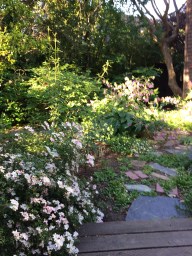
My garden has a dozen shades of green,
a peppering of purple, yellow, white,
and red, below a jacaranda screen
pale violet against the summer light.
It features branches, flowers, leaves, and vines.
It welcomes birds and makes the squirrels fat.
A skunk has bunks beneath the deck, and dines
on grubs and preens at night upon the mat
that lays outside the threshold of my door.
I know all this, because of late, I’m here
as much as possible. Enjoying more
of its selected perfect atmosphere,
this garden is my favorite place to be,
and now its newest ornament is me.

Posted in Critters, Neighborhood, Poetry | Leave a comment

Why Not?

Alt Forest

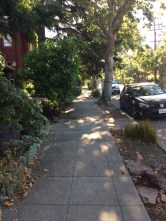
I walk for transportation. People ask
where do I get the time to move that way?
As if a chance to meditate’s a task,
or trekking this topography’s a gray
obnoxious labor. What would I prefer?
The stress-release of walking on these streets
in mild weather, or incurring sure
distressing traffic and electric tweets?

Likewise, now I’m not working for a wage,
no longer hormone-driven or impelled
to multi-task – now I’ve attained the age
of looking longer, slower, time has welled
and given me some days to care for you;
there isn’t any job I’d sooner do.

Posted in Aging, Poetry | Leave a comment

Tissue Lint

tissuelint

I got so old I now have allergies,
or maybe it’s particulates in air,
but often I’m beset – I sniff and sneeze
repeatedly. I blow my nose and tear
the tissue, marveling at sinus spill.
Too young to tuck a kleenex in my cuff,
I carry them in purse and pocket. Still,
I’ve suffered times I didn’t have enough.

So there are folded tissues in my bag,
and semi-crumpled versions in my jack-
et, hoodie, pockets of my jeans. The drag?
When I neglect to take the tissue back
before the laundry starts: before the glint
of white on clothing flecked with tissue lint.

Posted in Aging, Poetry | Leave a comment

Dietribe

salad

Imagine zero carbohydrate meals…
I couldn’t eat so easily; the seeds
and nuts, the beans and berries – these appeal
ahead of meat. My satisfaction feeds
on salad, almost every afternoon.
I don’t adore fried chicken, want a steak,
but I’m a whore for cherries, and I swoon
for avocado more than coffee cake.

I gave up being perfect long ago,
and recently forsook apologies.
Now I’m reducing carbs, but so well know
my taste I’ll fail if I’m confined to cheese
and meat and eggs, or even shiny fat –
my tongue’s too tuned to tart to live like that.

Posted in Behavior Modification, Food, Health, Poetry | Leave a comment

Sweet, But Not Real Bright

two_silhouette_profile_or_a_white_vase

“Joy’s kind of like a retriever: sweet but not real bright.”

My husband said that to our daughter, and she told me.

To put the scene in perspective, they are not young: 68 and 40.

I was shocked. I’d never heard the analogy before. I thought it was a disloyal statement to make about one’s spouse. And I knew it was untrue. About retrievers anyway. My last dog had been a mutt but her dominant quality and talent was fetching. Susie was very smart. And maybe it was the regular prednisone for all those allergies, but my pet’s disposition was not sweet.

It wasn’t true about Joy either. I have no argument about her (lack of) intelligence, but I’ve never seen the sweetness. And based on some of her careless cruelties when my kids were young and had to put up with her stepmothering, narcissistic and needy and petulant seem better adjectives for her, no matter how sincerely she has apologized recently.

It was disloyal of Hank to speak of Joy that way, but I am permitted to so-describe Orson. I met him on public transit a month ago and our fast acquaintance sparked some interest. Then we got together. Uh oh…

The man is ten years younger than I am. That’s okay. He’s tall and not unfit, physically. Again, good. But I’ve now spent two afternoons with him, talking and walking and talking and resisting his attempts to handle my body or get me to handle his, and I have to conclude that he’s probably innately sweet, but not real bright.

I don’t think I’m an intellectual snob. I’m educated and well-read, and I understand language better than most, but I’m smart enough to know how much smarter I could be. And once one exceeds a certain intelligence threshold (probably an IQ of 115 or so, if you believe in IQ), that’s good enough. Willfulness and resilience count more then.

The problem with Orson is I doubt he meets that threshold. And even if he does, and even if his trajectory demonstrates resilience, he’s too sad for me.

Admittedly, I’ve enjoyed talking about myself to him. In fact, I’ve savored describing myself to him, in my imagination, more than the reality of actually speaking to him. But I have spoken and I have listened to him speak. Here are a few of the things I’ve heard:

On the subject of tattoos: “No, I don’t have one. I’m a universal donor.” (I replied, “You mean you’re O positive?” and I thought, “Does he really think they’re cross-typing in San Francisco?”)

Regarding children: “I never had any. Never wanted any. The world’s too crowded now.” (I’m thinking: “Oh yeah. That’s why someone doesn’t have kids. Sure.” And when he indicated maybe he’d change his mind about that, and I blurted, “Orson, that ship has sailed,” he asserted that 57 is not too old to father a kid).

On-demand water heaters? He opined that they’re trouble. I asked why. He commented that because the hot water doesn’t run out, you’ll use too much. As if the length of time one spends in the shower is governed by the water tank…

I asked him if he’s involved with anyone (this was after I confessed it’s been at least a decade for me). He pondered for a moment, admitted it hasn’t been ten years with a smile, and then described his latest affair. It ran for three months – all of last autumn. He’d met the woman in a park, while walking his dogs. She was married but not getting any. They agreed on an arrangement, meeting every Sunday evening in the park, and fucking in the bushes. (“Say what?”) He acknowledged it was simple sex, with clothes on. He said they went to the movies once when her husband was away, but it was a bad flick. (I can’t count the number of ideas wrong with this story). Then he asked me if I thought his behavior constituted cheating (Me: “No. Adultery yes. Cheating no.”)

He asserted that he’s a “cheating bastard.” He said the last time he had a real girlfriend, with whom he spent most nights (still retaining his apartment but not using it much) and adopted a dog, after the relationship fell empty of all but dog care, he took up with a neighbor. The women found out and both of them dumped him.

He also declared that he’s an asshole. That comment was apparently an acknowledgment that he has some anger issues (who doesn’t?). But he qualified it by stating that he only exercises his asshole-ness when he encounters someone who’s a bigger asshole than he is.

He said he likes to read. I asked him what. “Right now, just some magazines,” he said sheepishly. And then he admitted, with obvious embarrassment, that his favorite genre is sci-fi. (I didn’t understand then or now what’s wrong with that.)

“What’s your biggest peeve?” he asked me the last time we were together. I couldn’t come up with just one. He announced that his is species extinction. (Peeve? He calls that a peeve? That’s a fucking grief!)

I don’t think he’s an asshole or a cheating bastard. I’m inclined to go with “moron.”

But he appears to be sweet. He’s been repeatedly disappointed, by his parents, his brother, the high school buddies who at a party injured him and gave him the disability that narrowed his future, and probably all the women he didn’t properly approach or cherish since. But he didn’t “eat his shotgun” back when he was 18 (he’s told me that story both times we visited), and he seems to be trying to live authentically.

It’s obvious he deals with frequent sadness. When I asked him how he treats his depression, he looked at me with a sincere face and said, “Exercise.” As far as I’m concerned, that was Orson being real.

It got to me. Almost made me receptive. So when we stood to say goodbye and he leaned in for a kiss, I responded. It wasn’t repulsive, but I can’t say my knees melted. Then he groaned a little, kissed me again, took my right hand off his shoulder, and tried to move it to measure his erection.

Whoa! My reflexes were faster than my mind. I spun from him and paced away, muttering “arrested at 17” (that was his age when the disabling accident occurred).

“I wasn’t arrested,” he said.

“Developmentally. Sexually.”

I should not see Orson again. I should change names, switch this to third person, and submit it to my writing group. I told myself (and him) that I’m not ready for sex with him, but I’d like to get to know him better. That there may be a spark upon further acquaintance. But as I type it, I know it won’t happen. He’s a dim bulb.

But it’s his birthday today. He asked without a leer for a little time with me tonight. I’ve agreed to serve him a berry pie and beer.


That’s the last Mom wrote. She didn’t submit anything to her writers’ group the next morning. She didn’t go to the office. A day later I got the call from her assistant. I did what I could remotely and then traveled here. To find her place abandoned and this draft in her office.

It’s just not like her to disappear. Especially without word to me. I’m trying to get the police to pay attention, but I fear she’s with a cheating bastard asshole. Or was. 
Posted in Fiction | Leave a comment

Ermine

My hair was almost black when I was born.
A young brunette, I argued with my peers
that contrast was more lovely, long or shorn,
but now I’ve grown my sable white with years.
I used to be the youngest in my crowd.
I skipped a grade, attracted older friends
with my precociousness and through my loud
unceasing mouth, but now my health extends
my vigor, while my cohort stoops and wanes.
I’m spending time with younger folks than me,
so getting used to being senior strains
the way I’ve viewed myself historically.
Such shifting qualities are nothing strange,
adapted as we are, to notice change.

Posted in Aging, Poetry | Leave a comment

Seeking Sneaking Sun

skunk

When I sit in the sun I’m overhot,
but inside it’s too chill to bare my knees.
Now matter where I opt for, I forgot
the fickleness of sixty-five degrees
in summer – shifting from the inside out
and back indoors with schizophrenic funk.
It’s just our weather – downy fog about
the bay, provoking me and neighbor skunk.

I’m used to polecats underneath my place –
they share the ground with ‘possums and perhaps
racoons (I hear but seldom see a face).
My yardmates as a rule are taking naps
while I’m awake, but lately there is one
big skunk that seems to want the midday sun.

Posted in Critters, Poetry, Weather | Leave a comment