
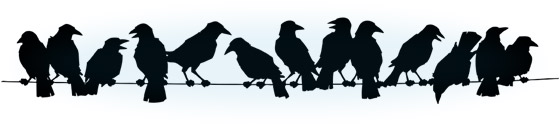
Bertilda is furious. That’s an apt adjective; the old woman is mad. She has spent most of her life being angry. She’s in her mid-80s now, regularly misplacing her memory, her cat, and her keys.
She could be a model for a Fury too: angular and twisted, with a lurching walk, crazed hair, skeletal features, permanent scowl. She’s a hateful individual and an obnoxious neighbor.
Her newest tirade is about the crows. She’s always had issues, and most of us who live nearby are accustomed to the way she yells from her front window about how people park their cars, walk their dogs, or place their recycling containers. We’re used to the way she’ll come knocking at the door, ask if we have her missing mailbox key, and then scream at us if we dare to suggest that it may be sitting on some surface in her small condominium (we’re all been in there, now and then, so we know the amount of stuff constitutes a hoard almost big enough for a reality show). But the cawing and shrieking about crows is new.
Bertilda has a normal speaking voice. But she doesn’t use it often; mostly she yells. That’s unpleasant. Harsh in tone and foul in vocabulary. She slaps the air with “Fuck you!” and “You stupid asshole! You shithead! That’s why I hate you fucking Americans!” (she’s German-born). The only time her voice is nice is when she’s calling her cat. She always has a cat (or two). She adopts them. Occasionally a cat disappears. She then blames her (unidentified, unspecified) enemies, for killing them and hiding their corpses. These are the same enemies she accuses of moving her parked car, nightly, and stealing her keys.
Her current cat is a handsome, perverted Russian Blue named Louie. Like all of her pets, he’s an outdoor animal. When Bertilda calls him, her voice sounds musical. Instead of “Kitty kitty kitty” she sings “Louie Louie Louie.” Whenever I hear her I think of the “Suey suey suey” pig-call.
As far as I can tell, the crow population boomed several years ago. I’ve lived in Berkeley for decades, and we never had the black birds before. Jays, robins, hummers, even seagulls, yes, but no crows and no pigeons (sighted just last winter, probably related to the ongoing drought). The crows can be loud. They’re a bit intimidating, they way they flock to a big tree and occupy it. And they shit.
Bertilda rants regularly about them. We all live in the shade of a magnificent 200 year-old oak tree (its trunk is in my back yard, across the creek, but its crown shades the adjacent yards and its roots probably know the whole block). Sometimes large communities of crows meet in the tree at dusk. And there are other roosts around as well: the bay laurel between me and the north neighbor, the black walnut between me and the Bertilda-Anne-Jerry condo arrangement. Our yards host crowds of crows, squirrels, and raccoons (we’ve seen opossums and skunks too, but they don’t mass in big numbers).
Her vehemence began when she found the robin’s nest. It had tumbled from the walnut tree and it still contained shards of blue eggshell. “Crows!” she snarled. “Damn beasts ate the babies!” A day after that, I went to check on the hummingbird nest, and it was gone. I’d noticed it in the crotch of an old rose bush that straggled under the oak. I’d shown it to Anne and Bertilda: a quarter cup of twigs and fluff, tightly bound, with two jellybean sized eggs nestled (!) in it.
Bertilda blamed its absence on the crows too.
I seldom agree with her, but I was no fan of the black birds either. It seemed like they’d arrived en masse a few years ago, taken over most of the tree tops, and weren’t going to leave. Their calls were grating on the ears. Their shit looked like blops of tar on our redwood decks.
So I googled the question: “why are there more crows around now?” and the subject popped up on my screen before I had typed six words. I started to read when I was distracted by Louie.
That cat is weird. He’s pretty, with his short even gray fur and his vivid eyes, but he’s so skittish he won’t let me near him. Just then he was nosing around the small patch of grass between my back door and the creek. He picked a spot near the center of the green, and then he shat like a dog. Really. Right out in the open, looking back at me like he was soiling my place deliberately. When he finished he did nothing to bury it. He examined his shit and then waltzed away, tall up and asshole breathing. It seemed to be a hostile act.
What the hell. Louie shouldn’t even be outside. They’re called “house cats” for a reason. They live much longer if they stay inside. Owners of outside cats never pay any attention to where their pets defecate. And just about every outside cat I’ve ever known either had a short life or acquired bullet wounds along the way.
I refocused on my ipad screen. And got facts and answers immediately.
Crows eat our waste. Their populations grow when human populations do. We toss so many fast-food remnants that we create feeding grounds for the corvids. It’s warmer in the city than the outlying areas by 5 to 10 degrees; crows like that too. And we tend not to have great horned owls, which are their main natural enemy.
In the 1980s, the annual crow count around here was 30 to 90. Two decades later and the count had soared to about 1,100. It’s more than that now.
To add to all of that, around 40 years ago crows were added to the list of species protected under the Migratory Bird Treaty Act of 1918. That’s when farmers mostly stopped shooting them.
Along with the numbers, I picked up other bits. I read that crows may be one of the most intelligent animals on the planet. They can recognize human faces. They mate for life. They spend about 5 years rearing their young. They build strong crow communities. All the noise in a tree is probably about sharing news of the day before roosting for the night.
No one knows why a group of crows is called a murder. The birds are scavengers, so they’ll tend to be near corpses; maybe that’s the link. Because even though they have a reputation for stealing the eggs of songbirds, in truth the perpetrators of egg-theft are usually squirrels and snakes.
Well, we don’t have snakes in our neighborhood ecosystem. But we have so many squirrels that I no longer find them cute. I once took a naturalist-guided hike through some peninsula forest area, and I remember him picking up acorns and talking about live oak propagation. I told him about the huge oak tree in my yard and commented that I never encountered an acorn on the ground beneath it. He said, “Do you notice squirrels?”
That’s when it struck me: how large our squirrel population is. When I first moved in, I thought they were interesting. It charmed me, the way a sitting squirrel curved his tail so he seemed to be the shape of a question mark. It impressed me, how they spiral-raced up trees and, when the loser fell 40 feet to the ground, his light flexy body was not injured. But over time I’d come to find them tiresome, with their seasonal chittering, their litter, their tendency to use my roof like an outhouse.
Right then something else struck me: the flicker of fast movement in my peripheral vision that made me look out the window and catch Louie torturing a bird. I couldn’t tell what kind of bird it was, but I saw that it was small, fluttering maniacally, and doomed. I knew it wouldn’t help for me to chase the cat away; even if he abandoned his prey, the little critter was near-dead and on a sure course to achieve that state.
With cat-hate in my heart, I watched Louie finish the slaughter and slink off with most of the corpse.
And that’s how I became pro-crow.


 Sputterpub's Blog