
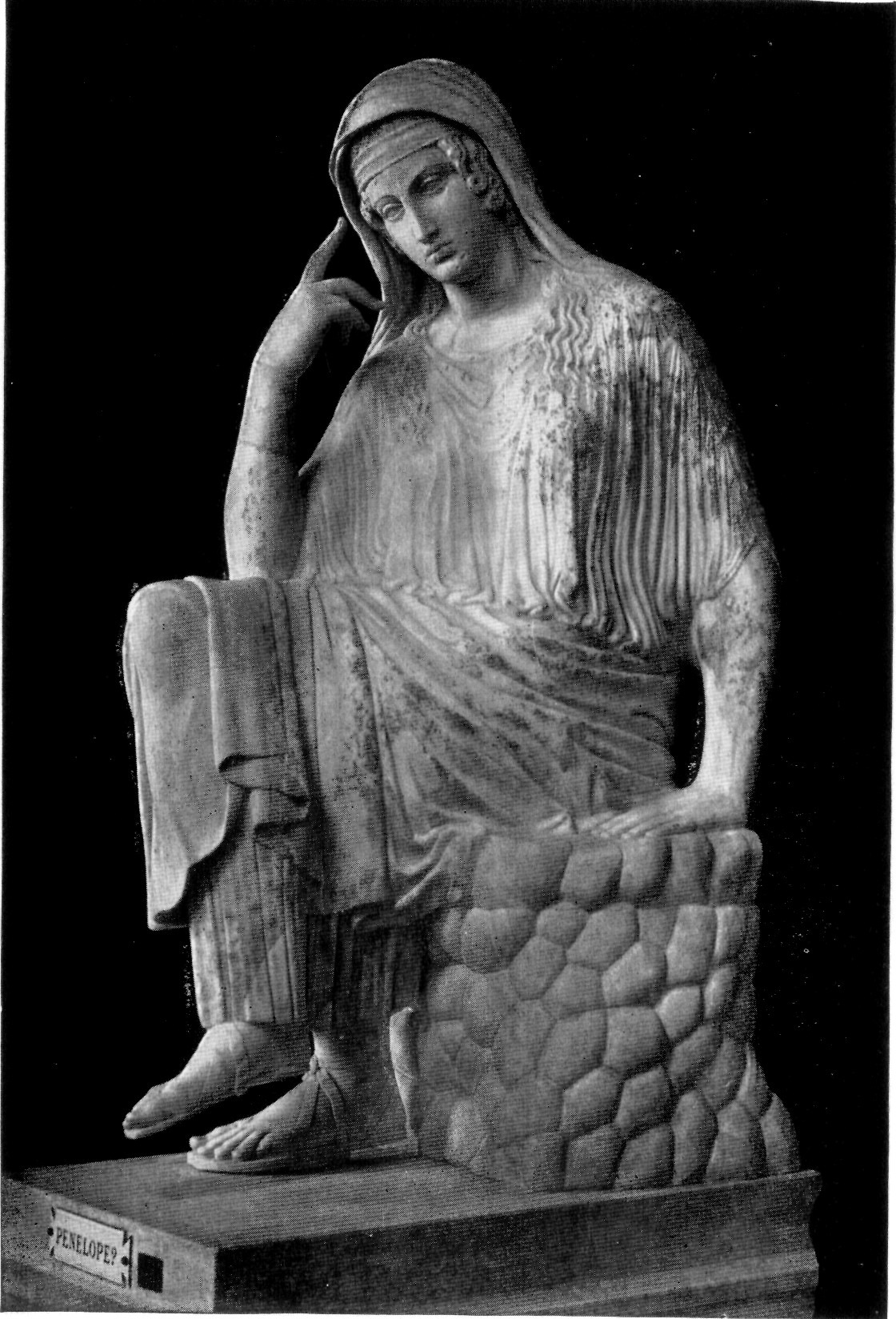
Her parents had no clue how inappropriate it was to name her Penelope. It was her mother’s idea, because she liked the sound, and her father agreed. At first they called her their little Pen, then Penny-pen and even Penny Penelope, but by the time she was six she insisted on just Penny.
Pén-e-lope, was how her named looked to her. Three syllables. When she pronounced it correctly, Pen-él-o-pee, it reminded her of calliope, the rolling circus organ. She didn’t learn until she was fifteen that Calliope was the name of the Greek Muse of epic poetry. Then she looked into epic poetry, and first read the Odyssey, and met the original Penelope.
And discovered that she bore the name of a woman famed for patience. The first Penelope slept alone for more than a decade while her husband battled the Trojans, and then she waited another dozen years while he found his way home.
Not so young Penny. Born to an antsy mother, quick by nature, she had been impatient from birth. She cried louder for her bottle than other babies. She was readily fretful. She was a beautiful youngster, but not an easy one.
As she grew she continued to be attractive, and she learned to conceal some of her fretfulness. She tried to limit her regrets, which she came to see as backward fretfulness; she thought regret was not a fruitful emotion. As for forward fretfulness, she divided that into the positive (impatience) and the negative (worry), and then she justified the former as if it helped her avoid the latter. But she was always a compulsive responder – Penny couldn’t hear a question without voicing a reply.
Lovely, bright and personable, she was well socialized by the time she was twenty-two. She married her first husband then because she was impatient to get on with her life. The excitement and energy involved in the engagement, wedding, early homemaking, first-house buying, and child-birthing kept her interest for almost seven years, but then she got antsy. She felt old and bored and dismal. She had an affair.
Her paramour was named Patrick. He was a bit of a wild Irish boy who seemed younger than his thirty-five years. Pat matched Penny’s impatience with impulsiveness; the two of them took a lot of silly risks in their two years of trysting but some deity must have smiled on them (they were a pretty pair, and pretty erotic) because they never got caught.
They were both married throughout their affair. Pat had been chronically unfaithful to his wife Eileen, but it was the first time out for Penny. She looked at Pat as her professor on infidelity, which wasn’t wise on her part but was very flattering to his.
All of Pat’s prior playmates had been single. They just went to her apartment or condo whenever he felt like it. But the affair with Penny presented logistical problems. They neither had extra money, so renting a room wasn’t practical. Their first time was in a vacant lot near Penny’s house. Pat did the chivalrous thing – he spread his suit jacket on the ground for her – and then discovered smashed snails on the jacket back when he got home.
Occasionally a single friend of his or hers would lend them a key for a midday meeting, but mostly they had to be resourceful. He drove a roadster, and they were limber enough to manage several positions of conjunction in it. Penny took to wearing skirts and leaving her underwear in the car when they went for nighttime walks in parks that had private places, under pedestrian bridges or behind the band shell building.
Of course these machinations spiced their time together, in fact and especially in memory. Although their affair ended after a couple of years (his idea but neither of them then knew why), they each remembered it with fondness and a bit of fever, so when they heard about each other again twenty years later, they both sparked with interest.
Pat was still with Eileen. Their oldest child was grown and married and appeared to be the husband his father wasn’t. There were two younger girls, their twelve-year old daughter and the extra, now eleven, that Pat had fathered on a now-bankrupt girlfriend who, in her financial extremis, emerged a year earlier with the surprising child. Pat then had to admit to Eileen that he’d stepped out “that one time,” and Eileen accepted, forgave, and opened her heart to help raise the girl. Pat called his wife his ticket to heaven. He’d continued unfaithful to her until about three years earlier, when he hit the age of fifty-two and a lot of his restlessness faded like a person in a dim room behind a screen door, moving away more indistinct.
In the same time, Penny had divorced, married, divorced, married, and divorced again. She continued to be impatient. Western science had recently discovered an impulse gene; researchers asserted that individuals who rushed into relationships and activities often carried a genetic marker for it. Penny wondered if there was some sort of impatience/fretting gene too. The antsiness of her family almost resembled a disorder. But mostly, Penny had come to think that different people live at different rates, and that compatibility between individuals depended on finding partners of similar velocity.
Pat wasn’t exactly restless, but he was bored. In his recollection Penny had been the most memorable of his girlfriends; he called her. They met, and neither thought the other looked worse for the passage of time. They shared a bottle of champagne with an unnoticed lunch, and before dessert they were publicly displaying their affection, obviously seeing only each other in a rather crowded place. The meeting made each feel younger and sexier. They were bound to repeat it.
Penny was then single but the logistics were still not easy. Her youngest of four was living at home, a high school student with an unpredictable social life. Pat was sensitive about Penny’s son; he’d been raised by a beautiful single mother who nurtured him and even welcomed him into her bed when she didn’t have a boyfriend. She often had a boyfriend. Pat referred to his childhood self as Telemachus, and that name soon became his code for Penny’s son.
So Pat and Penny had a few lunches and wondered. They touched more often and kissed more deeply, and their hugs turned fully frontal. They were tempted to use the car, but they weren’t as agile as they used to be.
Penny had a woman friend, a lesbian named Patricia, the other Pat. They’d become acquainted in a quilting class at the local branch of the library, a fluke enrollment for each of them that never paid off in bedcovering but delivered much in friendship. They walked and talked and dined together regularly. They shared an interest in gardening; soon their walks became botanical, and they sometimes worked together with the plants in their yards. Penny took to calling her friend She-Pat now and then, to distinguish her from He-Pat, Penny’s love, but Patricia didn’t mind. The two women were close enough that they discussed their relationships in detail, and Pat was as interested in the reawakening eroticism of Penny-and-Pat, as Penny was in the cohabitational debates of Pat-and-Ellie.
She-Pat had been with her partner then for two and a half years. Ellie wanted them to live together but Pat was still hesitating. That was when she made the generous offer to Penny. “I’m at work all day, and I’m in class seven to ten every Thursday night,” she said, as she handed Penny a key to her townhouse. “There’s no reason why you and your Pat shouldn’t have the use of the place when I don’t need it.”
That made it hard for Penny to be objective about the cohabitation question. If Ellie moved in, Penny knew she and Pat would no longer be able to use the place. She tried to be fair (she really did think living together would strip away what little romance remained for those two), but she and her Pat wanted to continue to enjoy that bedroom and bathroom.
They were fastidious about their use. They kept their own linens and always took the time to remake the bed. They stocked the liquor cabinet and even bought music. They couldn’t do the laundry, but once they presented She-Pat with a set of beautiful plush towels.
The arrangement brought the three of them closer. Sometimes Penny and He-Pat lost track of the time and were still there when She-Pat came home. The mistake wouldn’t have continued if it hadn’t succeeded; from the first, they got along well and enjoyed one another. She-Pat was younger than Penny or her lover, and came from a badly broken home. She acted almost like a daughter to Penny and He-Pat, and they (being parents after all) naturally responded to her, with interest and advice.
She-Pat was always concerned about personal safety. If Penny’s impatience was a flaw (and she thought it was – she would have rather been more serene), and if He-Pat’s impulsiveness was a problem (he was raised to be a good Christian man, and he would have preferred a life of marital fidelity, or as he put it, he wished he had married a woman he loved enough to be true to all his life), then She-Pat’s physical insecurity was a defect too. It held her back from all adventure.
She once stayed in a hotel room that was burglarized, and she reacted by putting too many locks on the doors and windows of her home. She wouldn’t jaywalk. She filtered out all strange e-mail; no old acquaintances could use that medium to reach her. She took unnecessary short cab rides through safe neighborhoods. She overestimated the intelligence of government and the reach of technology. She deliberately paid extra to get a car with a passenger-side airbag because she wouldn’t drive her four-year-old niece around without one (and that was only three months before the news broke about how dangerous an airbag can be to a kid).
“Well, what’s wrong with taking a short cab ride?” She-Pat once asked Penny a little testily. They were planting impatiens in Penny’s front garden, and Pat was standing with the hose in her hand, ready to water the plants in, while Penny knelt on the moist groundcover-and-earth. “Maybe it’s unnecessary, but what harm does it do?”
“It’s inconsiderate of the cabbie, for one thing. I mean, what’s he going to get from the deal: three bucks and a smile?” Penny used the back of the trowel to press earth around one plant, and then the blade of it to dig a hole for another. “But the main problem is the subtle psychological message you give yourself. It feeds your insecurity when you act like a ten-minute financial district walk is dangerous. And calling a cab is just such an act.”
Penny shifted her weight onto her left leg and planted her right foot next to the impatiens as she stood. She picked mud off her knee and continued. “Same thing with all the locks on the door. They don’t hurt anything in themselves, except they delay movement in and out of your place, which, frankly, frustrates the hell out of me at times. But they keep reminding us, they keep implying: watch it, watch it, careful, beware, beware, be wary, wary, wary, cautious…”
Penny argued against oversecurity more effectively one night from She-Pat’s bed. It was one of those occasions when she answered a question that hadn’t been asked. She and He-Pat had fallen asleep there after some particularly sweet lovemaking; they woke up when She-Pat walked in after her class. The three of them got to talking, She-Pat in the bedside chair with a tall glass of water, Penny spooned up against her Pat’s warm middle-aged belly, sipping from his then-diluted vodka.
“You know,” Penny said as she snuggled pushing back against her lover and looking upward at her friend, “I was thinking about how you always hesitate before following me jaywalking. It hit me that your reluctance isn’t about whether it’s unsafe; maybe it’s about whether it’s against the rules. I think you may be a compulsive rule-follower rather than compulsively into safety. Isn’t that one of the symptoms of an adult child-of-alcoholics? I think I remember that…”
From behind her came “That’s it.” He-Pat, almost impulsive in his agreement. (No, thought Penny, not so much impulsive as quick: at the same pace as herself: which was why they were happy together). In front of her came a look of dawning comprehension on She-Pat’s face and in her posture: she sat up straighter and slightly back, at the same time inhaling, dropping her lower lip slightly, raising her eyebrows.
“You don’t want to draw attention to yourself. You don’t want to be noticed, except by your friends. You just want to pass quietly through this life, minding your own business, being left alone,” Penny said. She-Pat nodded to it all.
That was the night the three decided to ride the new roller coaster. It was an off-the-wall plan: a trio of middle-aged folks heading to the park for a thrill ride. Penny of course was impatient to go. He-Pat was silly about it; She-Pat was willing.
If only they hadn’t, Penny thought for months afterward. In time she stopped that and began accepting. But at first, she “if only’d” from morning till night. “Impatient,” she learned, doesn’t mean antsy. “Patient” is from “pati” meaning “ to suffer.” To be patient, really, is to endure suffering without complaint. Penny can’t do that. Penny complained.
The roller coaster was new and big. But they never made it to the park. They were heading there in She-Pat’s SUV, He-Pat riding shotgun and Penny in the middle back seat, teasing him, when She-Pat swerved to avoid what turned out to be a tattered couch cushion in the road. The top-heavy van spun three times and rolled.
The miracle was that no one died. Penny’s Pat sustained the worst injury; he was not belted in so he could twist back to face her, and when his air bag deployed it forced the twist tighter, and broke him.
His spine was wrecked. He will be forever paralyzed below the waist. His personality was destroyed by that catastrophe. His destiny now is to be the nursling of saintly Eileen.
Penny walked away from the accident uninjured. Patricia sustained a compound fracture of her right leg. She talks less now about safety issues but she thinks about them all the time. Ellie was a conscientious, affectionate care-provider while she mended. Ellie hasn’t moved out since.
After recovery, Penny and Pat resumed their gardening. Pat never got her full knee mobility back, so Penny took the kneeling part of their cooperative labor, and Pat did more of the hosing and raking.
They liked the impatiens in Penny’s front yard so much that they decided to try a different variety in her shady back yard. “Impatiens,” said Penny as she tamped down dirt and leaves around the bushy plant. “A quality to which I can definitely relate.”
“Pronounced differently, isn’t it? Don’t you say im-păt-i-ens?”
“Nope. Im-pā-shenz. And if you look it up, it says it’s from ‘not enduring, impatient.’ But I think the name may have to do with the way the genus bursts its pods, kind of impatient-like, to scatter its seeds. I think.”
“I can’t believe you looked it up.”
“Oh yeah. Sure. I was looking up me. You know: impatient. Which led me to patient. Which is where I learned it really means the ability to endure without complaint. Logical: that explains how we extend the word to the folks who see doctors. Anyway, that means impatient I am unable to endure without complaint. Which is true. And not, now that I think about it, so bad. I’ll take impatient.”
“You miss Pat. Don’t you?”
Penny didn’t answer.


 Sputterpub's Blog