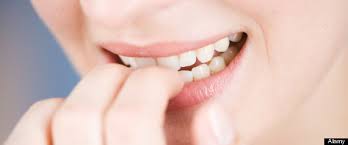
As she got older Annie became self-conscious about the activity and its traces. Of course she tried to break the habit, and sometimes – in a vacation environment – she’d leave her hands alone long enough to see healing, to feel softening, to plan on a future with lovely unpicked fingertips. But then some stressor or good book would absorb her and before she understood what she was doing, she’d make inroads on the skin of her right thumb (it always started there). Another word for “inroad” is “invitation,” she came to realize. For soon after she injured her thumb with her teeth she created a fresh hard spot, that became impossible to ignore, that her index and middle fingers found. Then her teeth joined the party, and she had ragged flesh again.
She wondered if there was any nutritional value in her own skin. Was it protein? Carb? She figured it was a fat-free snack. Was there a calorie gain or loss? Did it cancel out? Did she remove with her teeth the exact value she ingested? She and some friends had used the Internet to learn that one couldn’t be sickened by eating one’s own shit, but she couldn’t find information about finger-munching. (No one was deliberately dining on excrement…that question came up during a discussion about bathroom contamination. They’d all heard about the perils of lidless toilets, paper towel dispensers, hand-dryers, and door handles; one could breathe germs or accidentally ingest excrement that got on one’s hands – and then came the question could one get sick from one’s own poop? and they read that the answer was “no” – one’s excrement matched one’s GI tract – so they wondered why the flushing paranoia extended to the homes of those living alone.)
Annie’s ultimate cure, as it turned out, had little to do with will power or determination. Her mouth started to rot. She was diagnosed with periodontal disease when she was 50, and it turned out to be chronic and severe. She had always followed dental protocol (she can still recite the words from the old Crest package, back when the brand bragged that it was the only paste approved by the American Dental Association). She saw the dentist once or twice a year and engaged in all recommended oral hygiene activities, but she had root proximity in her upper jaw and some components in her saliva that were like manna to the anaerobic bacteria that create plaque. She learned to endure painful deep professional cleaning, she used special toothpaste and brushes, she spent much time and more money wrestling her condition into almost remission (slowing its progression anyway), but her mouth grew ever more tender and her teeth felt loose even when still in bone. She stopped eating unsliced apples. She no longer enjoyed corn on the cob. It became uncomfortable for her to really go after a piece of thumb skin. She started noticing. She started stopping.
Meanwhile, amid the regular trips to the dentist and periodontist, injected into their periodontal comments almost like a nonsequitor, her examiners would occasionally theorize that Annie was grinding her teeth in her sleep. The nightguard suggestion was made several times.
She resisted. In fact she refused. She was a light sleeper and she didn’t want to add any paraphernalia to the experience. She used to clench; for a period of almost a year in her mid-30s she had headaches that she ultimately attributed to jaw-clenching. She began then to do exercises to relax her jaw and neck. She knew how unattractive it looked, pressing her chin into her upper chest to stretch her neck, but she did it, at home. And she trained herself to keep her teeth apart while she slept, and to check her jaw position first-thing, whenever she woke. She still sometimes clenched, but she didn’t press her jaws together any more.


 Sputterpub's Blog