
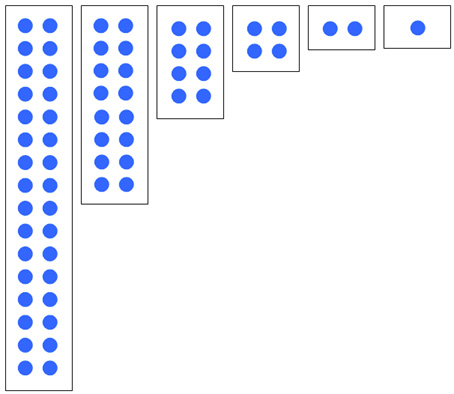
If how we use our brains creates neural pathways that in turn permit how we use our brains, then perhaps how we use our communication devices creates avenues that govern our relationships with our communicators.
Ancient Greek had a dual tense. Nouns could be singular, plural or dual. Much of the Iliad is in dual; heroes and their best friends adventure together and the verbs used are for a pair of people.
When I studied Greek in college I was exposed to the dual. I learned then that older forms of English and German had it too. “Brether” and “childer” are almost-survivors in our language, lurking between “brother” and “brethren” and between “child” and “children” to show us a bit of how we used to speak.
I was enjoying dinner out with a dear friend recently, and we began bemoaning, nostalgically, the extinction of best-friendships. Both of us remember having a closest friend from age 12 or so: that junior high buddy, the everyday telephone connection, the pen pal during summer vacations, the go-to peer.
Our kids don’t have best friends. And their kids, as far as we can judge from the fledgling cohorts, don’t have best buddies either. The generations after ours are social – as interested in what their fellows are doing and as likely to be infected with FOMO (Fear Of Missing Out) as any youth who has gone before them – but they don’t limit their sharing to one special person, and their communications, broad and often spiced with TMI, don’t go as deep or reach as intimately as dialogue between two.
The idea that struck me over dinner: is it all about the phone?
I was a child of single-digit age in the 1950s. Homes had phones, but families had to share the lines and use operators to place calls, at least in the early years. I remember the rotary dial was high-tech that decade, and residential customers would pay extra to avoid a party line.
By the time I was entering adolescence we could place almost all calls on our own (we still used the operator for person-to-person connections to ourselves, which signified to our callers that we were home and prepared to answer the cheaper station-to-station ring, and kids away from home had to use the operator to reverse charges too). Then Ma Bell introduced the push-button number pad; I remember a new-tech display in Tomorrowland where I, super fast on the dial, couldn’t complete a call as fast as my unmotivated brother could push the new buttons. By the mid-1960s every home had a private line and all phones had buttons. Some of my girlfriends even scored their own bedroom extension – those adorable princess models that, we quickly learned, were too light-weight and short of cord to stay on our nightstands.
By the time I was 15 I was using the phone regularly. I was conversing nightly with my closest girlfriend and, occasionally, with a brave boy who called me to stammer into a conversation about nothing, always at risk that my father or younger brother would pick up the headset in the kitchen and harass us. Remember? Because I’m typing this all from memory, partly because I’m too lazy to research and also because I want to record recollection untainted by facts.
My kids didn’t cart cell phones to school but they seemed to have innate computer skills and they took to Internetworking like it was mother’s milk. I remember noting how prevalent mobile phone use was in Paris compared to here, when I spent some time there in 1997 – it seemed then that US cellphone service lagged behind Europe’s and that made sense; we’d so perfected our landlines that they didn’t need “improvement” the way phone systems elsewhere did.
But the kids were interacting. They were soon using email so much they started a special language for it. And then along came the bulletin board services that opened the way for LiveJournal and a few years later Facebook. Et cetera. The generations after the babyboomers dove into those media, lifting their eyes from their screens only long enough to roll them at us for our failure to understand how useful their networks are.
After us, kids didn’t engage one-to-one. They began speaking at large, sharing intimate details with their cohorts and omitting the deep revelations that only surface after heavy and continued communication with a trusted other. After us, it seems that a kid doesn’t relate to a person as much as to a posse.


 Sputterpub's Blog