Phoebe remembers being a Camp Fire Girl. Her name there was Netopu, pronounced phonetically and translated “makes friends,” but that phrase seemed to her as untrue as the achievements for which she was awarded ugly beads. She liked it that they sold candy instead of the bland cookies the Girl Scouts peddled. And she liked it when they made artificial flowers.
Before then, Phoebe tried making flowers out of bathroom tissue. She’d poke white or pink tissue into the hole that formed when she made a fist of her left hand. The result was flower-like, but still a tissue. She wasn’t satisfied.
In Camp Fire Girls they used real tissue paper, crepe paper, pipe cleaners and green gardener’s tape. Careful folding of fringed tissue could produce a good carnation. By curving crepe paper around her thumb, Phoebe could form a passable rose petal, and cluster that with its fellows into a bud or a bloom. Either would unfurl from a tape-wrapped pipe cleaner stem. They looked good.
Did she learn anything else in Camp Fire Girls? She can tell the temperature (in degrees Fahrenheit) by counting cricket chirps for 14 seconds and then adding 40. But she learned that from a fact-a-day desk calendar. She can find south, by pointing the 12 on her analog watch at the sun, and locating the midpoint between that number and the hour hand. But her father taught her that. She can write out the formula for photosynthesis, or build a DNA model, but those are facts she memorized, from TimeLife books in her parents’ home. All she can remember learning from Camp Fire Girls are how to make credible artificial flowers and how much she despises group-type activities.
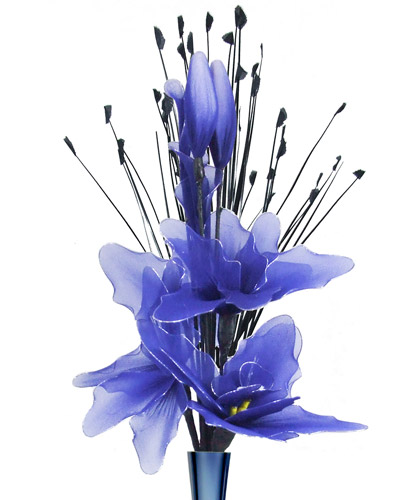
She’s looking at girl memories through a 25 year scope. Phoebe is near 40 now, and she’s spending a few minutes in her friend’s downstairs bathroom. It’s one of those windowless rooms, with two switches on the wall beside the doorway; the closer provides light and the other turns on the fan. Natalie has accentuated the small darkness of the room by having it papered everywhere in stripes. Even the back of the door and the switchplates are covered in vertical bands of blue, black and silver. On the far corner of the lavatory counter, near where a window would be if the room had an exterior wall, Nat has placed a blue glass vase of silk flowers.
They’re rather lifelike. Fashioned to mimic lilies, they’re almost realistic enough to invite a finger-stroke test. Except they’re unnatural. No real flowers could grow in a room like this. They now seem more like ribbons than like flowers: lovely useless fabrications.
Phoebe can’t figure this room. Nat and Bill bought their house in the hills when it was under construction. It was built to look old, which is some kind of attitude Phoebe doesn’t understand. True old can be charming, she thinks, but it will be drafty and have dust-collecting corners. It will have idiosyncratic creaks and exude history. False old appears nothing but contrived. This particular false old house is built to resemble the two story boxes of the 1920s. Many of the genuine boxes in the flatlands have been converted to what the style affords: sensible upstairs and downstairs units. Those that are still single-family dwellings have the unspectacular floor plans and exteriors that their simple shape permits. The real boxes sit on the flat lots between the hills and the bay, pinned to their property by mature trees. This false old box is perched on top of the hill ridge at the border of the park, and it sits awkwardly on its land like it was dropped there by a Kansas tornado.
Phoebe figures the architect tried to dress up the old design by placing the grand staircase in it. The true old box has a staircase running up one of the side walls; when the house is broken into two units, the entry door to the upper flat opens directly from the front porch to the stairs. This false old box has a wide set of steps rising from the central entryway, turning halfway up at a charming plush window seat. It’s a very nice staircase, but it creates a windowless space under it and in the center of the first story: hence the dark bathroom.
When Natalie and Bill purchased the house, they got to pick carpets, wallpapers, paints and appliances. So no one but they can be blamed for the way the downstairs bathroom was done; then it was magenta, green and gold, with filigree accessories and magenta towels and shower curtain. Phoebe just assumed it was Bill’s project or some private marital joke, and didn’t comment. But after Bill left, and after Nat determined that she couldn’t do better with another house, she redecorated most of the place. This house re-warming party marked the end of that eight-month project. And while it’s true that Natalie changed the bathroom colors from magenta/green/gold to blue/black/silver, it’s also true that she retained the hideousness of the paper-everything concept.


 Sputterpub's Blog