
When Goofus and Gallant were seven years old, they were both pretty good with their yo-yos. Each could walk the dog, and Gallant had already mastered half a dozen other tricks. Goofus wasn’t as successful with the fancy stuff, but he could stand on the sidewalk in front of his house and make the returning top bounce up and down for most of a morning. In fact, one day that May Goofus claimed he’d thrown-and-caught his yo-yo a million times.
His older sister didn’t believe him. “You did NOT,” she asserted, and she repeated that with increasing force each time Goofus insisted he DID, for about three minutes. Then she retreated to her own activities.
Gallant didn’t believe him either. “You lie!” he accused. Gallant had some history on his side. On at least three prior occasions, he’d watched Goofus tell untruths. He knew his playmate didn’t value honesty the way he did.
Goofus kept insisting. A million times. Gallant gave up the argument after a bit. He invited Goofus to his yard and they played on the climbing structure Gallant’s father had built.
It wasn’t till dinnertime, when Goofus repeated his claim in his father’s hearing, that he began to learn. “A million times?” his father asked. “Yeah.” Then his dad said, “Son. Can you count to a hundred?” “Sure.” “How about a thousand? Can you count that high?” “Well yeah. But it will take way longer.” “Goofus,” his father continued, “ I want to you consider this. One million is a thousand thousands. Think how long it would take you to count that high.”
So Goofus thought. It didn’t take him as long to think as to count. That’s when he figured out that just because someone stopped arguing with him didn’t mean he won the argument.
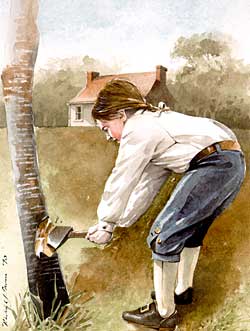
Goofus began to dissect the act of lying. He concluded that there are several forms of dishonesty. He knew his culture had a zero-tolerance policy about it – he’d heard the George-Washington-and-the-cherry-tree story – but it didn’t take much observation for him to note that the social lies his parents told, about how someone looked in a new outfit or whether they would go out with some inviters, were often motivated by kindness. And even when others weren’t involved, there were the lies that avoided responsibility and the untruths that made a story better. Clearly the first type were murky/bad compared to the story lies.
Goofus continued to try story lies now and then. He wised up about exaggeration; he became a fact-checker about his own tall tales. And in time he even gave that up. He decided it took too much effort to remember his lies and maintain them. He opted to tell the truth, even socially.
Gallant always told the truth, when they were kids. In time he learned to run social lies, but nothing more dishonest. He was praised for his good citizenship. He enjoyed his upright reputation. But he never developed the ability to tell when others were lying to him.
Gallant’s parents tried to teach him that one needs to master proper language before one can use bad language effectively. So did Goofus’s. Neither set of parents addressed the advantages of lying. Neither household seemed to realize that only by learning to lie well can one both choose honesty and develop the skill to detect it in others. Goofus had to get that on his own.


 Sputterpub's Blog