Her eyes were blue at birth and everyone expected they’d darken. Most white babies come with blue eyes, but Abby’s parents were brown-eyed brown-haired people of brown-eyed brown-haired stock, so her relatives all waited for the blonde fuzz to be replaced with dark curls and for those blue irises to melt into the liquid chocolate hue of the Grays.
Like a changeling, Abby persisted in difference. Her mother was delighted with the silky blonde hair; most of the baby pictures show Abby with a ribbon bow somehow affixed to her head. The progression of childhood photos have her hair in varying lengths and steadily darkening as she grew toward high school and the discovery of peroxide, but the eyes always stayed blue.
Her surname was Gray but she came of Llewellyns and Ahernes. Her genes were mixed northern European, with strong tides of Welsh and Irish. And Ireland, like Iran, means Aryan(land), and Hitler, the moron, thought that meant blonde/blue. But the original people had markers for pigment, and it was only those travel-mad, emotionless, horny Vikings who inserted recessive genes across the pond.
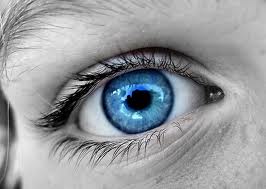
Abby’s eyes stayed blue. They were the best feature in an adorable face. She had a ring of silver around her pupils, over gray-blue edged in navy. They shined between thin lids, well-spaced above a small nose centered over a rosebud mouth that never grew beyond child-size. Her jaw was small. Her cheeks were plump and hid their bones. She wasn’t beautiful but her face was cute well into middle age.
When Abby was 12 her mother heard a strange tale from a facialist. While this woman named Michaela slathered fruit-based emollients over her T-zone and (always stroking upward) along her neck, she told Abby’s mother that blue eyes are a sign of somatic purity. Michaela had a degree in nutrition and had been her own guinea pig for a graduate project. Over a two-year period she followed a strict vegan diet. All organic, all vegetable, with little cooking and reduced calories. Michaela was of Italian/Romanian heritage – olive-skinned, dark-haired, brown-eyed – and within 20 months on the clean diet her dark eyes cleared to baby blue.
Abby’s mother immediately thought back to her daughter’s infancy, and wondered if all her care with the baby food, all the grinding of organic vegetables and steeping of whole grains, had produced this marvel of iris. “But that can’t be,” she reasoned back at herself. For she’d given the same care to the food she fed Abby’s brothers, and they both had the family coloring. Anyway, much as she tried to guard her kids from refined sugar and unrefined TV, Abby and her brothers had all found plenty of candy and cartoons at their friends’ homes.
From then on, Abby’s mother wondered if irises were like deciduous trees. She remembered being struck to learn that autumn leaves don’t change color; rather, they lose it as their chlorophyll goes, and the vibrant red, alarm orange, and sunset gold are what’s left after nature leeches out all the green. “Maybe eyes without color are watery blue,” Abby’s mother thought. “Maybe brown and green and hazel are added pigments, and my daughter’s striking eyes fall short.” It made as much sense to her as the idea that an attractive dimple is actually a deformity, but she’d heard that somewhere, too. Abby’s mother was an extremely social individual, and sometimes she couldn’t remember from whom she’d heard what.
When Abby was 13 her eyes retreated. The breasts which she began at 12 outgrew her training bra. They pulled at the front of her T-shirts and made her blouses gap. They were particularly prominent because the final spurt of growth which followed their painful appearance (and stopped a year later, when her periods started) only pushed her height to 5’1″. Those precocious breasts supplanted her eyes as her best feature.
Her eyes took revenge in headaches. The cutting pain came about twice a week that winter, but because no one else in her family needed glasses as a child, her parents didn’t think to have Abby’s eyes checked. She spent afternoons at home with her aching head on her mother’s lap, waiting for the aspirin to work. She would rather have been in her own bed in her room, but for some reason Abby’s otherwise impatient mother took comfort in supporting Abby’s head and neck and occasionally stroking her brow.
The best medicine for the headaches turned out to be eyeglasses. It took almost six months before Abby saw an opthalmalogist, and then he was rather impressed with how well she was managing, given her level of myopia. For Abby uncorrected was only seeing 20/400. Excellent as she was at recognizing people by the way they moved or the colors they wore, the strain to her eye muscles was producing headaches.
Also, although she could interpret people’s gross movements without her glasses, Abby missed small facial expressions. She didn’t acknowledge many smiles of greeting. A lot of the girls thought she was a snob. The boys didn’t mind it that she appeared to ignore them; her breasts were the stuff of their dreams and excused everything. They looked, they wondered, they admired, they snickered, they sometimes even told tales. The girls overheard, and some went from calling Abby a snob to branding her a slut (in 3 moves: snob-slob-slot-slut).


 Sputterpub's Blog