
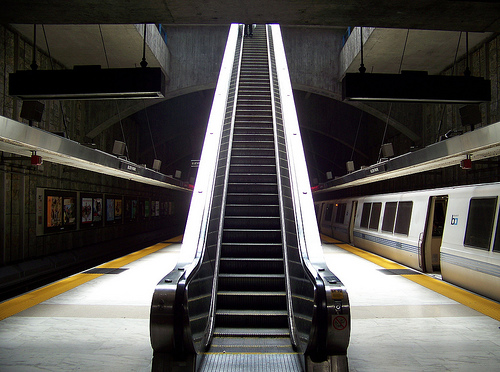
I read a news article recently about the testimony of an 80 year old man, about an event he remembers from half a century ago. PG&E wants to use the testimony in its defense, but the man’s recollection includes details that aren’t likely to be true: specifics like water pressures that just weren’t utilized at that time.
It made me recall what I’ve seen on the Science Channel, about the inaccuracy of recollection and the tendency, once misremembering, to stick to the inaccurate version with gusto and sincerity: to in fact convert one’s memory from what happened to what is recalled.
Now I turn to me. I’m 62 years old and I take pride in my memory. I was born lucky that way, developed luckily too, but also I aid and support my memory regularly. I recite. I create and use flash cards. I assess an experience several times, in different directions and from other points of view.
I remember facts about the origins of the BART system, but when I tried to find Internet support for them recently, I failed. Am I misremembering? Or onto another indication of how unfree the information highway is?
Nick and I were young marrieds at the time. We were vigorous and curious, energetic and bright. He was doing graduate work at Cal in acoustic engineering. He worked under a professor who was the sound consultant for the BART design. The professor was older and spoke with a German or Eastern European accent. He had a young lovely blonde wife and they lived in a woody contemporary home in the hills above the Claremont.
Westinghouse had the contract for the BART electrical system. Train detection was a crucial component of that system of course; the computer always had to know where all the equipment was. Westinghouse designed a train detection system that identified equipment by sensing from what portion of the third rail power was being drawn. The problem with that is it couldn’t detect the train you most needed to know about: the dead one that wasn’t drawing power.
Really. That’s what we heard at the time. So the BART design had to be tweaked to find the dead trains. The tweak required the installation of special brushes near the wheels, things that would carry a charge even on a malfunctioning train. Those brushes are what make the ear-itating screech/whine when the train goes fast. I’ll bet they’ve spurred the sales of more noise-deadening earplugs than any other feature of Bay Area life.
Otherwise, BART would have been silent.
I remember other criticisms from that time, about the cantilevered seats and the lack of straps for standees to hold, about corruption on the board and idiotic projections regarding employment, but the Westinghouse error, almost Aesopian in scope (fabulous!), and the unfortunately noisy correction – they are the big ones.
And I can’t find any of this when I search.


 Sputterpub's Blog