

I wondered awhile ago about the word “apple.” I looked it up recently and I have a few comments.
It’s as fundamental and basic as we all suspect. The word means itself and may figure in every significant culture. Or maybe not.
Apple means “fruit” or “apple” and by extension just about anything round. The word was appel or aple in Middle English, æppel or æppl or æapl in Anglo-Saxon and Old English, and probably something like ab(e)l in Proto-Indo-European.
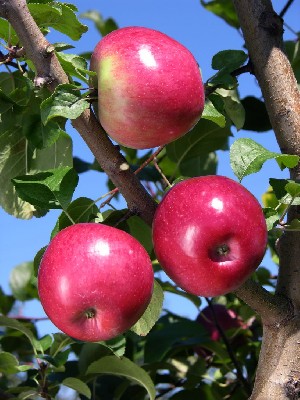
It’s a pomaceous fruit (from the Latin pome for fruit or – guess what? – apple) and the plant is in the rose family. It may have been the earliest cultivated tree.
It originated in Western Asia. The first hybrids were developed in eastern Turkey. Somewhere near Eden.
Because apple can mean any kind of fruit and just about any fruit can be called an apple, we don’t know if the golden apples of Greek myth were onions and we don’t know if the forbidden fruit of the Bible was a pomegranate. We’re probably wisest assuming something like a Platonic form of fruit.
(And I want the Edenic tree to be more majestic than an apple: a giant sequoia perhaps, or at least an oak.)
Apples aren’t as good for you as other fruits. They’re relatively low in Vitamin C (although they have a nice level of other antioxidant compounds). They’re a good source of fiber if you eat them unpeeled, but you can find better. One of their advantages is durability; apples last awhile. And everyone knows how an apple’s flavor transforms when it is heated. That’s one of the basic miracles of cooking, like what happens to onions, or to flour-and-water.
Now that I’m spending more time in Oregon, I’m occasionally in apple culture. I learned recently, from an old grower, that you should always refrigerate apples. Not only will the cold preserve them, but they taste better chilled.
The Old Welsh for the fruit was aballon. Insula Avallonis is Latin for Apple Tree Island.


 Sputterpub's Blog