

I looked up “opinion” recently, and I was disappointed to see that it means itself. My resources assert that it has been used since the mid 13th century, that it is a belief that rests on grounds insufficient to produce certainty, and that it comes from opinio and opinari, Latin for opine.
Ho hum.
But that put me in the neighborhood of the word onion. On the same page, or just a “pi” deletion away, electronically. “Onion” entered our language about a hundred years after opinion. Around 1350. Onion is the same as the ME onyon and the Old Fr. oignon and the Latin ūniōn. Those words mean unity, oneness, a large pearl. Akin to union.
The onion (Allium cepa) is a plant of the lily family, with an edible bulb that has a strong smell and taste and perfectly concentric layers. Although the word is less than 700 years old it appears the food has been cultivated for millenia, starting in the Nile region.
In my soup-inventing years, when the object was to produce a meal out of whatever happened to be in the kitchen, I could manage without just about any ingredient except onion.
And I understand Julia Child said at least once: “It is hard to imagine a civilization without onions.”
They’re good food. Raw they add tang, dehydrated they are crunchy and easy, and cooked, especially when sauteed slowly, they caramelize and release intense flavor. The smell of fresh-cooked onions is universally attractive.
In the old days before email, before fax machines even, recordkeepers made copies on an impact typewriter, by interlacing carbon sheets with paper so thin it was called “onionskin.” Onionskin paper even had fingerprint whorls like the vegetable. Its pattern distinguished it from airmail paper, which was also exquisitely thin, and which was necessary because back then, in 1970 or so, it was financially correct to make your transoceanic letters light.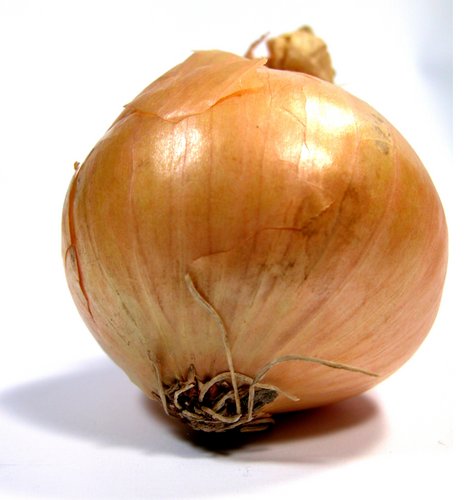


 Sputterpub's Blog