

I was editing a post recently, and I replaced the word “leash” with “tether.” The act made me conscious about the words in a way I’d never experienced.
Offhand the difference is about direction. Both items are leads and both are commonly made of leather or web-strong strapping. But a leash is for guiding its object along a path from point to point, and a tether sends its subject into a circle with a radius as long as the tether is. A leash usually has a person at one end: a tether not so much (until recently, when electronic devices started sporting tethers instead of carrying straps).
My dictionary says leash comes from the Late Latin laxa (a loose cord) from Latin laxus (loose).
For tether’s origin we have to go back to an Old High German word. The zeotar was the pole of a wagon. I’m guessing domesticated animals were tied to it. Zeotar appears to be cognate with a N. German/Middle Dutch word for cattle: tüder. And that’s clearly close to the Old Norse word tjöðr or tjöthr or tiothr, all of which are just a vowel away from our tether.
Tether means a rope or chain by which an animal is fastened so it can range only within a set radius. Its secondary meaning is the limit of one’s strength or resources. We say we’re at the end of our tether when we can’t take any more. Or we say we’re at the end of our rope but we mean tether; don’t we see our path of stressed effort describing a ragged circle?
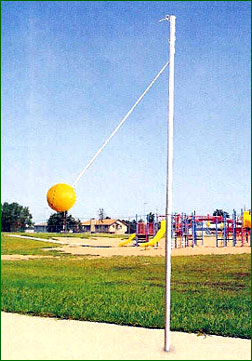
(When I was a kid every playground included at least one tetherball pole. We didn’t know the rules but we respected the simplicity and power of the equipment. Now that I look around I see none. Tetherballs are available, the Internet shows me, but young kids don’t appear to be experiencing them. Is this absence about safety? Andy remembers a freak tetherball accident from middle school, when a boy broke his neck (and died) after the tetherball he whacked came around the pole and slammed his own skull. I can’t recall a helmet requirement – the game seems to have quietly disappeared from kid sports.)


 Sputterpub's Blog