

Let me tell you about carrots. I had no idea they were going to feature so prominently in my life.
Danny loves them. I think he has always wanted at least a pound a day, and he has often achieved his quota. He likes them big and raw and unpeeled; when he was young he ignored the orthodontist’s advice – he ate big carrots and he bent several retainers.
He’s a good choker, like most in the family. He never gagged on a carrot bit. I read recently that the roots give up a lot more of their nutrients when mashed, pulped, or cooked, so I hope he’s taking the time to chew them well.
Danny’s skin is congenitally olive but environmentally orange. He has the sharpest night vision of any grownup I know.
I spent a little reference time on the vegetable recently. At first I saw no connection between carrot and karat, but eventually I understood Bugs Bunny’s wisdom. I gathered a few facts along the way.
Daucus carota is the horticultural name, and the plant was native to Europe and southwestern Asia. It appears to have come out of what’s now Iran and Afghanistan, and became part of our diet around the 8th century.
We eat the taproot, although carrot was first grown for its leaves and seeds, like its relatives parsley, fennel, dill and cumin. The plant is in the celery family. It’s a biennial, and it tries to grow the big taproot to support its second year flower, but we take it for food
If left to flower, the white blossoms attract pest-consuming wasps. There’s evidence that carrots will increase tomato yield if the two plants are intercropped.
Sauteed with onions and celery, carrots form classic mirepoix, which is a good basis for any broth, soup or stew.
Like potatoes, carrots got a bad rap from the glycemic index, but there are problems with the glycemic index, and maybe that’s a subject for a future post.
As for word origin, we get carrot from the French carotte from the Latin carota from the Greek karōton (καρότον), all of which seem to have come from the Indo-European root ker (horn). At first the word karat (carat) looks unrelated – from the Arabic qirat, which came to mean the weight of four grains – but that turns out to have descended from the Greek keration (fruit of the locust tree) which also came from ker.
The word for carrot in Spanish is zanahoria. I like its sound. Obviously it’s not ker. It’s from Andalusian Arabic (saffunnárya).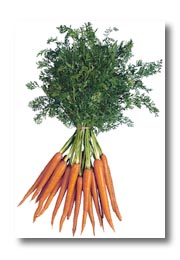


 Sputterpub's Blog